Gadananadhi
1. Introduction
1.1 About Rice Research Station, Ambasamudram
The Rice Research Station, Ambasamudram, was established as the third Rice Research Station in Tamil Nadu, in the year 1937, to tackle the problems of rice cultivation in Thamirabarani river ayacut of southern Tamil Nadu. The Rice Research Station, Ambasamudram is situated near the Western Ghats on the Tirunelveli-Papanasam Road.
It has completed 79 years of service to the farming community of southern districts. The station has released 20 improved rice varieties, of which ASD16 is the most popular variety, occupying more than 50 per cent of the rice area in southern Tamil Nadu. The station is producing breeder /TFL seed of ASD 16, ASD 18 and ASD 19 rice varieties for supply of quality seed to farming community.
The station was awarded with “Best Research Station Award” by TNAU in the year 1996 for the service rendered to the farming community and its achievements in rice research.
Mandate of the Station
- To conduct basic, applied and collaborative research in rice breeding, agronomy, soil science, entomology and pathology to evolve varietal and management technologies.
- To produce nucleus, breeder and truthful labelled seeds of the popular rice varieties released from this station.
- To accelerate the pace of technology transfer through demonstrations and trainings to the extension officials and farmers of Tirunelveli district
Land area particulars
| Total Area | 9.81 ha |
| Cultivable area | 8.30 ha |
| Buildings, Road, Threshing floor | 1.51 ha |
Irrigation Source
Channel - Nathiunni channel of Thamirabarani river
(pH 7.1; EC 0.058 mmhos/cm2)
Agro – Climatic Factors
- Latitude - 80 42’ N
- Longitude - 770 28’ E
- Altitude (MSL) - 64.8 m
- Annual Rainfall - 913 mm
- Rainy days (No.) - 54.0
- Soil texture - Sandy loam
- Soil pH - 4.8 to 6.4 (acidic)
Research accomplishments
Crop improvement
Twenty rice varieties have been released from this station. The details are furnished below.
| Variety | CommonName | Parentage | Year of Release | Yield(t/ha) | Duration(days) | Rice grade and colour |
|---|---|---|---|---|---|---|
| ASD 1 | Kar samba Red | Pure line | 1943 | 4.5 | 115 | SB, Red |
| ASD 2 | Kar Samba White | Pure line | 1944 | 4.0 | 110 | SB, White |
| ASD 3 | Veedhividangan | Pure line | 1944 | 3.0 | 135 | SB, Red |
| ASD 4 | Kuruvakalayan | Pure line | 1945 | 3.5 | 135 | LB, Red |
| ASD 5 | Karthigai Samba | Pure line | 1945 | 4.0 | 150 | MS, White |
| ASD 6 | Anaikomban | Pure line | 1945 | 3.0 | 160 | MS, White |
| ASD 7 | Kar Samba Red (Early) | Pure line | 1945 | 3.0 | 105 | SB, Red |
| ASD 8 | Thuyamalli | Pure line | 1951 | 3.0 | 86 | SB, Red |
| ASD 9 | Avasara Samba | Pure line | 1951 | 3.0 | 92 | SB, Red |
| ASD 10 | Kolavalai | Pure line | 1952 | 2.5 | 170 | SB, White |
| ASD 11 | Ottukichili | Natural CrossGEB 24 / PTB 15 | 1955 | 4.5 | 150 | MS, White |
| ASD 12 | OttuAnaikomban | Natural CrossGEB 24 / PTB 15 | 1964 | 4.5 | 165 | MS, White |
| ASD 13 | Arikiravi | Pure line | 1965 | 4.0 | 170 | LB, Red |
| ASD 14 | Pennai | TN 1/ ASD 1 | 1970 | 4.8 | 110-115 | MS, Red |
| ASD 15 | -- | IR 26 / IR 22 | 1979 | 4.6 | 115-125 | MS, White |
| ASD 16 | -- | ADT 31 / CO 39 | 1986 | 5.6 | 110-115 | SB, White |
| ASD 17 | -- | ADT 31 / Ratna // ASD 8 / IR 8 | 1989 | 5.4 | 100 | SB, Red |
| ASD 18 | -- | ADT 31 / IR 50 | 1991 | 7.3 | 105 - 110 | MS, White |
| ASD 19 | -- | Lalnakanda / IR30 | 1995 | 4.2 | 125– 130 | SS, White |
| ASD 20 | -- | IR 18348 / IR25863 // IR 58 | 1997 | 6.7 | 110 | LS, White |
SB – Short bold; LB – Long bold; MS – Medium slender
Among the varieties released, ASD 1 (Kar Samba Red) released in 1943 was the ruling variety of the tract in the first crop season (Kar) until TKM 9 was introduced (upto 1980). ASD 5 (Karthigai samba) and ASD 11 (Ottukitchili) of 150 days duration are noted for their suitability to late planted condition and quality rice. ASD 7 (105 days) is noted for its resistance to GLH, BPH and leaf-folder. ASD 8 (86 days) for its resistance to GLH and ASD 9 (92 days) for its resistance to BPH and GLH. These three strains (ASD 7, 8 & 9) are thus internationally renowned and are being used in resistance breeding all over the world.
Among the other released varieties, ASD 16 (110-115 days) is very popular in the southern districts and is gaining popularity among the farmers in other districts of Tamil Nadu, because of its high yielding ability coupled with its suitability to all the three seasons. In the state level crop yield competition during 1988-89, it recorded the highest grain yield of 20.13t/ha by a farmer in Alwarthirunagari of Thoothukudi district. ASD 16 (ADT 31 / CO 39) is a semi-dwarf (93cm) variety with duration of 115 days. It has short bold white rice and recorded an average grain yield of 6500 kg/ha and straw yield of 8000 kg/ha. It is recommended for cultivation throughout Tamil Nadu as an alternate variety in the place of ADT 31, ADT 36, TKM 9, CO 39, IET 1444 and IR 50. The head rice recovery is 72% with high protein (10%) and good cooking quality and overall taste score above 75%. Also, it is tolerant to salinity and moderately resistant to brown leaf spot, sheath rot and BPH.
ASD18 (105-110 days) released during 1991 is very popular throughout Tamil Nadu because of its high grain yield coupled with medium slender white rice and resistance to major insects pest and diseases. ASD 18 (ADT 31 / IR 50) a semi-dwarf variety suitable for Kar and Pishanam season. It has recorded an average grain yield of 6000 kg/ha. It is resistant to BPH and Blast and moderately resistant to Leaf folder, gall midge, RTD and sheath rot. It is an alternate variety for ADT 36 and IR 50.
ASD 19 released during 1995 is suitable for October sowings in second crop season (Pishanam) of southern districts in the place of IR 20 and ADT 39. It is high yielding with short slender white rice. ASD 19 (Lalnakanda / IR 30) is a semi-dwarf (108 cm) variety maturing in 127 days. It recorded an average grain yield of 5.8 t/ha with 14.2% increase over the variety IR 20. It is moderately drought tolerant. It has well exsertwed panicle with short slender white rice having a protein content of 9.59% and good cooking quality. The milling recovery is 73% which is 3.8% higher than IR 20. Its 1000 grain weight is 18.3 g. ASD 19 possesses moderate resistance to blast and also tolerant to early drought.
2. Gadananadhi Sub Basin
| Sub Basin | : | Gadananadhi |
| District | : | Tirunelveli |
| WRO Region | : | Madurai |
| Blocks Covered | : | 1.Ambasamudram |
| : | 2. Kadayam | |
| : | 3. Mukkudal | |
| : | 4. Keelapavur | |
| : | 5. Tenkasi | |
| No. of tanks | : | 121 |
| No. of direct anicuts | : | 18 |
| Registered ayacut area | : | 5452.895 Ha |
Gadananadhi, Ramanadhi and Jambunadhi which are the tributaries of Tamirabarani river are the major rivers in Gadananadhi Sub Basin.
The Gadana river is one of the tributaries of Tamirabarani river, takes its origin in the Alwarkurichi peak of Western ghats in Ambasamduram Taluk, Tirunelvelli District and joins with Tamirabarani near Thiruppudaimaruthur village. There is a dam across Gadana river with capacity of 352 mcft, situated 3 Km west of Sivasailam village of Ambasamudram Taluk.
The Ramanadhi river is another tributaries of Tamirabarani river, take its origin at Western ghats in Ambasamduram Taluk of Tirunelvelli District and join with Gadananadhi U/s of Kakkanallur Anicut in Alwarkurichi Village of Ambasamudram Taluk. There is a reservoir across Ramanadhi with capacity of 152 mcft, situated at above 4 Km from Kadayam village of Ambasamudram Taluk.
The Jambunadhi which is also one of the tributaries of Tamirabarani river take its origin in Western ghats south side of Courtallam hills in TenkasiTaluk of Tirunelvelli District and join with Ramanadhi in Therku Kadayam Village of Ambasamudram Taluk.
The registered Ayacut area of the Gadananadhi Sub-basin is 5452.895 ha. There are 121 tanks and 18 anaicuts under the control of WRD of PWD in this sub basin. These 121 tanks possess an ayacut of 3663.335 ha and 18 anaicuts possess an ayacut of 1789.560 ha.
The last 10 years average rainfall of Gadanadam is 960 mm. The important crops grown in the sub basins are Paddy, Pulses, Coconut, Banana and vegetables. Blockwise registered ayacut area in the sub-basin is furnished below. (Area in ha)
| Sl.No | Block | No. of tanks | No. of direct anicuts | Fully irrigated area | Partially irrigated area | Gap area | Registered ayacut area | ||
| Cultivable gap | Permanent gap | Total | |||||||
| 1 | Ambasamudram | 31 | 1 | 499.73 | 141.375 | 52.311 | 58.989 | 111.3 | 752.405 |
| 2 | Kadayam | 60 | 14 | 2123.865 | 908.145 | 245.52095 | 274.71405 | 520.25 | 3552.245 |
| 3 | Keelapavur | 3 | 2 | 29.785 | 13.13 | 3.72945 | 4.20555 | 7.935 | 50.85 |
| 4 | Pappakudi | 25 | 1 | 660.77 | 182.995 | 98.2394 | 110.7806 | 209.02 | 1052.785 |
| 5 | Tenkasi | 2 | - | 0 | 35.69 | 4.1924 | 4.7276 | 8.92 | 44.61 |
| Total | 121 | 18 | 3314.15 | 1281.335 | 403.9932 | 453.42 | 857.41 | 5452.895 | |
|---|---|---|---|---|---|---|---|---|---|
The registered Ayacut area of Gadananathi Sub Basin is 5452.895ha. Out of which, 3314.15ha comes under fully irrigated, 1281.335 hacomes under partially irrigated and 857.41ha comes under gap area. Cultivable gaps are in this sub basin is 403.99 Ha, which constitutes about 47 % of gap area. The average rain fall of the district is 963mm. The important crops grown in the sub-basin are Paddy, Pulses, Coconut, banana and vegetables.
2.1. Location of sub-basin
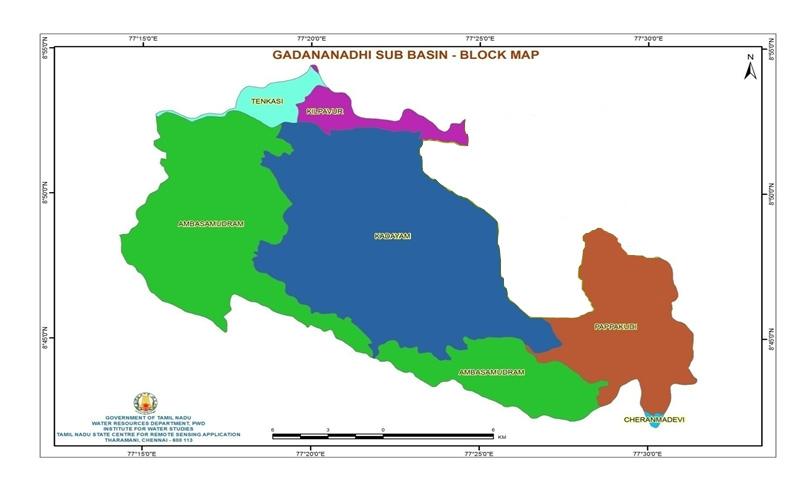
Source: Modified from WRD
2.2. Climate and Rainfall Pattern
2.2.1. Temperature
In the day time the coastal regions are cooler than the interior parts by about a degree in summer and southwest monsoon seasons and warmer by one to two degrees during the rest of the year. From about the middle of February, temperature increases steadily. In May which is usually the hottest month in the interior, the mean daily maximum temperature is 37.1 degree Celsius. The weather is quite hot in May and June and the maximum temperature sometimes reaches 45 degrees Celsius. With the onset of the south west monsoon by the end of May or beginning of June, there is some drop in temperature. By about the middle of October, both day and night temperatures decrease appreciable. The period from November to January is the coolest part of the year with the mean daily maximum temperature of about 30 to 31 degree Celsius in the interior parts. The mean daily minimum in these months is about 22 to 23 degree Celsius in the district in general.
2.0.2 Humidity
The relative humidity in general, during the year, is between 55 and 65 percent in the Interior parts of the district, except during the northeast monsoon season, when it is over 65 per cent. The coastal parts are comparatively more humid.
2.0.3 Cloudiness
During the months of April and May, the skies become heavily clouded and threatening in the afternoons on many days when thunderstorms follow. In the southwest and northeast monsoon seasons, the sky is heavily clouded or overcast.
2.0.4 Winds
Winds are generally light to moderate in strength. Winds are mainly north westerly or westerly between May and September months and north easterly or northerly from October to February months.
2.0.5 Rainfall
Main rainy season is from October to the middle of January. During the southwest monsoon season the rainfall is more in the western parts of the district.November is generally the rainiest month.The average rain fall in the district is 963.09 mm per annum. Gadananadhi sub-basin receives substantial rainfall during south west monsoon apart from receiving high rainfall during North east monsoon season.
| S. No | Month / Season | Rainfall (mm) |
|---|---|---|
| 1. | Winter Season | |
| January | 24.35 | |
| February | 39.71 | |
| Total | 64.05 | |
| 2. | Summer | |
| March | 70.61 | |
| April | 73.95 | |
| May | 49.11 | |
| Total | 193.64 | |
| 3. | South West Monsoon | |
| June | 36.79 | |
| July | 29.16 | |
| August | 25.50 | |
| September | 42.45 | |
| Total | 131.58 | |
| 4. | North East Monsoon | |
| October | 207.11 | |
| November | 263.66 | |
| December | 102.45 | |
| Total | 573.17 | |
| Grand Total | 963.09 |
Soil types
| Soil order | Soil Characteristics | Crop Suitability |
|---|---|---|
| Inceptisol | Red or brown or grey soil with surface horizon more developed than sub surface. They are developing soils, moderately deep, coarse loamy to loam moderately drained to well drained | Suited for commonly grown crops with exceptions |
| Alfisol | The red or brown soils having accumulation of alleviated clay in sub surface horizon it well drained, poor water and nutrient holding capacity. | Annual crops with shallow roots systems come up well |
| Vertisols | Black soil | Suitable for cotton, Pulses etc |
Farmers test their soils once in three years with the help of Agricultural Extension staff of area. The soils are mainly tested through the Soil Testing Labs (STL) located at Tirunelveli.
2.3. Walkthrough Survey
Consultative process undertaken in Gadananadhisubbasin:
Walkthrough survey organized by the PWD along with line departments were attended in the following dates.
| S. No | Date | Block | Village |
|---|---|---|---|
| 1 | 20.11.2015 | Papakudi | Adaichani, PapankulamKadayam |
| 2 | 23.11.2015 | Ambasamudram | MannarkovilAiyanarkulam |
| 3 | 24.11.2015 | Papakudi | Pallakalputhukudi |
| 4 | 14.12.2016 | Papakudi | Papakudi (papankulam), Nandanthatai (Saralkulam)Palakalputhukudi (Pallakalperiakulam) |
| 5 | 15.12.2016 | Ambasamudram | Gowthamapuri(Vandankulam tank) |
| Kadayam | Alwarkuruchi (Valathankulam tank) | ||
| 6 | 16.12.2016 | Kadayam | Govindapuri (Marthandaperiakulam)Sivasilam (Manjalodaikulam)MelaAmbur (Punaipillaikulam) |
3. Crops and Cropping Pattern
3.1. Cropping Area
| Name of the sub Basin | : Gadananadhi | Fully Irrigated | 3314.15 Ha |
| Registered Ayacut Area | : 5452.895 Ha | Partially Irrigated | 1281.335 Ha |
| Gap area | 857.41 Ha |
3.2. Major crops cultivated
| Paddy | Paddy is the principal crop extensively cultivated in both First season (June – September) and Second season (October - January). Locally the first season is called as Kar and second season is called as Pishanam. Normal productivity of Rice in the region is5056 kg per ha. |
| Pulses | Pulse crops are being cultivated during Third season (February – April) .The normal productivity of pulses is 845 kg / ha. Blackgram is the predominant pulse crop cultivated. |
CROPPING PATTERN
| Name of the sub Basin | Gadana sub-basin | Fully Irrigated | : | 3314.16 ha |
| District | Tirunelveli | Partially Irrigated | : | 1281.315 ha |
| Block | Ambasamudram, Kadayam, Pappakudi, Keelapavur, Tenkasi | Gap | : | 857.41 ha |
| Registered Ayacut Area | 5452.89 Ha | Total Ayacut Area | : | 5452.885 ha |
| S.No | Crop | Without Project | With Project | Increasing | ||||||
| FI | PI | RF/G | TOTAL | FI | PI | RF/G | TOTAL | |||
| I | Perennial crop | |||||||||
| 1 | Coconut | 0 | 8.58 | 0 | 8.58 | 0 | 8.58 | 0 | 8.58 | 0 |
| 2 | Mango | 0 | 0.56 | 0 | 0.56 | 0 | 0.56 | 0 | 0.56 | 0 |
| 3 | Sapota | 0 | 0.23 | 0 | 0.23 | 0 | 0.23 | 0 | 0.23 | 0 |
| 4 | Guava | 0 | 2 | 0 | 2 | 0 | 2 | 0 | 2 | 0 |
| 5 | Teak | 0 | 0.23 | 0 | 0.23 | 0 | 0.23 | 0 | 0.23 | 0 |
| 6 | Tamarind | 0 | 0.05 | 0 | 0.05 | 0 | 0.05 | 0 | 0.05 | 0 |
| 7 | Acid Lime | 0 | 0.52 | 0 | 0.52 | 0 | 0.52 | 0 | 0.52 | 0 |
| 8 | Amla | 0 | 0.08 | 0 | 0.08 | 0 | 0.08 | 0 | 0.08 | 0 |
| 9 | Jack | 0 | 0.03 | 0 | 0.03 | 0 | 0.03 | 0 | 0.03 | 0 |
| 10 | Other tree crops | 0 | 1.85 | 0 | 1.85 | 0 | 1.85 | 0 | 1.85 | 0 |
| 11 | Flowers\Tube Rose | 0 | 1.25 | 0 | 1.25 | 0 | 1.25 | 0 | 1.25 | 0 |
| 12 | Fodder | 0 | 2.23 | 0 | 2.23 | 0 | 2.23 | 0 | 2.23 | 0 |
| Total | 0 | 17.61 | 0 | 17.61 | 0 | 17.6 | 0 | 17.61 | 0 | |
| II | Annual Crop | |||||||||
| 1 | Sugarcane | 0 | 0 | 0 | 0 | 0 | 0 | 0 | 0 | 0 |
| 2 | Banana | 10.45 | 3.82 | 0 | 14.27 | 10.45 | 3.82 | 0 | 14.27 | 0 |
| 3 | T.C. Banana | 264.71 | 0 | 0 | 264.71 | 264.71 | 0 | 0 | 264.71 | 0 |
| 4 | Tapiaco | 0.05 | 0 | 0.05 | 0 | 0.05 | 0 | 0.05 | 0 | |
| Total | 275.16 | 3.87 | 0 | 279.03 | 275.16 | 3.87 | 0 | 279.03 | 0 | |
| III | 1st crop | |||||||||
| 1. a | Paddy | 2726.45 | 0 | 0 | 2726.45 | 0 | 0 | 0 | -2726.5 | |
| b | Paddy - SRI | 0 | 0 | 0 | 0 | 2726.453 | 0 | 0 | 2,726.45 | 2726.45 |
| 2 | Maize | 3.065 | 0 | 0 | 3.065 | 880 | 0 | 0 | 880 | 876.935 |
| 3 | Pulses | 4 | 0 | 0 | 4 | 124 | 0 | 0 | 124 | 120 |
| 4 | Groundnut | 14 | 0 | 0 | 14 | 22 | 0 | 0 | 22 | 8 |
| 5 | Gingelly | 0 | 0 | 0 | 0 | 0 | 0 | 0 | 0 | 0 |
| 6 | Cumbu | 0 | 0 | 0 | 0 | 0 | 0 | 0 | 0 | 0 |
| 7 | Tomato | 6 | 0 | 0 | 6 | 28 | 0 | 0 | 28 | 22 |
| 8 | Bhendi | 25 | 0 | 0 | 25 | 380 | 0 | 0 | 380 | 355 |
| 9 | Brinjal | 7 | 0 | 0 | 7 | 7 | 0 | 0 | 7 | 0 |
| 10 | Onion | 24 | 0 | 0 | 24 | 49 | 0 | 0 | 49 | 25 |
| 11 | Cucumber | 0 | 0 | 0 | 0 | 0 | 0 | 0 | 0 | 0 |
| 12 | Gourds | 36 | 0 | 0 | 36 | 208 | 0 | 0 | 208 | 172 |
| 13 | Radish | 0 | 0 | 0 | 0 | 0 | 0 | 0 | 0 | 0 |
| 14 | Curry leaf | 0 | 0 | 0 | 0 | 0 | 0 | 0 | 0 | 0 |
| 15 | Cluster Beans | 0 | 0 | 0 | 0 | 0 | 0 | 0 | 0 | 0 |
| 16 | Greens | 0 | 0 | 0 | 0 | 0 | 0 | 0 | 0 | 0 |
| 17 | Watermelon | 0 | 0 | 0 | 0 | 0 | 0 | 0 | 0 | 0 |
| 18 | Chillies | 6 | 0 | 0 | 6 | 20 | 0 | 0 | 20 | 14 |
| 22 | Colacassia | 80.3 | 1 | 0 | 81.3 | 80.3 | 1 | 0 | 81.3 | 0 |
| Total | 2931.82 | 1 | 0 | 2932.82 | 4524.753 | 1 | 0 | 4525.753 | 1592.94 | |
| Grand Total (I+II+III) | 3206.98 | 22.48 | 0 | 3229.46 | 4799.913 | 22.5 | 0 | 4822.393 | 1592.94 | |
| IV | 2 nd crop | 0 | ||||||||
| 1. a | Paddy | 4451 | 0 | 4451 | 0 | 0 | 0 | 0 | -4451 | |
| b | Paddy - SRI | 0 | 0 | 0 | 0 | 4891 | 0 | 0 | 4891 | 4891 |
| 2 | Maize | 0 | 0 | 0 | 0 | 0 | 0 | 0 | 0 | 0 |
| 3 | Cholam | 0 | 0 | 0 | 0 | 0 | 0 | 0 | 0 | 0 |
| 4 | Pulses | 0 | 0 | 0 | 0 | 0 | 0 | 0 | 0 | 0 |
| 5 | Redgram | 0 | 0 | 0 | 0 | 0 | 0 | 0 | 0 | 0 |
| 6 | Groundnut | 0 | 0 | 0 | 0 | 0 | 0 | 0 | 0 | 0 |
| 7 | Fallow | 0 | 0 | 857.41 | 857.41 | 0 | 0 | 22.43 | 22.43 | -834.98 |
| Total | 4451 | 0 | 857.41 | 5308.41 | 4891 | 0 | 22.43 | 4913.43 | -394.98 | |
| V | 3rd crop | |||||||||
| 1. a | Paddy | 9 | 0 | 0 | 9 | 0 | 0 | 0 | 0 | -9 |
| b | Paddy - SRI | 0 | 0 | 0 | 0 | 9 | 0 | 0 | 9 | 9 |
| 2 | Pulses | 0 | 0 | 1671 | 1671 | 0 | 0 | 4891 | 4891 | 3220 |
| 3 | Groundnut | 45 | 0 | 0 | 45 | 60 | 0 | 0 | 60 | 15 |
| 4 | Cotton | 45.99 | 1.04 | 0.00 | 47.02 | 47.03 | 0.00 | 0.00 | 47.03 | 0.01 |
| Total | 99.985 | 1.035 | 1671 | 1772.02 | 116.025 | 0 | 4891 | 5007.025 | 3235.01 | |
| Great Grand Total | 7757.96 | 23.515 | 2528.41 | 10309.9 | 9806.938 | 22.5 | 4913.4 | 14742.85 | 4432.96 | |
| Cropping Intensity | 217.158 | 284.1918 | ||||||||
3.3. Constraints identified
| S. No | Crop | Constraints | Intervention required |
|---|---|---|---|
| 1. | Paddy | (i) Water stress in critical stages (ii) Labour scarcity at peak season (iii) Non adoption of high yielding new varieties (iv) Non adoption of ICM technologies (v) Declining soil fertility (vi) Micronutrient deficiency |
Demonstration SRI / Safe AWDI technologies Crop diversification with Maize in high water stress areas Demonstration of machine planting/power weeder Providing PVC pipesSeed production and distribution of new varieties Application of green manure Application of Zinc sulphate Demonstration of Pseudomonas application Capacity building through trainings/exposure visits |
| 2. | Black gram | (i) Non adoption of high yielding new varieties (ii) Water stress in critical stages (ii) Non adoption of ICM technologies (iii) Micronutrient deficiency |
YMV resistant new varieties Demonstration water management technologies (Micro/Mobile sprinkler) Providing PVC pipes Application of Pulse wonder/Foliar nutrition Capacity building through trainings/exposure visits |
| 3 | Coconut | (i) Water stress during summer season (ii) Non adoption of INM Technologies (iii) Pest and diseases |
Demonstration water management technologies (Drip fertigation) Application of coconut tonic/micronutrients Technologies for management of red , palm weevil/ rhinocerous beetle/Coconut wilt Capacity building through trainings/exposure visits |
| 4 | Banana | (i) Water stress during summer season (ii) Non availability of pest and disease free planting material (iii) Non adoption of INM Technologies (iv) Pest and diseases |
Demonstration water management technologies (Drip fertigation) Application of micronutrients Technologies for management of rhizome weevil /Panama wilt Capacity building through trainings/exposure visit |
| 5 | Vegetables | (i) Non adoption of high yielding hybrids (ii) Water stress during summer season (iii) Non adoption of INM and IPM technologies |
Providing high yielding hybrids seeds Demonstration water management technologies(Drip fertigation/Sprinklers) INM and IPM technologies Capacity building through trainings/exposure visits |
4. Field Interventions
Details of activities
To overcome the constraints (prevalent in the sub basin), the counter measures proposed through project mode and mission mode approaches are
- 1. Productivity enhancement in Rice
- 2. Promotion of pulse production in sub basin
- 3. Diversification of crop under water stress condition
- 4. Precision farming under vegetables
4.1. Productivity enhancement in Rice – GM-Pulses
Rice is the main staple crop grown in the Gadananadhi sub basin wherein there is still scope for improving the productivity as the yield gap varies from 1.2 – 1.6 both in first and second seasons. Scientific management techniques of allocating irrigation water, based on soil and climatic condition to achieve maximum crop production per unit of water applied over a unit area in unit time is very much essential under the present condition. Mechanized System of Rice Intensification (SRI) and adoption of safe AWD are the scientific management tools to save the water and increases the productivity in rice cultivation.
In Gadananadhi sub basin Rice followed by Rice is the major cropping system. Due to continuous cultivation of rice over years without the addition of organic matter has significant effect on the soil properties and inturn in the rice productivity. During the last 2 – 3 decades the cattle population has started reducing and farmers are extensively using the rice straw for cattle feeding. This has resulted in poor availability of organic matter and crop residues for soil enrichment. In this regard enhancing the soil fertility through the option of green manuring is becoming very much essential to uplift the soil physical conditions, organic matter, soil nutrients and thus grain yield.
| S. No. | Technology | Area(ha) | Unit cost(Rs.) | Total cost(Rs. In lakhs) |
|---|---|---|---|---|
| 1 | GM - SRI – Pulses | 130 | 10,000 | 13.00 |
Details of unit cost for Green Manure
| S. No. | Particulars | Amount (Rs.) |
|---|---|---|
| 1. | Seed cost 40 kg/ha @ Rs. 50/kg | 2000.00 |
Details of unit cost for Rice
| S. No | Particulars | Amount(Rs.) |
|---|---|---|
| 1 | Cost of Soil testing | 20.00 |
| 2 | Seed cost - 10 kg / ha @ Rs.30/kg | 300.00 |
| 3 | Cost of nursery raising | - |
| 4 | Cost of fertilizers (150:50:50 kg NPK / ha) | |
| Urea - 300 kg/ha @ Rs.6 /kg | 1,800.00 | |
| Muriate of Potash – 80 kg @ Rs.16/kg | 1,280.00 | |
| ZnSO4 25 kg @ Rs.40/kg | 1,000.00 | |
| 5 | Bio fertilizer & Bio inoculants | 1,600.00 |
| Grand Total | 6,000.00 |
Details of unit cost for Rice Fallow Pulses
| S. No | Particulars | Amount(Rs) |
|---|---|---|
| 1. | Seed cost 20 kg/ha @ Rs. 100/kg | 2000.00 |
| Grand Total | 2000.00 |
3.2 Pulse seed production programme: Production of TFL Seeds under farmers participatory approach to produce quality pulse seeds
In the Gadananadhi sub basin, growing pulses as preceeding or succeeding crop with rice is the new important commodity group for giving special focus. Pulses are the main the source of plant protein for the achieving the nutritional security of the rural households and also act as the soil – nutrient enhancer by the way of fixing atmospheric nitrogen. Current yield levels are merely a 50 per cent of the potential yield attainable, and the State being the net importer of pulses. As there is always huge scope for improving the productivity levels of major pulse crops, poor seed replacement rate, timely availability of quality seeds, zero mineral nutrition, improper pest management practices, poor post-harvest practices etc., are the major constraints to increase the productivity. Providing the quality seeds of improved pulse varieties and improved production technologies will pave the way for improving the pulse productivity in the basin.
| S. No. | Technology | Area(ha) | Unit cost(Rs.) | Total cost(Rs. In lakhs) |
|---|---|---|---|---|
| 1 | Pulse seed production programme: Production of TFL Seeds under farmers participatory approach to produce quality pulse seeds | 100 | 6000 | 6.00 |
Details of unit cost for TFL pulses:
| S. No | Particulars | Amount (Rs.) |
|---|---|---|
| 1. | Cost of Soil testing | 20.00 |
| 2. | Seed cost with seed treatment - 20 kg / ha @ Rs.150/kg | 3,000.00 |
| 3. | DAP 25 kg / ha @ Rs.22.50/kg | 560.00 |
| 4. | Pulse Wonder 2 kg/ha @ Rs.220/kg | 440.00 |
| 5. | Cleaning and Packaging of seeds | 1,000.00 |
| 6. | Bio fertilizers and Bio inoculants | 980.00 |
| Grand Total | 6,000.00 |
Demonstration of improved production techniques with various oil seed crops with prime focus on improving productivity, encouraging crop diversification
Primarily rice is a water loving crop. The water requirement of rice is 1200 mm. In the past decade the first season rice crop is facing water shortage in terminal stage. In some years the first season rice crop could not be raised due to inadequate water availability. To mitigate this kind of water problems it is very much essential to introduce the water use efficient crops like maize. The water requirement of maize is 400-500 mm. The demand for maize in India as well as in Tamil Nadu is very high. Considering the less water requirement and marketability, introduction of maize in the Gadananadhi sub basin will reduce the water stress on rice.
| S. No. | Technology | Area(ha) | Unit cost(Rs.) | Total cost(Rs. In lakhs) |
|---|---|---|---|---|
| 1 | Crop diversification (with maize) | 100 | 4,000 | 4.00 |
Details of unit cost: Maize
| S. No | Particulars | Unit Cost(Rs. / kg) | Amount(Rs.) | TNAU Cost(Rs/ha) |
|---|---|---|---|---|
| 1 | Hybrid seed @ 15 kg/ha | 320 | 4,800 | 4,000.00 |
| Total Cost | 4,800 | 4,000.00 |
3.4 Production of vegetable under precision farming mode by adopting of IPM concept
Another focus in the Gadananadhi command area is to promote precision farming in high value crops like mango / banana / vegetables. Presently the Government of India has also laid emphasis that atleast 10% of the total command area brought under Micro Irrigation to increase overall water use efficiency of the system. In line with the GOI aspirations micro irrigation will be given due emphasis.
| S. No. | Technology | Area(ha) | Unit cost(Rs.) | Total cost(Rs. In lakhs) |
|---|---|---|---|---|
| 1 | Vegetable under precision farming and IPM | 20 | 1,20,000 | 24.00 |
Details of Unit cost: Precision Farming in Vegetables
| S. No | Particulars | Amount (Rs.) |
|---|---|---|
| 1. | Drip cost as per the Govt. norms @ 75 % subsidy | 75,000.00 |
| 2. | Cost of Seed/Seedlings | 25,000.00 |
| 3. | Water Soluble fertilizers | |
| 19:19:19-100 kg @ Rs.75/kg | 7,500.00 | |
| Urea - 200 kg @ Rs.6/kg | - | |
| MAP-50 kg @ Rs.90/kg | 4,500.00 | |
| SSP-100kg @ Rs.7.5/kg | 750.00 | |
| 4. | Bio fertilizer | 1,750.00 |
| 5. | Mulching sheets & Laying | 5,500.00 |
| Grand Total | 1,20,000.00 |
3.5. Formation of Pulse commodity groups and federated to FPO (seed to sales) and later linking the marketing department
In the Gadananadhi sub basin, growing pulses as proceeding or succeeding crop with rice is the new important commodity group for giving special focus. Pulses are the main the source of plant protein for the achieving the nutritional security of the rural households and also act as the soil – nutrient enhancer by the way of fixing atmospheric nitrogen. Current yield levels are merely a 50 per cent of the potential yield attainable, and the State being the net importer of pulses. As there is always huge scope for improving the productivity levels of major pulse crops, poor seed replacement rate, timely availability of quality seeds, zero mineral nutrition, improper pest management practices, poor post-harvest practices etc., are the major constraints to increase the productivity. Providing the quality seeds of improved pulse varieties and improved production technologies will pave the way for improving the pulse productivity in the basin.
| S. No. | Technology | Area(ha) | Unit cost(Rs.) | Total cost(Rs. In lakhs) |
|---|---|---|---|---|
| 1 | Formation of Pulse commodity groups and federated to FPO (seed to sales) and later linking the marketing department | 40 | 2000 | 0.80 |
3.6. Promotion of Pesticide Free vegetables in sub-basins through climate resilience activity in model Bio Villages known as pesticide free Village
Nowadays all the people are very enthusiastic towards organic farming, pesticide free vegetables for health concern and are ready to pay high price. In Gadananadhi basin farmers are cultivating brinjal, tomato, bhendi etc. So the farmers are promoted to produce pesticide free vegetables and fetch high price in the market and thereby income may be increased.
| S. No. | Technology | Area(ha) | Unit cost(Rs.) | Total cost(Rs. In lakhs) |
|---|---|---|---|---|
| 1 | Promotion of Pesticide Free vegetables | 50 | 2500 | 1.25 |
5. Capacity Building and IEC Activities
5.1. Capacity Building
5.1.1 Training to stakeholders
The stakeholders will be provided with Skill based trainings either through On-Campus / Off-campus trainings. The abstract of proposed trainings are as below.
| S. No. | Particulars | Duration (days) | No/batch | Total batch | Budget / batch | Total budget (lakhs) |
|---|---|---|---|---|---|---|
| 1. | Nursery technology for SRI paddy | 1 | 50 | 10 | 10,000 | 1.50 |
| 2. | Seed production in Pulses | 1 | 50 | 5 | 10,000 | 1.00 |
| 3. | Precision farming practices for vegetables | 1 | 50 | 10 | 10,000 | 1.50 |
| Total | 4.00 |
5.1.2. Exposure visit
In-order to have practical knowledge on various improved farming practices prevailing across the District and State, it has been proposed to expose the stakeholders by organizing educational tours for having better cross learning.
5.2 IEC
5.2.1. Awareness creation
Organize awareness campaign
- Informal meetings with Farmers / Water Users Association through PRA methods – Focus group discussion and transect walk
- Ensure transparency
- Explain about the scheme – organization objectives, activities, project contribution and farmers share
- Emphasis the role of stake holders in the project
- Project the expected benefit
5.2.2 Documentation
- Maintenance of records and registers
- Field note for each activity
- Daily memorandum sheet
- Receipt and issue of inputs
- Technical observations on soil, water and crop
5.2.3 IEC Equipments
- Computer / laptop
- Camera
- Computer accessories
5.2.4 Out sourcing charges
- Vehicle /TA
Outsourcing of vehicle
- Expenditure on TA /DA for the purpose of TN-IAM Project
- Fuel bill of university vehicle utilized for the project
- Hire charges of university vehicle utilized for this purpose
6. Management cost
Out sourcing of technical staff
Outsourcing of technical staff
Outsourcing of technical staff will be done as per the requirement and proposed intervention.
7. Year-wise crop activity (Area in ha)
| S.No | Activity | I Year | II Year | III Year | IV Year | V Year | VI Year | Total |
|---|---|---|---|---|---|---|---|---|
| 1 | GM - SRI – Pulses | 40 | 30 | 30 | 30 | 0 | 0 | 130 |
| 2 | Area expansion of pulses (Rice Fallow Pulse) | 30 | 25 | 25 | 20 | 0 | 0 | 100 |
| 3 | Crop diversification (with maize) | 30 | 25 | 25 | 20 | 0 | 0 | 100 |
| 4 | Vegetable under precision farming and IPM concept | 5 | 5 | 5 | 5 | 0 | 0 | 20 |
| Total | 105 | 85 | 85 | 75 | 0 | 0 | 350 |
Total budget for Gadananadhi sub basin P-Physical in ha, F-Financial in rupees in lakhs
| S. No | Particulars | Unit cost Rs/ha | I Year | II Year | III Year | IV Year | V Year | VI Year | Total | |||||||
| A | Activities | P | F | P | F | P | F | P | F | P | F | P | F | P | F | |
| 1 | GM-SRI - Pulses | 10000 | 40 | 4.00 | 30 | 3.00 | 30 | 3.00 | 30 | 3.00 | 0 | 0.00 | 0 | 0.00 | 130 | 13.00 |
| 2 | Pulse seed production programme : Production of TFL Seeds under farmers participatory approach to produce quality pulse seeds | 6000 | 30 | 1.80 | 25 | 1.50 | 25 | 1.50 | 20 | 1.20 | 0 | 0.00 | 0 | 0.00 | 100 | 6.00 |
| 3 | Vegetable and Banana under precision farming and IPM concept | 120000 | 5 | 6.00 | 5 | 6.00 | 5 | 6.00 | 5 | 6.00 | 0 | 0.00 | 0 | 0.00 | 20 | 24.00 |
| 4 | Crop Diversification | 4000 | 30 | 1.20 | 25 | 1.00 | 25 | 1.00 | 20 | 0.80 | 0 | 0.00 | 0 | 0.00 | 100 | 4.00 |
| 5 | Formation of Pulse commodity groups and federated to FPO (Seed to sales) and later linking with the Marketing Dept. | 2000 | 10 | 0.20 | 10 | 0.20 | 10 | 0.20 | 10 | 0.20 | 0 | 0.00 | 0 | 0.00 | 40 | 0.80 |
| 6 | Promotion of Pesticide Free vegetables | 2500 | 15 | 0.38 | 15 | 0.38 | 10 | 0.25 | 10 | 0.25 | 0 | 0.00 | 0 | 0.00 | 50 | 1.25 |
| B. | Implementation for farm mechanization | 0.00 | 0.00 | 0.00 | 0.00 | 0.00 | 0.00 | 0 | 0.00 | |||||||
| 7 | Conoweeder | 1000 | 40 | 0.40 | 30 | 0.30 | 30 | 0.30 | 30 | 0.30 | 0 | 0.00 | 0 | 0.00 | 130 | 1.30 |
| Total (A+B) | 170 | 13.98 | 140 | 12.38 | 135 | 12.25 | 125 | 11.75 | 0 | 0.00 | 0 | 0.00 | 570 | 50.35 | ||
| II | IEC & CB | |||||||||||||||
| 1 | Training to stake holders | 1.00 | 1.00 | 1.00 | 0.50 | 0.50 | 0.00 | 4.00 | ||||||||
| 2 | Exposure Visit | 0.50 | 0.50 | 0.50 | 0.00 | 0.00 | 0.00 | 1.50 | ||||||||
| 3 | Awareness Creation activities | 0.50 | 0.50 | 0.50 | 0.25 | 0.10 | 0.00 | 1.85 | ||||||||
| 4 | Documentation | 0.40 | 0.40 | 0.40 | 0.10 | 0.10 | 0.40 | 1.80 | ||||||||
| 5 | IEC equipments | 0.75 | 0.00 | 0.00 | 0.00 | 0.00 | 0.00 | 0.75 | ||||||||
| 6 | Outsourcing of vehicle and TA | 0.65 | 0.65 | 0.65 | 0.65 | 0.65 | 0.40 | 3.65 | ||||||||
| Total | 3.80 | 3.05 | 3.05 | 1.50 | 1.35 | 0.80 | 13.55 | |||||||||
| III | Management Cost | |||||||||||||||
| 1 | Out sourcing of technical staff | 1.78 | 1.52 | 1.53 | 1.33 | 0.15 | 0.08 | 6.39 | ||||||||
| Over all Total | 19.56 | 16.95 | 16.83 | 14.58 | 1.50 | 0.88 | 70.29 | |||||||||
|---|---|---|---|---|---|---|---|---|---|---|---|---|---|---|---|---|
Abstract - Gadananadhi Sub basin
| S.No | Intervention details | Unit cost Rs/ha | P | F |
|---|---|---|---|---|
| I | A.Field Interventions | |||
| 1 | GM-SRI-Pulses | 10000 | 130 | 13.00 |
| 2 | Pulse seed production programme : Production of TFL Seeds under farmers participatory approach to produce quality pulse seeds | 6000 | 100 | 6.00 |
| 3 | Production of vegetable under precision farming mode by adopting of IPM concept. | 120000 | 20 | 24.00 |
| 4 | Crop Diversification through Innovative experiments Introducing New cropping patterns or crops | 4000 | 100 | 4.00 |
| 5 | Formation of Pulse commodity groups and federated to FPO (Seed to sales) and later linking with the Marketing Dept. | 2000 | 40 | 0.80 |
| 6 | Promotion of Pesticide Free vegetables in sub-basins through climate resilience activity in model Bio Villages known as pesticide free Village. | 2500 | 50 | 1.25 |
| B.Implements for farm mechanization | ||||
| 1 | Conoweeder | 1000 | 130 | 1.30 |
| Sub Total (A+B) | 570 | 50.35 | ||
| II | IEC & CB | |||
| 1 | Capacity Building | |||
| a). Training to stake holders | 4.00 | |||
| b).Exposure visit | 1.50 | |||
| 2 | IEC | |||
| a).Awareness Creation activities | 1.85 | |||
| b).Documentation | 1.80 | |||
| c).IEC equipments | 0.75 | |||
| d) Outsourcing of vehicle and TA | 3.65 | |||
| Sub Total | 13.55 | |||
| III | Management cost | |||
| 1 | Out sourcing of technical staff | 6.39 | ||
| Over all Total (I+II+III) | 70.29 |