1.Introduction
1.1 About the centre
Regional Research Station, Aruppukottai is the implementing centre for the Kousiganadhi sub basin. A total of seven varieties have been released from this station in dryland crops like Sorghum, Black gram, Red gram, Varagu, Custard apple and two in Mushroom (One each in milky and oyster)
About the sub basin
- Sub-basin : Kousiganadhi
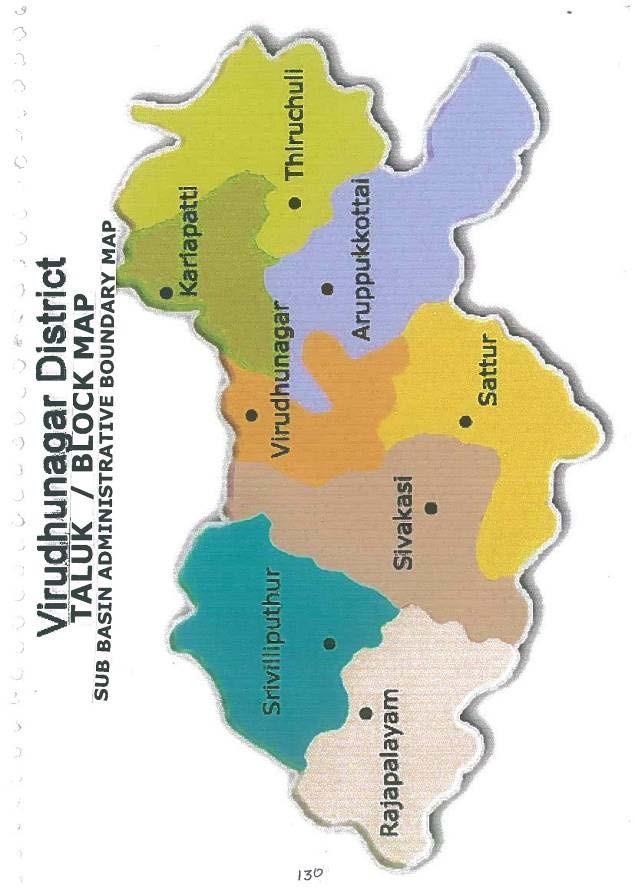
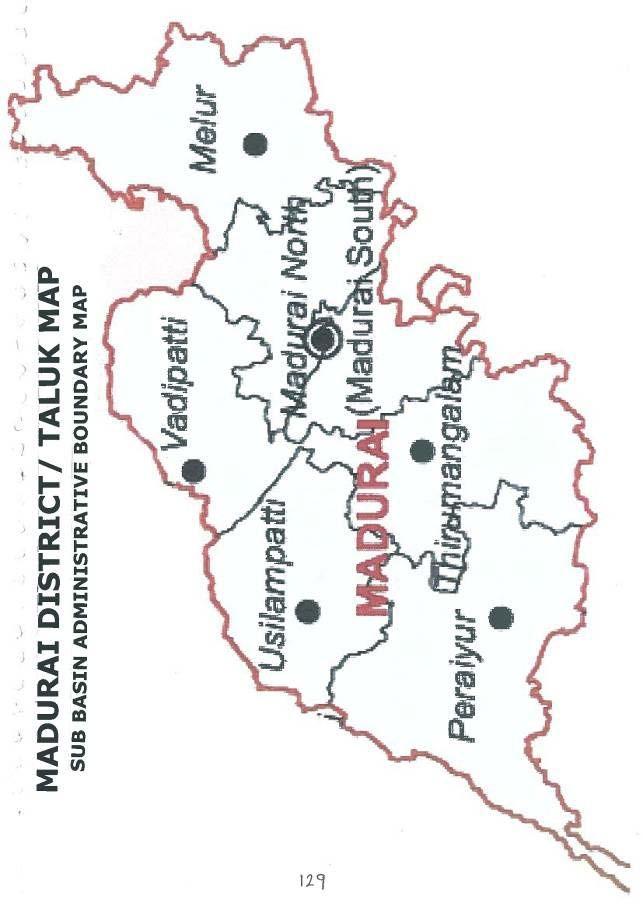
- Districts : Virudhunagar and Madurai
- Blocks covered : Aruppukottai, Virudhunagar, T.Kallupatti & Kallikudi
- Total registered ayacut area : 1804 ha
- Total number of tanks : 10
- Total number of canals : 2
District - Virudhunagar Block - Aruppukottai
| Sl. No. |
Name of the basin |
Name of the sub basin |
Name of the Channel |
Registered ayacut in (ha) |
Fully irrigated (ha) |
Partially irrigated (ha) |
Total(ha) |
|
Vaippar |
Kousiganadhi |
Right and Left Main Canal of Kullursandai reservoir |
434.280 |
304.12 |
130.16 |
434.280 |
Village wise ayacut - Kullursandai dam
| Sl. No. |
Taluk |
Village |
Ayacut details in hectars |
|
|
|
L.M.C |
R.M.C |
Total |
|
Aruppukottai |
Kullursandai |
35.79 |
-- |
35.79 |
|
Aruppukottai |
Sulakkarai |
3.21 |
365.05 |
368.26 |
|
Aruppukottai |
Kallumarpatti |
-- |
29.49 |
29.49 |
District - Virudhunagar Block -Virudhunagar
| Sl. No. |
Name of the basin |
Name of the sub basin |
Name of the Channel |
Registered ayacut in (ha) |
Fully irrigated (ha) |
Partially irrigated (ha) |
Total(ha) |
|
Vaippar |
Kousiganadhi |
Right and Left Main Canal ofKullursandai reservoir |
735.720 |
511.21 |
224.51 |
735.720 |
Village wise ayacut - Kullursandai dam
| Sl. No. |
Taluk |
Village |
Ayacut details in hectars |
| L.M.C |
R.M.C |
Total |
|
Virudhunagar |
Mettukundu |
232.86 |
31.31 |
264.17 |
|
Virudhunagar |
Chennalkudi |
318.26 |
36.88 |
355.14 |
|
Virudhunagar |
Maruluthu |
-- |
47.84 |
47.84 |
|
Virudhunagar |
Chettiyapatti |
-- |
68.55 |
68.55 |
District - Madurai Block - T. Kallupatti
| Sl. No. |
Name of the basin |
Name of the sub basin |
Name of the tank |
Registered ayacut in (ha) |
Fully irrigated (ha) |
Partially irrigated (ha) |
Total(ha) |
|
Vaippar |
Kousiganadhi |
Thevankuruchi |
108.05 |
70.23 |
37.82 |
108.05 |
|
Vaippar |
Kousiganadhi |
Kadaneri |
41.46 |
26.95 |
14.51 |
41.46 |
|
Vaippar |
Kousiganadhi |
Nakkaneri |
40.00 |
26.00 |
14.00 |
40.00 |
|
Vaippar |
Kousiganadhi |
Vaiyur Karisalkulam |
48.58 |
31.58 |
17.00 |
48.58 |
|
Vaippar |
Kousiganadhi |
Kunnathur Karisalkulam |
53.80 |
34.97 |
18.83 |
53.80 |
District - Madurai Block - Kallikudi
| Sl. No. |
Name of the basin |
Name of the sub basin |
Name of the tank |
Registered ayacut in(ha) |
Fully irrigated (ha) |
Partially irrigated (ha) |
Total(ha) |
|
Vaippar |
Kousiganadhi |
Villur Periyakulam |
69.20 |
44.98 |
24.22 |
69.20 |
|
Vaippar |
Kousiganadhi |
Villur Ovari |
87.01 |
56.55 |
30.46 |
87.01 |
|
Vaippar |
Kousiganadhi |
T.Periyasevalkulam |
54.65 |
35.52 |
19.13 |
54.65 |
|
Vaippar |
Kousiganadhi |
Alangulam |
63.67 |
41.48 |
22.29 |
63.67 |
|
Vaippar |
Kousiganadhi |
Chittur |
67.58 |
43.92 |
23.66 |
67.58 |
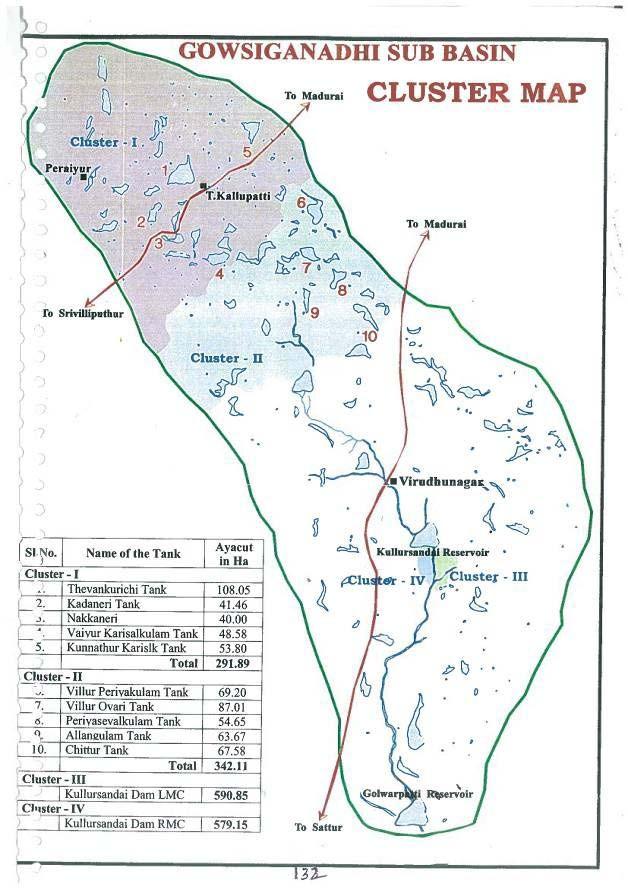
Clusters details
| Sl.No. |
ClusterNo. |
Name of the District |
Name of the Tank / canal |
AyacutArea (ha) |
|
I |
Madurai |
Thevankurichi Tank |
108.05 |
|
I |
Madurai |
Kadaneri Tank |
41.46 |
|
I |
Madurai |
Nakkaneri |
40.00 |
|
I |
Madurai |
VaiyurKarisalkulam Tank |
48.58 |
|
I |
Madurai |
KunnathurKarisalkulam Tank |
53.80 |
|
|
|
Total |
291.89 |
|
II |
Madurai |
VillurPeriyakulam Tank |
69.20 |
|
II |
Madurai |
VillurOvari Tank |
87.01 |
|
II |
Madurai |
T.Periyasevalkulam Tank |
54.65 |
|
II |
Madurai |
Allangulam Tank |
63.67 |
|
II |
Madurai |
Chittur Tank |
67.58 |
|
|
|
Total |
342.11 |
|
III |
Virudhunagar |
Kullursandai Dam LMC |
590.85 |
|
IV |
Virudhunagar |
Kullursandai Dam RMC |
579.15 |
Virudhunagar District Ayacut area
- Aruppukottai Block – 434.28 ha
- Virudhunagar Block – 735.72 ha
- Total– 1170.00 ha
Madurai District Ayacut area
- Kallikudi Block – 342.11 ha
- T. Kallupatti Block – 291.89 ha
- Total – 634.00 ha
2. Description of the Vaippar Basin
The River Vaippar originates at an altitude of 1644m in Vasudevanallur reserve forest on the eastern slopes of Western Ghats in Tirunelveli District and runs eastward for a distance of 112 km and finally debouches into Gulf of Mannar near Vembar village, 18 km from Vilathikulam town of Thoothukudi district. The Vaippar river basin is located between latitude 8º59’N to 9º49’ N and longitude 77º15’E to 78º23’E, having an area of 5423 Sqkm and is surrounded by Thamirabarani basin on the South, Western ghats and Vaigai basin on the West, Gundar basin on the North and Bay of Bengal on the East This basin has been divided into 13 sub- basins namely as follows;
- Nishabanadhi
- Kalingalar
- Deviar
- Nagariyar
- Sevalaperiyar
- Kayalkudiyar
- Vallampatti Odai/Uppodai
- Sindapalli Uppodai
- Arjunanadhi
- Kousiganadhi
- Uppathurar
- Senkottaiyar
- Vaipparmain
3. Description of Kousiganadhi Sub Basin:
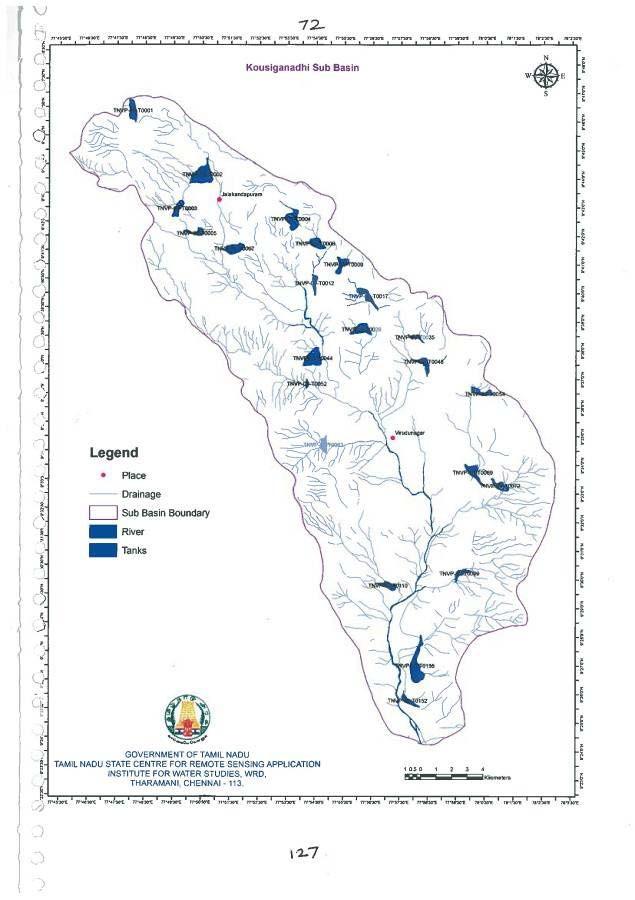
Kousiganadhi is one of the tributaries of the river Vaippar. It receives drainage from its own catchment. It originates at an altitude of about 200 m above MSL. in Peraiyur area (Vannivelampatti village) in Madurai District. Kousiganadhi passes through just south of Virudhunagar town. Kullursandai Dam is constructed across Kousiganadhi near Kullursandai village of Virudhunagar Taluk with a capacity of 3.59 MCM, to feed an irrigated command of 1170 ha. After joining a number of streams, it confluences with Arjunanadhi in Golwarpatti Dam. The catchment area of the sub basin is 527 sq km (520 sq km plain and 7 sq km hilly). Out of 13 Sub Basins of Vaippar river basin Modernisation of tanks were taken up in 11 Sub Basins under TNIAMWARM project funded by World Bank under first three years investments. Detailed Project report for Kayalkudiyar sub Basin is approved in IV thyear investment plan. Only Kousiganadhi Sub basin is not included in the TN IAMWARM project.
There are 23 non system tanks under this sub basin and the total command area is 1609.36 ha. It runs for a distance of 11.5 km and finally empties its discharge into Kullursandai Dam Virudhunagar Taluk.
The Kousiganadhi sub basin is located between the Latitude 9024’00”N to 9047’00”N and Longitude 77045’00”E to 780 05’00”E. The command area of this sub basin comes under Peraiyur & Thirumangalam Taluks of Madurai District and Virudhunagar, Sattur, Kariyapatti & Aruppukottai Taluks of Virudhunagar District. The blocks lying partially in this Sub Basins are T.Kallupatti & Kalligudi in Madurai District and Virudhunagar, Kariyapatti & Aruppukottai in Virudhunagar District.
3.1 List of Blocks, Taluks and District covered in Kousiganadhi Sub Basin:
| Sl. No |
DISTRICT |
TALUK |
BLOCK |
| 1. |
Madurai |
Peraiyur |
T.Kallupatti |
|
|
Thirumangalam |
Kalligudi |
| 2. |
Virudhunagar |
Virudhunagar |
Virudhunagar |
|
Aruppukottai |
Aruppukottai |
|
Kariyapatti |
Kariyapatti |
|
Sattur |
Virudhdunagar |
3.1.1. List of Districts, Blocks and Taluks, Tanks and Ayacut Details Proposed in this Project:
| Sl.No. |
District |
Block |
Taluk |
No.of Tanks / Canals |
Ayacut in (ha) |
| 1 |
Madurai |
T.Kallupatti |
Peraiyur |
5 |
291.89 |
| 2 |
Madurai |
Kalligudi |
Thirumangalam |
5 |
342.11 |
| 3 |
Virudhunagar |
Virudhunagar & Aruppukottai |
Virudhunagar & Aruppukottai |
Kullursandai LMC -1 |
736.46 |
| 4 |
Virudhunagar |
Virudhunagar & Aruppukottai |
Virudhunagar & Aruppukottai |
Kullursandai RMC -1 |
433.54 |
|
|
|
Total |
10+2 |
1804.00 |
3.2 Cluster Classification
| Sl.No. |
No. of Cluster |
Name of Cluster |
Block |
Taluk |
District |
| 1. |
CLUSTER I |
Thevankurichi |
T.Kallupatti |
Peraiyur |
Madurai |
| 2. |
CLUSTER II |
VillurOvari |
Kalligudi |
Thirumangalam |
Madurai |
| 3. |
CLUSTER III |
Kullursandai dam Left main canal |
Virudhunagar, Aruppukottai |
Virudhunagar, Aruppukottai |
Virudhunagar |
| 4. |
CLUSTER IV |
Kullursandai dam Right main canal |
Virudhunagar, Aruppukottai |
Virudhunagar, Aruppukottai |
Virudhunagar |
3.3. Soil Classification
In this sub basin, due to different stages, Weathering & parent material, the soil types are met with in following types.
| S. No |
Blocks |
Type of soil |
|
T.Kallupatti Block |
Dark reddish brown, sandy clay loam, strong coarse subangular blocky, hard (dry). |
|
Kalligudi Block |
Very dark grayish brown, clay, strong coarse sub angular blocky, very firm (moist), sticky and plastic (wet) |
|
Virudhunagar Block |
Very dark grayish brown moist clay, moderate medium angular block, dry hard, moist firm. |
|
Aruppukottai Block |
Dark yellowish brown, dark brown, sandy clay loam, massive breaking to weak medium sub angular block, slightly hard (dry). |
|
Kariyapatti Block |
Very dark gray moist, clay, strong coarse angular blocky, moist firm, wet very sticky and plastic. |
3.4 Land Holdings
The details of farm holdings and size classes prevalent in Kousiganadhi Sub basin are given below:
| Category |
Size of holdings |
Numbers |
Percentage |
| Marginal |
Below 1.00 ha |
656 |
57.85 % |
| Small |
1.00 – 2.00 ha |
389 |
34.30% |
| Medium |
2.00 – 5.00 ha |
65 |
5.73% |
| Big |
5.0 ha& above |
24 |
2.12% |
| Total |
|
1134 |
|
Above table revealed that the marginal farmers alone accounted for 57.85 percent in the sub basin followed by small farmers. Developmental initiatives will need to take the fact into account.
3.5. Canal having direct Ayacut
| Sl.No. |
Name of supplyChannel / canal |
Start Point |
End Point |
Length in metres |
Bedwidth in ‘m’ |
Bedslope |
Sideslope |
MFD incumecs |
Depthofflowin ‘m’ |
| Location |
Sill level |
Location |
Sill level |
| 1) |
Kullursandai Dam Left main canal |
KullursandaiDam LS 870m |
27.750m |
LS 6500m |
26.450m |
6500 |
1.00 |
1 in5000 |
1:1 |
0.9285 |
0.90 |
| 2) |
Kullursandai Dam Right main canal |
KullursandaiDamat LS 2500m |
27.750m |
LS 3500m |
27.050m |
3500 |
1.00 |
1 in5000 |
1:1 |
0.9285 |
0.90 |
Objectives
Keeping the above points in view the following interventions are proposed for Kousiganadhi sub basin
- To promote water saving technologies in agricultural crops for large scale adoption.
- To enhance crop and water productivity.
- To increase the crop productivity and area by diversification and intensification.
- Popularizing the innovative and eco friendly technologies of TNAU in crops for better returns
4.1 Implementation strategy
- Transfer of latest production technologies to increase the productivity
- Exposure visits
- Frequent review and documentation
5. Field Interventions
5.1. Productivity enhancement of Rice
GM - SRI
Adoption SRI followed by green manure incorporation will increase the soil nutrient status as well as soil organic carbon content. Use of cono weeder not only control the weeds but also increases the soil nutrient content through incorporation of weeds in the soil. Adopting this practice will increase water use efficiency. Scientific management technique of allocating irrigation water based on soil and climatic condition to achieve maximum crop production per unit of water applied over a unit area in unit time is very much essential under present condition. System Rice Intensification (SRI) is one among the scientific management tool. Under conventional system of rice cultivation the rice yield will be low due to poor water and weed management, poor aeration affects the root activity and tiller production and poor water management increases the water requirement. Efficient water management reduces the irrigation water requirement
Evaluating the new agro techniques will pave way for yield increase in Rice. Starting from sowing to harvest all the need based improved techniques will be demonstrated.
| S.No. |
Technology |
Total area (ha) |
Unit cost (Rs.) |
Total cost(in lakhs) |
| 1 |
Productivity enhancement of Rice - GM |
40 |
8000 |
3.20 |
Details of Unit cost for Green Manure:
| S.No. |
Particulars |
Amount (Rs.) |
| 1. |
Seed cost 40 kg/ha @ Rs. 50/kg |
2000.00 |
|
Grand Total |
2000.00 |
Details of Unit cost for SRI:
| S.No |
Particulars |
Amount(Rs.) |
| 1 |
Cost of Soil testing |
20.00 |
| 2 |
Seed cost - 10 kg / ha @ Rs.30/kg |
300.00 |
| 3 |
Cost of nursery raising |
- |
| 4 |
Cost of fertilizers (150:50:50 kg NPK / ha) |
|
Urea - 300 kg/ha @ Rs.6 /kg |
1,800.00 |
|
Muriate of Potash – 80 kg @ Rs.16/kg |
1,280.00 |
|
ZnSO4 25 kg @ Rs.40/kg |
1,000.00 |
| 5 |
Bio fertilizer & Bio inoculants |
1,600.00 |
|
Grand Total |
6,000.00 |
5.2. Area enhancement, Area expansion and productivity enhancement of pulses under crop diversification in gap areas:
Farmers are not adopting the technologies like use of improved high yielding varieties, seed treatment with pseudomonas fluorescens and foliar spray of TNAU pulse wonder. Hence it is proposed to conduct the demonstration involving improved technologies of pulses. The technologies are use of seeds of high yielding varieties, seed treatment with pseudomonas fluorescens and foliar spray of TNAU pulse wonder.
| S.No. |
Technology |
Total area (ha) |
Unit cost (Rs.) |
Total cost(in lakhs) |
| 1 |
Area enhancement, Area expansion and productivity enhancement of pulses |
80 |
5000 |
4.00 |
Details of Unit cost for Area expansion Pulses:
| S. No |
Particulars |
Amount(Rs.) |
| 1. |
Cost of Soil testing |
20.00 |
| 2. |
Seed cost with seed treatment - 20 kg / ha @ Rs.150/kg |
3,000.00 |
| 3. |
DAP 25 kg / ha @ Rs.22.50/kg |
560.00 |
| 4. |
Pulse Wonder 2 kg / ha @ Rs.220/kg |
440.00 |
| 5. |
Bio fertilizers and Bio inoculants |
980.00 |
|
Grand Total |
5,000.00 |
Redgram under cropping sequence in Vegetables ( Brinjal, Tomato, Bhendi and Chillies)
Farmers are not adopting the technologies like use of improved high yielding varieties and seed treatment with pseudomonas fluorescens. Hence it is proposed to conduct the demonstration involving improved technologies of Redgram under cropping sequence in vegetables (Brinjal, Tomato, Bhendi and Chillies) the technologies are use of seeds of high yielding varieties and seed treatment with pseudomonas fluorescens.
| S.No. |
Technology |
Total area (ha) |
Unit cost(Rs.) |
Total cost(in lakhs) |
| 1 |
Redgram under cropping sequence in Vegetables (Brinjal, Tomato, Bhendi and Chillies) |
15 |
10000 |
1.50 |
Details of Unit cost for Red gram:
| S. No |
Particulars |
Amount(Rs.) |
| 1. |
Cost of Seeds / Seedlings |
10000.00 |
|
Grand Total |
10000.00 |
5.4. Improving productivity of Toor Dhal (Red Gram) under precision farming techniques including IPM approach
Under this water scarce situation, by adopting precision farming techniques productivity of Redgram will be increased apart from increase in WUE.
Precision farming is an approach where inputs, including water and fertilizers, are applied in precise amounts to maximize yields by reducing water use, residues in soil and water, and chemical sprays, and substantially increased average yields compared to traditional cultivation techniques. Precision farming provides a new solution to balance productivity with environmental concerns. Based on advanced information technology, it includes describing and modeling variation in soils and plant species and integrating agricultural practices to meet site specific requirements.
| S.No. |
Technology |
Total area (ha) |
Unit cost(Rs.) |
Total cost(in lakhs) |
| 1 |
Redgram under precision farming |
2 |
100000 |
2.00 |
Details of Unit cost for Red gram:
| S. No |
Particulars |
Amount (Rs.) |
| 1. |
Drip cost as per the Govt. norms @ 75% Subsidy |
64,200.00 |
| 2. |
Cost of Seedlings and Transplanting |
18,000.00 |
| 3. |
Water Soluble fertilizers |
|
|
Urea - 200 kg @ Rs.6/kg |
1,200.00 |
|
MAP-100 kg @ Rs.90/kg |
9,000.00 |
|
SOP- 50 kg @ Rs.75/kg |
3,750.00 |
| 3. |
Pulse Wonder 2 kg/ha @ Rs.220/kg |
440.00 |
| 4. |
Bio fertilizer & Bio Pesticide |
2,000.00 |
| 5. |
Organic Manures viz. Vermicompost |
1,410.00 |
|
Grand Total |
1,00,000.00 |
Demonstration of improved production techniques with various oil seed crops with prime focus on improving productivity, encouraging crop diversification
Farmers are not adopting the technologies like use of improved high yielding varieties and seed treatment with pseudomonas fluorescents. Hence it is proposed to conduct the demonstration involving improved technologies of gingelly. The technologies are use of seeds of high yielding varieties and seed treatment with pseudomonas fluorescents.
| S.No. |
Technology |
Total area (ha) |
Unit cost(Rs.) |
Total cost(in lakhs) |
| 1 |
Oil seed cultivation with improved practices (Gingelly) |
30 |
5000 |
1.50 |
Details of Unit cost for Oil seed:
| S. No |
Particulars |
Amount(Rs.) |
| 1. |
Cost of Soil testing |
20.00 |
| 2. |
Gypsum 400 kg / ha @Rs.5/kg |
2,000.00 |
| 3. |
Fertilizer cost |
1,500.00 |
| 4. |
Pheromone trap and lure for Spodoptera litura |
730.00 |
| 5. |
Micro nutrient spray (DAP–2.5 kg, Ammonium sulphate – 1 kg, Borax – 500 gm and planofix–375 Ml) @ Rs.250 for 3 sprays. |
750.00 |
|
Grand Total |
5,000.00 |
5.6. Promotion of Pesticide Free vegetables in sub-basins through climate resilience activity in model Bio Villages known as pesticide free Village
Now a day’s farmers spent huge amount of money for purchase of pesticides to control pests which leads to decreasing market value of pesticide sprayed vegetables.
Hence pesticide free vegetables are more popular in public in terms of health.
The farmer’s income will definitely increase through adoption of growing pesticide free vegetables.
| S.No. |
Technology |
TotalGroup |
Unit cost(Rs.) |
Total cost(in lakhs) |
| 1 |
Promotion of pesticide freeVegetables |
20 |
2500 |
0.50 |
6. Capacity building & Information, Education & Communication
6. 1. Capacity building
6.1.1. Training to stake holders
Under the head of capacity building, imparting training to all the beneficiaries either as off-campus or as on-campus and exposure visit to the farmers is planned.
| Sl. No. |
Particulars |
Duration (days) |
No/batch |
Total batch |
Budget / batch |
Total budget (lakhs) |
| 1. |
Nursery technology for SRI paddy |
1 |
50 |
10 |
10,000 |
1.00 |
| 2. |
Seed production in Pulses |
1 |
50 |
10 |
10,000 |
1.00 |
| 3. |
Precision farmingpractices for Red gram |
1 |
50 |
10 |
10,000 |
1.05 |
|
|
|
|
|
Total |
3.05 |
6.0.2. Exposure Visit
In-order to have practical knowledge on various improved farming practices prevailing across the District and State, it has been proposed to expose the stakeholders by organizing educational tours for having better cross learning.
6.2. IEC Measures including Awareness creation, documentation and IEC equipment
6.2.1. Awareness Creation:
Informal meetings with Farmers / Water Users Association through PRA methods – Focus group discussion and transect walk
- Ensure transparency
- Explain about the scheme – organization objectives, activities, project contribution and farmers share
- Emphasis the role of stake holders in the project
- Project the expected benefit
6.2.2. Documentation
- Field note for each activity
- Maintenance of records and registers
- Daily memorandum sheet
- Receipt and issue of inputs
- Technical observations on soil, water and crop
6.2.3. IEC Equipments
- Purchase of Laptop and Camera
6.2.4. Outsourcing of vehicle
- Expenditure on TA /DA for the purpose of TNIAM Project
- Fuel bill of university vehicle utilized for the project
- Hire charges of university vehicle utilized for this purpose.
7. Management Cost
Outsourcing of technical staff is included in TNAU sub basin plan to carry out the field activities.
8. Year Wise Crop Based Activities
| S. No. |
Particulars |
Total (ha) |
| I |
II |
III |
IV |
Area( ha) |
| 1. |
Green Manure-Paddy (SRI) |
20 |
10 |
5 |
5 |
40 |
| 2. |
Area expansion of pulses (Black gram/ Green gram) |
30 |
25 |
15 |
10 |
80 |
| 3. |
Improved cultivation practices for enhancing production in oilseed crop (Sesame) |
10 |
10 |
5 |
5 |
30 |
| 4. |
Promotion of Redgram under cropping sequence in vegetable cultivation |
5 |
5 |
5 |
0 |
15 |
| 5. |
Productivity enhancement in Redgram through precision farming practices |
2 |
0 |
0 |
0 |
2 |
| 6. |
Promotion of Pesticide Free vegetables in sub-basins through climate resilience activity in model Bio Villages known as pesticide free Village |
5 |
5 |
5 |
5 |
20 |
|
Total |
72 |
55 |
35 |
25 |
187 |
9. Total Budget (Year wise) for Kousiganadhi Sub basin (in lakhs)
P-Physical in ha, F-Financial in lakhs Rs.
| S. No |
Particulars |
Unit cost Rs/ha |
I Year |
II Year |
III Year |
IV Year |
V Year |
VI Year |
Total |
| A |
Activities |
P |
F |
P |
F |
P |
F |
P |
F |
P |
F |
P |
F |
P |
F |
| 1 |
GM-SRI |
8000 |
20 |
1.60 |
10 |
0.80 |
5 |
0.40 |
5 |
0.40 |
0 |
0.00 |
0 |
0.00 |
40 |
3.20 |
| 2 |
Area Enhancement, Area Expansion and productivity enhancement of pulses under crop diversification in gap areas: (Black gram/green gram |
5000 |
30 |
1.50 |
25 |
1.25 |
15 |
0.75 |
10 |
0.50 |
0 |
0.00 |
0 |
0.00 |
80 |
4.00 |
| 3 |
Demonstration of improved production techniques with various oil seed crops with prime focus on improving productivity, encouraging crop diversification (Groundnut/sesame) |
5000 |
10 |
0.50 |
10 |
0.50 |
5 |
0.25 |
5 |
0.25 |
0 |
0.00 |
0 |
0.00 |
30 |
1.50 |
| 4 |
Red Gram under cropping sequence in vegetables |
10000 |
5 |
0.50 |
5 |
0.50 |
5 |
0.50 |
0 |
0.00 |
0 |
0.00 |
0 |
0.00 |
15 |
1.50 |
| 5 |
Red Gram under precision farming / IPM approach |
100000 |
2 |
2.00 |
0 |
0.00 |
0 |
0.00 |
0 |
0.00 |
0 |
0.00 |
0 |
0.00 |
2 |
2.00 |
| 6 |
Promotion of Pesticide Free vegetables in sub-basins through climate resilience activity in model Bio Villages known as pesticide free Village |
2500 |
5 |
0.13 |
5 |
0.13 |
5 |
0.12 |
5 |
0.12 |
0 |
0.00 |
0 |
0.00 |
20 |
0.50 |
| B. |
Implementation for farm mechanization |
|
|
|
|
|
|
|
|
|
|
|
|
|
|
|
| 7 |
Cono weeder |
1000 |
20 |
0.20 |
10 |
0.10 |
5 |
0.05 |
5 |
0.05 |
0 |
0.00 |
0 |
0.00 |
40 |
0.40 |
|
Total(A+B) |
|
92 |
6.43 |
65 |
3.28 |
40 |
2.07 |
30 |
1.32 |
0 |
0.00 |
0 |
0.00 |
227 |
13.10 |
| II |
IEC & CB |
|
|
|
|
|
|
|
|
|
|
|
|
|
|
|
| 1 |
Training to stakeholders |
|
|
0.75 |
|
0.75 |
|
0.75 |
|
0.40 |
|
0.40 |
|
0.00 |
|
3.05 |
| 2 |
Exposure visit |
|
|
0.30 |
|
0.30 |
|
0.30 |
|
0.00 |
|
0.00 |
|
0.00 |
|
0.90 |
| 3 |
Awareness creation |
|
|
0.40 |
|
0.40 |
|
0.40 |
|
0.25 |
|
0.10 |
|
0.00 |
|
1.55 |
| 4 |
Documentation |
|
|
0.40 |
|
0.30 |
|
0.30 |
|
0.10 |
|
0.10 |
|
0.10 |
|
1.30 |
| 5 |
IEC equipments |
|
|
0.60 |
|
0.00 |
|
0.00 |
|
0.00 |
|
0.00 |
|
0.00 |
|
0.60 |
| 6 |
Out sourcing of vehicle |
|
|
0.50 |
|
0.30 |
|
0.30 |
|
0.30 |
|
0.30 |
|
0.30 |
|
2.00 |
|
Total |
|
|
2.95 |
|
2.05 |
|
2.05 |
|
1.05 |
|
0.90 |
|
0.40 |
|
9.40 |
| III |
Management Cost |
|
|
|
|
|
|
|
|
|
|
|
|
|
|
|
| 1 |
Out sourcing of technical staff |
|
|
1.20 |
|
1.20 |
|
1.20 |
|
1.20 |
|
0.00 |
|
0.00 |
|
4.80 |
|
Over all total |
|
|
10.58 |
|
6.53 |
|
5.32 |
|
3.57 |
|
0.90 |
|
0.40 |
|
27.30 |
Abstract of Kousiganadhi Field Activities
| S.No |
Intervention details |
Unit cost Rs/ha |
P |
F |
| I |
A.Field Interventions |
|
|
|
| 1 |
GM-SRI |
8000 |
40 |
3.20 |
| 2 |
Area Enhancement, Area Expansion and productivity enhancement of pulses under crop diversification in gap areas: (Black gram/green gram |
5000 |
80 |
4.00 |
| 3 |
Demonstration of improved production techniques with various oil seed crops with prime focus on improving productivity, encouraging crop diversification (Groundnut/sesame) |
5000 |
30 |
1.50 |
| 4 |
Promotion of Red Gram (Toor Dhal) under cropping sequence in vegetables |
10000 |
15 |
1.50 |
| 5 |
Improving productivity of Toor Dhal (Red Gram) under precision farming techniques including IPM approach |
100000 |
2 |
2.00 |
| 6 |
Promotions of Pesticide Free vegetables in sub-basins through climate resilience activity in model Bio Villages known as pesticide free Village. |
2500 |
20 |
0.50 |
|
B. Implements for farm mechanization |
|
|
0.00 |
| 7 |
Cono weeder |
1000 |
40 |
0.40 |
|
Sub Total (A+B) |
|
227 |
13.10 |
| II |
IEC & CB |
|
|
|
| 1 |
Capacity Building |
|
|
|
|
a). Training to stake holders |
|
|
3.05 |
|
b).Exposure visit |
|
|
0.90 |
| 2 |
IEC |
|
|
|
|
a).Awareness Creation activities |
|
|
1.55 |
|
b).Documentation |
|
|
1.30 |
|
c).IEC equipments |
|
|
0.60 |
|
d) Outsourcing of vehicle and TA |
|
|
2.00 |
|
Sub Total |
|
|
9.40 |
| III |
Management cost |
|
|
|
|
Out sourcing of technical staff |
|
|
4.80 |
|
Over all Total (I+II+III) |
|
|
27.30 |