Lower Bhavani
1. About Agricultural Research Station, Bhavanisagar
1.1Establishment
To cater the needs of the farmers of Erode district, the Agricultural Research Station was started by the Department of Agriculture at Satyamangalam in August 1951 with an area of 20 hectares. Later it was shifted to Bhavanisagar in 185.28 hectares and started functioning from 1st March 1955. The station is positioned at the origin of LBP (Lower Bhavani Project) reservoir. It is a lead centre for western zone which lies in 11° 29’ N latitude and longitude of 77° 80’ E at 256 m above MSL. Cultivable area of this station is 154.94 hectares. This is a major multi crop station in the State engaged in research, diploma education, extension and seed production activities of various agricultural and horticultural crops
1.2. Mandate
- Breeding and evaluation of new crop varieties and hybrids in rice, sorghum, pulses, cotton, vegetables, sugarcane and turmeric for Western Zone of Tamil Nadu.
- Development of agro-technologies for agricultural and horticultural crops and cropping systems.
- Water and fertilizer management research on agricultural and horticultural crops through drip irrigation, fertigation and operational research programmes.
- Pest and disease surveillance and recommendations on various crops.
- Production of breeder, foundation and TNAU labeled seeds in crops and grafts/ seedlings of fruit crops.
- Evolving technologies for rain-fed crops.
- Research on the utilization of farm implements.
- Dissemination of the technologies by conducting farmers’ day, field days, training programmes and through mass media.
- Agricultural education by offering Diploma in Agriculture programme through M.S. Swaminathan Institute of Agriculture (MSSIA) at this station.
1.3. Research
The All India Co-ordinated Research Project (AICRP) for research on water management is functioning at Agricultural Research Station, Bhavanisagar from 01.09.1969. The climate is mainly semi arid tropic. The mean annual rainfall is 717 mm. The mean maximum temperature is 33.9° C and that of the minimum temperature is 21.6° C. The average wind velocity is 3.2 KMPH. Sunshine hours range from 3.7 to 7 per day with an average evaporation of 4.3 mm per day.
The soils of Agricultural Research Station, Bhavanisagar are representative of the Lower Bhavani Project Command area. The soils have been developed from the sedimentary rocks of varying composition. The colour of the soils ranges from reddish brown to dark reddish brown and the structure ranges from granular at the surface to sub angular blocky. The soil depth ranges from 15 to 45 cm. the pH and EC of the soil ranges from 6.8 to 7.5 and 0.2 to 0.4 dSm-1 respectively. The available N ranges from 141 to 220 kg ha-1, available P2O5 from 11 to 20 kg ha-1 and available K2O ranges from 202 to 350 kg ha-1. The field capacity of the soil is 20.6 per cent and the wilting point is 8.7 per cent.
Researchers on water management studies were conducted in various crops like rice, millets, pulses, oilseeds, sugarcane, cotton, vegetable crops, etc., under various aspects of water management, water saving, soil conservation, micro irrigation, drip irrigation and fertigation, farming systems, etc., are discussed in this book.
Scientists Involved
| Dr.N.K. Prabhakaran | : | Professor and Head (Agronomy) |
| Dr.M.Rajavel | : | Assistant Professor (Crop Physiology) |
2. About the basin (Lower Bhavani Sub Basin)
2.1. Introduction
The Lower Bhavani Project (LBP) is the first major project executed in Tamil Nadu after independence during 1948 to 1955 at a cost of Rs.1034 lakhs in the First Five Year Plan. LBP is the second largest reservoir in Tamil Nadu with a capacity of 929 million cubic metres (32.80 TMC ft).This Dam is located in the Bhavani River just below the confluence of river Moyar and river Bhavani. Bhavanisagar is 16 KM (10 miles) west of Sathyamangalam and about 36 Km (23 miles) North East of Mettupalayam in Erode District of Tamil Nadu. The dam is the longest Earthen dam of its kind in the state measuring 8696 metres of which 464 metres is in masonry in the river bed portion. The main canal is having a length 124 miles irrigating a total ayacut of 83770 hectares (207000 acres). Besides this, an area of 17022 ha are being cultivated through Thadapalli, Arakkankottai and Kalingarayan basins via Bhavani river under various crops like Paddy, Turmeric, Banana, Sugarcane, Coconut, Vegetables, Groundnut, Tapioaca and Maize. Nearly 60 % of the total sown area is irrigated in this district. The Bhavanisagar dam extensively benefits the cultivation of crops in all most all the taluks in this district
2.2. Block wise registered ayacut area in the sub-basin is furnished below. (Area in ha)
| Sl. No | Cluster Name | Name of the Channel | Name of Tank / Anicut | Village | Block | District | Total Ayacut (Ha) | Gap Area | ||||
| Registered Ayacut | Fully irrigated | Partially irrigated | RF/Fallow | Perm. Gap | Total Gap | |||||||
| 1 | Ukkaram | Shenbagapudur Anicut | Shenbagapudur | Sathiyamangalam | Erode | 126.50 | 101.20 | 18.98 | 06.32 | 06.32 | ||
| Palayakalayanur Anicut | Palayakalayanur | Sathiyamangalam | Erode | 109.77 | 65.86 | 21.95 | 21.96 | 21.96 | ||||
| Ukkaram Anicut | Ukkaram | Sathiyamangalam | Erode | 76.58 | 57.44 | 07.66 | 11.48 | 11.48 | ||||
| Sundakkam palayam | Sathiyamangalam | Erode | 190.45 | 114.27 | 22.85 | 53.33 | 53.33 | |||||
| Arasur | Sathiyamangalam | Erode | 40.96 | 18.43 | 08.19 | 14.34 | 14.34 | |||||
| Indiyampalayam | Sathiyamangalam | Erode | 122.44 | 61.22 | 24.49 | 36.73 | 36.73 | |||||
| Makkinankombai | Sathyamangalam | Erode | 87.22 | 47.97 | 08.72 | 30.53 | 30.53 | |||||
| Total | 753.92 | 466.39 | 112.84 | 0 | 174.69 | 174.69 | ||||||
| 2 | Kurumanthur | Kurumanthur Anicut | Kurumanthur | Nambiyur | Erode | 19.82 | 09.91 | 02.97 | 06.94 | 06.94 | ||
| Karattupalayam | Nambiyur | Erode | 215.88 | 129.53 | 32.38 | 53.97 | 53.97 | |||||
| Karattupalayam Anicut | Karattupalayam | Nambiyur | Erode | 333.15 | 183.23 | 49.97 | 99.95 | 99.95 | ||||
| Elathur Anicut | Elathur | Nambiyur | Erode | 53.31 | 23.99 | 05.33 | 23.99 | 23.99 | ||||
| Andipalayam | Nambiyur | Erode | 31.45 | 17.30 | 03.15 | 11.00 | 11.00 | |||||
| Kadathur | Nambiyur | Erode | 485.04 | 266.77 | 48.50 | 169.77 | 169.77 | |||||
| Alukkuli Anicut | Alukkuli | Gobichettipalayam | Erode | 122.19 | 48.88 | 18.33 | 54.98 | 54.98 | ||||
| Kalingiyam Anicut | Kalingiyam | Gobichettipalayam | Erode | 144.17 | 79.29 | 21.63 | 43.25 | 43.25 | ||||
| Kolapalur Tank | Kolapalur | Gobichettipalayam | Erode | 64.75 | 35.61 | 09.71 | 19.43 | 19.43 | ||||
| Total | 1469.76 | 794.51 | 191.97 | 0 | 483.28 | 483.28 | ||||||
| 3 | Kugalur | Kadukkampalayam Anicut | Polavakkalipalayam | Gobichettipalayam | Erode | 28.03 | 16.82 | 02.80 | 08.41 | 08.41 | ||
| Kugalur C | Gobichettipalayam | Erode | 124.09 | 68.25 | 17.37 | 38.47 | 38.47 | |||||
| Odathurai | Bhavani | Erode | 78.56 | 41.64 | 09.43 | 27.49 | 27.49 | |||||
| Total | 230.68 | 126.71 | 29.60 | 0 | 74.37 | 74.37 | ||||||
| 4 | Kallipatti | Sanjeevarayan Tank | Perumugai | T. N. Palayam | Erode | 89.38 | 47.37 | 10.73 | 31.28 | 31.28 | ||
| 5 | Gettisamu dram | Anthiyur Tank | Pachampalayam | Anthiyur | Erode | 176.50 | 93.55 | 21.18 | 61.77 | 61.77 | ||
| Gettisamudram Tank | Gettisamudram | Anthiyur | Erode | 93.15 | 49.37 | 11.18 | 32.60 | 32.60 | ||||
| Vempathy Tank | Vempathy | Anthiyur | Erode | 76.49 | 40.54 | 09.18 | 26.77 | 26.77 | ||||
| Brammadesam Tank | Brammadesam | Anthiyur | Erode | 51.42 | 27.25 | 06.17 | 18.00 | 18.00 | ||||
| Appakudal Tank | Appakudal | Bhavani | Erode | 23.08 | 12.23 | 02.77 | 08.08 | 08.08 | ||||
| Total | 420.64 | 222.94 | 50.48 | 0 | 147.22 | 147.22 | ||||||
| 6 | Punjaipuliyampatti | Kovilpudur Tank | Punjaipuliyampatti | Bhavanisagar | Erode | 105.22 | 55.77 | 12.63 | 36.82 | 36.82 | ||
| Vemandampalayam Tank | Vemandampalayam | Nambiyur | Erode | 127.48 | 67.56 | 15.30 | 44.62 | 44.62 | ||||
| Mottanam Tank | Mottanam | Nambiyur | Erode | 45.32 | 24.02 | 05.44 | 15.86 | 15.86 | ||||
| Total | 278.02 | 147.35 | 33.37 | 0 | 97.30 | 97.30 | ||||||
| 7 | Chikkarasam palayam | Kanuvaikombaipallam Tank | Chikkarasampalayam | Sakthiyamangalam | Erode | 108.46 | 57.48 | 13.02 | 37.96 | 37.96 | ||
| Varadampalayam Tank | Varadampalayam | Sakthiyamangalam | Erode | 118.17 | 62.63 | 14.18 | 41.36 | 41.36 | ||||
| Total | 226.63 | 120.11 | 27.20 | 0 | 79.32 | 79.32 | ||||||
| 8 | Kavindapadi | Pandiyampalayam Anicut | Pandiyampalayam | Perundurai | Erode | 67.53 | 54.02 | 10.13 | 03.38 | 03.38 | ||
| Chandrapuram | Bhavani | Erode | 151.18 | 120.94 | 22.68 | 07.56 | 07.56 | |||||
| Kadukkampalayam | Gobichettipalayam | Erode | 115.47 | 92.38 | 17.32 | 05.77 | 05.77 | |||||
| Chandrapuram Anicut | Chandrapuram | Bhavani | Erode | 17.02 | 13.62 | 02.55 | 00.85 | 00.85 | ||||
| Odathurai | Bhavani | Erode | 117.34 | 93.87 | 17.60 | 05.87 | 05.87 | |||||
| Nallampatti Anicut | Singanallur | Perundurai | Erode | 62.37 | 49.90 | 09.36 | 03.11 | 03.11 | ||||
| Salangapalayam | Bhavani | Erode | 111.65 | 89.32 | 16.75 | 05.58 | 05.58 | |||||
| Salangapalayam Anicut | Salangapalayam | Bhavani | Erode | 123.43 | 98.74 | 18.51 | 06.18 | 06.18 | ||||
| Salangapalayam Anicut | Salangapalayam | Bhavani | Erode | 223.54 | 178.83 | 33.53 | 11.18 | 11.18 | ||||
| Kavindapadi | Bhavani | Erode | 157.39 | 125.91 | 23.61 | 07.87 | 07.87 | |||||
| Total | 1146.92 | 917.53 | 172.04 | 0 | 57.35 | 57.35 | ||||||
| 9 | Kanjikovil | Kanjikovil Anicut | Kanjikovil | Perundurai | Erode | 10.78 | 08.62 | 01.62 | 00.54 | 00.54 | ||
| Pallapalayam | Perundurai | Erode | 10.00 | 08.00 | 01.50 | 00.50 | 00.50 | |||||
| Periyapuliyur Anicut | Periyapuliyur | Bhavani | Erode | 20.28 | 16.22 | 03.04 | 01.02 | 01.02 | ||||
| Total | 41.06 | 32.84 | 06.16 | 0 | 02.06 | 02.06 | ||||||
| 10 | Nasiyanur | Alathur Anicut | Alathur | Bhavani | Erode | 4.58 | 03.66 | 00.69 | 00.23 | 00.23 | ||
| Vairamangalam | Bhavani | Erode | 85.95 | 68.76 | 12.89 | 04.30 | 04.30 | |||||
| Mullampatty Anicut | Attayampalayam | Erode | Erode | 96.47 | 77.18 | 14.47 | 04.82 | 04.82 | ||||
| Ellapalayam | Erode | Erode | 54.86 | 43.89 | 08.23 | 02.74 | 02.74 | |||||
| Samigoundanpalayam | Erode | Erode | 5.36 | 04.29 | 00.80 | 00.27 | 00.27 | |||||
| Villarasampatty | Erode | Erode | 5.56 | 04.45 | 00.83 | 00.28 | 00.28 | |||||
| Nasiyanur | Erode | Erode | 37.20 | 29.76 | 05.58 | 01.86 | 01.86 | |||||
| Ananthasagaram Tank | P.Mettupalayam | Bhavani | Erode | 50.00 | 40.00 | 07.50 | 02.50 | 02.50 | ||||
| Perundalayur | Bhavani | Erode | 57.92 | 46.34 | 08.69 | 02.89 | 02.89 | |||||
| Total | 397.90 | 318.33 | 59.68 | 0 | 19.89 | 17.00 | ||||||
| 11 | Nanjiuthukuli | Perumpallam Anicut | Erode | Erode | Erode | 83.19 | 66.55 | 12.48 | 04.16 | 04.16 | ||
| 46 Pudur | Modakurichi | Erode | 83.26 | 66.61 | 12.49 | 04.16 | 04.16 | |||||
| Punjai lakkapuram | Modakurichi | Erode | 174.20 | 139.36 | 26.13 | 08.71 | 08.71 | |||||
| Nanjiuthukuli | Modakurichi | Erode | 689.30 | 551.44 | 103.40 | 34.46 | 34.46 | |||||
| Erode Anicut | Erode | Erode | Erode | 46.98 | 37.58 | 07.05 | 02.35 | 02.35 | ||||
| Kuranganpallam Anicut | Punjaikalamangalam-A,B | Modakurichi | Erode | 1092.56 | 874.05 | 163.88 | 54.63 | 54.63 | ||||
| Pasur | Kodumudi | Erode | 141.70 | 113.36 | 21.26 | 07.08 | 07.08 | |||||
| Kilampadi | Kodumudi | Erode | 161.94 | 129.55 | 24.29 | 08.10 | 08.10 | |||||
| Total | 2473.13 | 1116.96 | 209.43 | 0 | 69.81 | 69.81 | ||||||
| 12 | Kulavilakku | Kulavilakku | Kulavilakku | Modakurichi | Erode | 52.50 | 42.00 | 07.88 | 02.62 | 02.62 | ||
| Palamangalam | Modakurichi | Erode | 31.68 | 25.34 | 04.75 | 01.59 | 01.59 | |||||
| Anjur Anicut | Anjur | Kodumudi | Erode | 102.18 | 81.74 | 15.33 | 05.11 | 05.11 | ||||
| Avalpoondurai Anicut | Avalpoondurai | Modakurichi | Erode | 24.42 | 19.54 | 03.66 | 01.22 | 01.22 | ||||
| Thuyampoondurai | Modakurichi | Erode | 34.98 | 27.98 | 05.25 | 01.75 | 01.75 | |||||
| Total | 245.76 | 196.60 | 36.87 | 0 | 12.29 | 10.54 | ||||||
| Tank Grand Total Area | 7773.80 | 4507.6 | 940.37 | 0.00 | 1248.8 | 1244.2 | ||||||
|---|---|---|---|---|---|---|---|---|---|---|---|---|
SUPPLYCHANNELS
| 13 | Anthiyur | Varratupallam | Anthiyur | Anthiyur | Erode | 641.91 | 60.98 | 436.50 | 0 | 144.43 | 144.43 | |
| Sankarapalayam | Anthiyur | Erode | 332.14 | 39.12 | 230.00 | 63.02 | 63.02 | |||||
| Ennamangalam | Anthiyur | Erode | 209.75 | 05.10 | 150.00 | 54.65 | 54.65 | |||||
| Total | 1183.80 | 105.20 | 816.50 | 0 | 262.10 | 262.10 | ||||||
| 14 | Vaniputhur | Gunderipallam | Kongarpalayam | T.N.Palayam | Erode | 375.52 | 300.42 | 56.33 | 18.77 | 18.77 | ||
| Goundenpalayam | T.N.Palayam | Erode | 267.56 | 214.05 | 40.13 | 13.38 | 13.38 | |||||
| Vaniputhur | T.N.Palayam | Erode | 185.84 | 148.67 | 27.88 | 09.29 | 09.29 | |||||
| Punjaithuraiyampalayam | T.N.Palayam | Erode | 38.19 | 30.55 | 05.73 | 01.91 | 01.91 | |||||
| Total | 1010.82 | 693.69 | 130.07 | 0 | 43.35 | 43.35 | ||||||
| Channels Grand Total Area | 2194.62 | 798.89 | 946.57 | 0 | 305.45 | 305.45 | ||||||
| Tank & channels Total area | 9968.42 | 5306.5 | 1886.94 | 0 | 1554.3 | 1549.67 |
|---|
2.3. Details of Lower Bhavani Project
The Lower Bhavani Project (LBP) was thrown open for irrigation in stages from the year 1952 onwards to serve its full designated command area in 1956. The total designed cultivable command area (CCA) is 83770 ha. However, the stabilized area is reported to be around 78526 ha with the gap fluctuating from 0 to 5244 ha during various years depending upon the rainfall and water yield from the catchment area of the reservoir.
The catchment area of the reservoir is 4,200 sq.km situated in parts of Periyar and the adjoining Coimbatore and the Nilgiris districts. The water spread area of the reservoir at FRL is 77.7 sq.km. The designed storage capacity of the reservoir is 929 Mm3, of which the live storage is 929 Mm3 and the dead storage 21 Mm3. The Lower Bhavani Project main canal runs a course of 200 km, while the distributaries and field bothies cover a total length of 1,300 km and 1,670 km respectively. The dam is gravity type stone masonry cum earthen structure runs to a length of 10.5 km. From the dam, through the river Bhavani (apart from LBP canal) water is released for irrigation to the old Ayacut area of 18,421 ha (from Kodiveri diversion dam – (i) Arakkan Kottai Channel 2,773 ha (ii) Thadapalli Channel 7,146 ha; from Kalingarayan diversion dam through Kalingarayan Channel 8,502 ha).
2.4. Ground water utilization
The LBP command area comprises of 162 revenue villages. There are about 15,698 open wells, 336 tube wells and 27 seepage tanks and totally they irrigate 25,674 ha (i.e. 22,567 + 1,759 + 1,148 ha respectively). The present estimate put the No. of wells to 30,000. Thus next to canals, wells dominate the LBP ayacut area. The ground water exists under water table conditions. It is recharged mainly by rainfall, seepage from cannel and applied irrigation water. During the irrigation seasons, the water level in wells reaches almost the ground level at many places and it declines when irrigation season ends. During the winter the water table is at depths ranging from 1 to 9 m below ground level. During the summer the depths of water table range from 7 to 24 m below ground level.
The net recharge of groundwater in LBP has been estimated to be 60,000 ha m per annum. About 50 per cent of them have electric pump sets, 30 per cent have diesel pump sets and the remaining 20 per cent have bullocks in motes for lifting water. The total annual extraction of water from all these wells is estimated to be about 41,975 ha m. There is thus still some hope to construct about 6000 more wells, but their location needs careful selection, rest there is mutual interference amongst the wells.
In such areas mostly sugarcane, banana, turmeric, cotton and pulses are cultivated through the year. The method of water distribution adopted in LBP i.e., each turn zone receiving irrigation supply in alternate years, uncertain and unreliable supply of canal water, particularly in the dry season (December to April) compels the farmers to exploit groundwater to supplement canal water.
Despite the investment and operational cost of well irrigation being several fold as compared to canal irrigation, the greater reliability and maneuverability of groundwater for contingent use make it very attractive to the farmers and hence the large scale development of groundwater in the command area.
2.5. Irrigation Pattern
The LBP was originally conceived as a system to provide irrigation for dry corps, but was later revised in response to the demand of farmers for growing rice. Equity has been a major objective of the water allocation strategy attempted in this project. The principle adopted for achieving equity is rotating wet and irrigated dry crops by years and seasons. The command area is divided into two halves or zones of equal extent. The half command or zone is not a contiguous half area but consists of the command areas of several alternate sluices, locally designed as I turn sluice command (Zone-I) and II turn sluice command (Zone –II). Water is released in a calendar year to half the command for raising irrigated groundnut from 16th December – January to 15th April and 15th August to 15th December for a wet rice crop which coincides NEM showers. The cycle is repeated in the following year to the other half.
In some areas, two different irrigation channels are used for different turns of irrigation, i.e., Ist turn left side channel and 2nd turn right side channel. The present OFWM pilot project study area is in one such distributor (U.10 Mettupalayam distributor). During the I-turn (wet-season) 8480 ha m of water to raise rice crop and in the II turn only 4240 ha m to raise irrigated groundnut crop will be allowed. In the II turn rotational water supply is being adopted. The sluices are designed at 60 duty for rice and 120 for ID crops. The entire command is divided into 38 divisions and managed.
2.6. Details of Command
i. Masonry dam: The dam consists of a central portion across the river for a length of 464.21 M (1523’). The masonry dam consists of 120.70 M (396’) of overflow section providing for an overflow (20’) over the crest. Four numbers of 8’ diameter penstock pipes have been provided for power generation
ii. Earth dam: The earth dam is built for a length of 4.8 KM (3 miles) in the left flank and for 3.6 KM (2 ¼ miles) on the right flank. The total length of the dam is 8.86 KM (5 ½ miles) including masonry portion. The earth dam on either sides of the masonry section was formed by use of combined machinery and manual labour. Bhavanisagar Dam is the first dam of its kind in India where an earth dam of this magnitude is constructed.
iii. River sluices: There are nine river sluices having a size of 1.83 M x 3.05 M (6’0 x 10’0) with sill at 248.41 M (815.00 Ft.) and about 34,700 cusecs can be discharged through these river sluices at M.W.L. condition.
iv. Canal sluices: There are five canal sluices of size 1.83 M x 3.05 M (6’ x 10’) with sill at 256.032 M (840.00 ft.)
v. Spill way: There are nine numbers of spillway gates of size 10.97 M x 6.10 M (36’ x 20’) with crest 273.32 M (900.00 ft.).It is capable of discharging 3156 cumecs (1,11,500 cusecs).
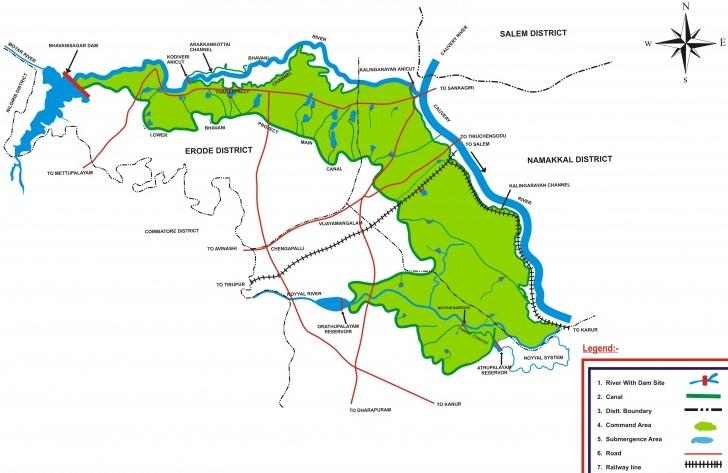
5. Lower Bhavani Project Command (Figure 1): The main canal is having a length 124 miles irrigating a total ayacut of 83,770 hectares (2,07,000 acres) mostly lying in Sathy, Gobi, Bhavani, Perundurai, Erode, Kangayem taluks of Erode District and Karur taluk of Karur District. The main canal is having about 1120 KM (700 miles) of distributaries and 1920 KM (1200 miles) of field bothies to cater the needs of the ayacuts.
The canal is capable of carrying 2300 cusecs. This is the maximum required at peak period of irrigation. Irrigation period for ayacut under this scheme is 15th August to 15th March. (First turn 15th August to 15th December, Second turn 16th December to 15th March). The scheme contemplated dry crops. But as per the request of the ayacutdars the Government in G.O.Ms.No. 2367 PWD dt 21.09.1964 have ordered to raise the wet crops in First Turn and dry crops in second turn.
2.7. Date of Opening and Closing of the Reservoir:
LBP Main Canal: Under the present seasonal sluice turn systems, supply of water is normally allowed in two separate seasons. First season starts from 15th August to 15th December and the second season from 15th December to 15th March.
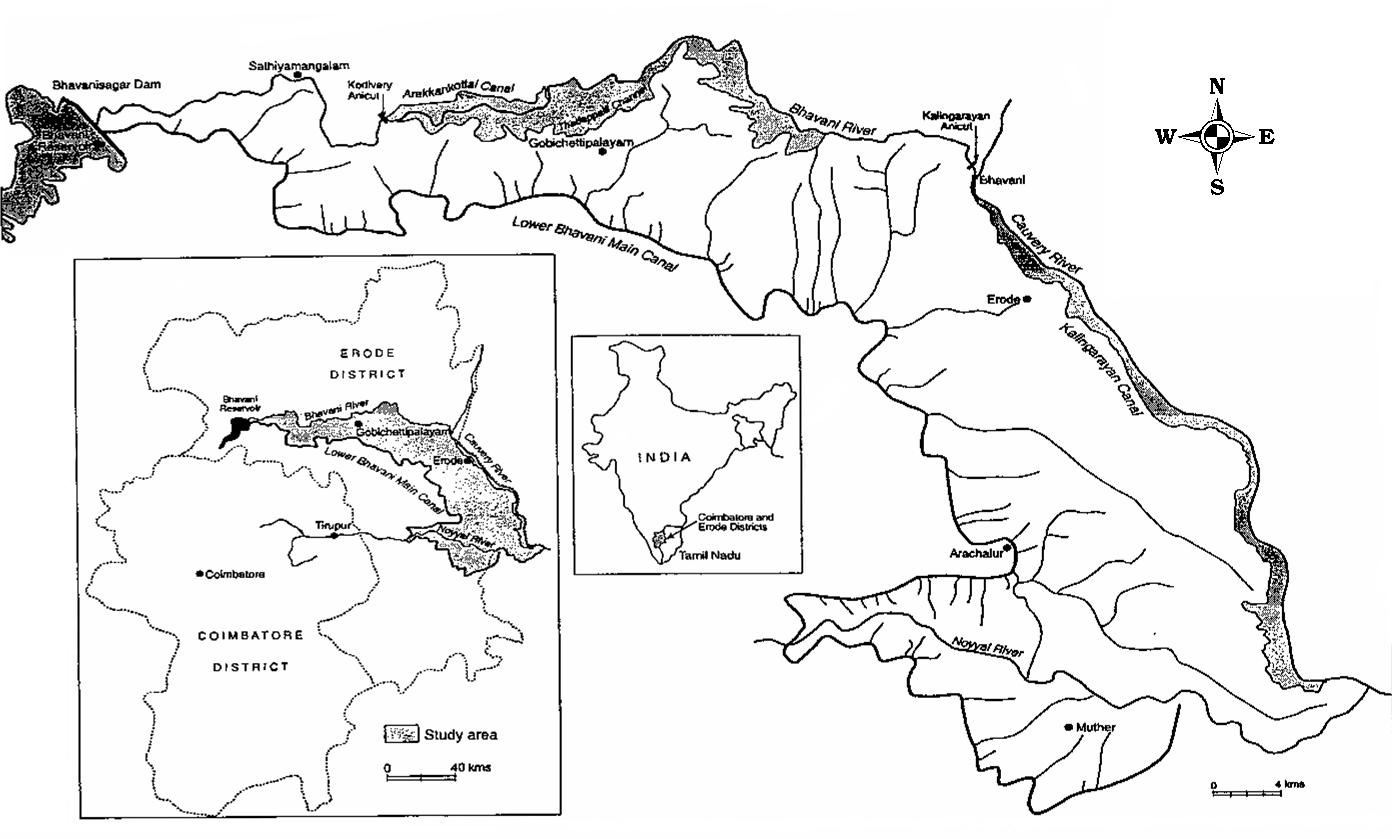
FIGURE 1. MAP OF LOWER BHAVANI COMMAND
2.8 Major constraints in Lower Bhavani sub basin
The success of agriculture yet depends on the successful monsoons. Frequent monsoon failures, low and uncertain rainfall and its skewed distribution affect the tempo of agricultural growt
Uneconomic size of a very large number of marginal and small farms, low economic status of the farmers and the low literacy level among farmers affect the full adoption of scientific farming and hence the agricultural production
Low and skewed distribution of rainfall and heavy down-pour in a few days especially during north – east monsoon and consequent flash floods occurring often and inadequate infrastructure to control and store the flood water, damages the standing crops heavily and affects the production.
Price volatility with high fluctuations and non-remunerative prices of farm products and consequent non-profitability of the farm business. This could lead to farmers quitting the agricultural profession itself, once for all.
The out – breaks of pests and diseases are often recurring in certain endemic areas of the State. These pose the threat to the crops leading to complete loss to many farmers.
In the recent years, due to heavy pumping of ground-water especially in summer and early kharif seasons, the reversal of ground water flow results in sea-water intrusion in the inlands along the coastal belt and consequently making the bore well as well as the open well-water, unfit for crop production and drinking. Many farmers in fact, abandoned the cultivation of especially the kharif crop, due to sea-water intrusion along the coastal belt
The inter-state disputes on the major irrigation systems like Cauvery, Mullai Periyar, Palar, etc. affect the agricultural growth of the State to a great degree and
Fast urbanization and industrialization and indiscriminate conversion of agricultural land to non-agricultural purposes, pose a great threat of contraction of land put to agricultural uses and consequent reduction in production.
3. Field activities
3.1. Productivity enhancement in rice (GM - SRI)
Rice is a major cereal crop in Erode district. The current average productivity is 4555 kg/ha. In Erode district the yield obtained in the progressive farmers field was highest (5765 kg/ha) than the average yield (4555 kg/ha) at farm level. The overall yield gap was calculated as 1210 kg/ha.
Technology Interventions:
In Lower Bhavani Sub Basin to reduce the yield gap and to achieve the potential yield in rice the productivity level will be augmented by in-situ incorporation of crop for improving soil health, introduction of high yielding varieties (Co 51), adopting reduced seed rate (10 kg/ha) through machine transplanting, Integrated Nutrient Management (INM), Integrated Pest and Disease Manageme
Greenmanure application is a must to maintain the organic carbon content and humus in soil so that soil problems like salinity can be prevented; soil nutrient availability is enhanced; activity of beneficial macro and microbial organisms is favored. Hence this technology is to be popularized before raising rice cropto show because the farmers on the merits of maintaining the soil health for better crop bio-environment
Safe Alternate Wetting and Drying Irrigation (safe AWDI) through field water tube is showing promise in addressing the problems of water scarcity, high energy usage and environmental degradation. Safe Alternate Wetting and Drying (safe AWD) is a water-saving technology that lowland (paddy) rice farmers can apply to reduce their water use in irrigated fields. After irrigation, the depth of ponded water will gradually decrease. When the ponded water has dropped to 10 cm below the surface of the soil, irrigation should be applied to re-flood the field with 5 cm of ponded water. From one week before to one week after flowering, ponded water should always be kept at 5 cm depth. After flowering, during grain filling and ripening, the water level can drop again to 10 cm below the surface before re-irrigation. It is a promising tool to the farmers to regulate the irrigation as per demand driven approach.
Action plan:
Technological demonstrations will be conducted in 110 ha in Lower Bhavani sub basin during 2017 - 2023 (split up details over the year is enclosed) with a budget outlay of Rs. 8.80 lakhs. The interventions will be implemented through crop demonstrations with the judicious supply of inputs. In rice, productivity enhancement will be popularized through exposure visits (2 nos), organizing tillering, harvest mela (5-10 nos) etc,
| S.No. | Technology | Total area (ha) | Unit cost (Rs.) | Total cost(in lakhs) |
|---|---|---|---|---|
| 1 | Green Manure - Paddy (SRI) | 110 | 8000 | 8.80 |
Details of Unit Cost for Green Manure
| S. No. | Particulars | Amount (Rs.) |
|---|---|---|
| 1. | Seed cost 40 kg/ha @ Rs. 50/kg | 2000.00 |
| Grand Total | 2000.00 |
Details of Unit Cost for Rice
| S. No | Particulars | Amount(Rs.) |
|---|---|---|
| 1 | Cost of Soil testing | 20.00 |
| 2 | Seed cost - 10 kg / ha @ Rs.30/kg | 300.00 |
| 3 | Cost of nursery raising | - |
| 4 | Cost of fertilizers (150:50:50 kg NPK / ha) | |
| Urea - 300 kg/ha @ Rs.6 /kg | 1,800.00 | |
| Muriate of Potash – 80 kg @ Rs.16/kg | 1,280.00 | |
| ZnSO4 25 kg @ Rs.40/kg | 1,000.00 | |
| 5 | Bio fertilizer & Bio inoculants | 1,600.00 |
| Grand Total | 6,000.00 |
3.2. Pulse seed production programme: Production of TFL Seeds under farmers participatory approach to produce quality pulse seed
Among major production constraints, availability of good quality seed of improved varieties is a major constraint in enhancing production and productivity of pulses. In Tamil Nadu, pulses are cultivated in an area of 8.16 lakh ha with the productivity of 755 kg/ha. The aim is to produce good quality seeds by the farmers through formation of village clusters and make them available to the farmers with other sub basins.
Technical Interventions:
For enhancing the quality seed production in pulses, the interventions like use of improved high yielding synchronized maturing varieties, Seed priming/pelleted seeds, maintaining a plant population of 33 per sq. metre, line sowing or drill sowing (30 x 10 cm), Seed treatment with fungicides and bio fertilizers, increased seed rate of 30 kg/ha. nutrient recommendation of 25 : 50 : 25 : 20 kg NPKS per ha, Foliar spray of 2 % DAP twice at 30 and 45 days after sowing, pre emergence application of pendimethalin @ 1 kg/ha followed by hand weeding and integrated pest and disease management to be practiced in Lower Bhavani sub basin areas.
Action Plan:
Demonstrations of technical intervention proposed in black gram and green gram through formation of village clusters in LBP sub basin will be taken up in 70 ha with an allocation of Rs.4.20 lakhs over the five years from 2017 to 2022 (split up details over the year). The farmers will be given hands on training on scientific methods of quality seed production for meeting their own requirement.
Efforts will be made to motivate the farmers to adopt the improved production technologies in pulse crops by organizing awareness camp cum training programmes (6 nos), exposure visits (2 nos) and field day (10 nos).
| S.No. | Technology | Total area (ha) | Unit cost (Rs.) | Total cost(in lakhs) |
|---|---|---|---|---|
| 1 | Production of TFL Seeds under farmers participatory approach to produce quality pulse seeds(Black gram/ Green gram) | 70 | 6000 | 4.20 |
Details of Unit Cost: TFL Seeds
| S. No | Particulars | Amount (Rs.) |
|---|---|---|
| 1. | Cost of Soil testing | 20.00 |
| 2. | Seed cost with seed treatment - 20 kg / ha @ Rs.150/kg | 3,000.00 |
| 3. | DAP 25 kg / ha @ Rs.22.50/kg | 560.00 |
| 4. | Pulse Wonder 2 kg/ha @ Rs.220/kg | 440.00 |
| 5. | Cleaning and Packaging of seeds | 1,000.00 |
| 6. | Bio fertilizers and Bio inoculants | 980.00 |
| Grand Total | 6,000.00 |
3.3. Improved Cultivation Practices for Enhancing Production in Oilseed (Groundnut/ Gingelly)
In Tamil Nadu, among the oilseed crops, groundnut is one of the most important crops i.e. 40 per cent of total area. The groundnut was grown under irrigated and un-irrigated conditions with low productivity. Many high yielding varieties have been released for cultivation, but their adoption by farmers is minimal.
Since the productivity of oilseed crop in the Erode district is low due to non-adoption of improved package of practices, efforts have to be made through large scale field demonstrations to introduce new high yielding varieties and improved production technologies to increase productivity of oilseed crops in the district
Technology Interventions:
The interventions like introduction of high yielding varieties (VRI 8, Co 6 & TMV 13), seed treatment with Trichoderma viride @ 4g/kg (or) Pseudomonas fluorescence @ 10g/kg of seeds + Rhizobium seed treatment @ 600g/ha, line sowing at 5 cm depth by using seed drill (or) line sowing with rope at 30 X 10 cm (33 plants/m2), soil test based fertilizer application or blanket recommendation of 25 : 50 : 75 kg NPK/ha and application of FYM @12.5 t/ha, gypsum application of 400 kg/ha (200 kg at basal and 200 kg at second hand weeding followed by earthing up), application of micro nutrient mixture 12.5 kg/ha with enough dry sand to make a total quantity of 50 kg/ha and broadcast evenly after sowing not incorporating the micronutrient mixture to the soil, the spraying of micronutrient spray with DAP 2.5 kg + Ammonium Sulphate 1kg + Borax 50g in 37.5 litres of water and left overnight; the supernatant collected; made to 500 litre; mix 350ml Planofix and spray per ha during 25th and 35th DAS, spraying of pre emergence herbicide, pendimethalin @ 1kg/ha applied on third day after sowing through flat fan nozzle with 500 l of water/ha followed by irrigation and post emergence herbicide pray imazethapyr @ 50g/ha at 20-30 days after sowing based on weed density.
Action Plan:
The proposed demonstration will be conducted in groundnut with a physical target of 20 ha with a budget outlay of Rs.1.00 lakh for six years (2017 - 2023) in Lower Bhavani sub basin (split up details over the year is enclosed in annexure).
Besides this, efforts will be made to motivate the farmers to adopt the improved production technologies in oil seed crops by organizing awareness camp cum training programmes (6 nos), exposure visits (2 nos) and field day (10 nos).
The machineries like seed drill (2 Nos), garden land weeder (2 nos), decardicator (2 nos) will be purchased and supplied in villages where the large scale demonstration being done.
| S.No. | Technology | Totalarea (ha) | Unit cost (Rs.) | Total cost(in lakhs) |
|---|---|---|---|---|
| 1 | Oil seed cultivation with improved practices (Groundnut) | 20 | 5000 | 1.00 |
Details of Unit Cost: Oil seeds
| S. No | Particulars | Amount(Rs.) |
|---|---|---|
| 1. | Cost of Soil testing | 20.00 |
| 2. | Gypsum 400 kg / ha @Rs.5/kg | 2,000.00 |
| 3. | Fertilizer cost | 1,500.00 |
| 4. | Pheromone trap and lure for Spodoptera litura | 730.00 |
| 5. | Micro nutrient spray (DAP–2.5 kg, Ammonium sulphate – 1 kg, Borax – 500 gm and planofix–375 Ml) @ Rs.250 for 3 sprays. | 750.00 |
| Grand Total | 5,000.00 |
3.4. Sustainable Sugarcane Initiative (SSI)
Sustainable Sugarcane Initiative (SSI), an innovative set of agronomic practices, that leaves reduced ecological footprint, is catching up very fast among the sugarcane growers. The SSI will most likely become the standard planting method owing to its yield advantage, reduced use of water and other inputs. Coordinated efforts of various sectors will accelerate the process of up scaling of SSI.
Technology interventions:
Interventions includes chip bud seedlings (25 days old ), spacing will be 5x2 feet, drip irrigation, removal of mother shoots, split application of water soluble fertilizers through fertigation, growing of intercrops.
Action plan:
Large scale demonstration on Sustainable Sugarcane Initiative (SSI) will be adopted in an area of 32 ha with a budget out lay of Rs. 32.00 lakhs at Lower Bhavani sub basin area (split up details over the year is enclosed).
This technology will be motivated among the farmers by organizing awareness camp cum training programmes (6 nos), exposure visits (2 nos) and field day (12 nos).
| S.No. | Technology | Total area (ha) | Unit cost (Rs.) | Total cost(in lakhs) |
|---|---|---|---|---|
| 1 | SSI | 32 | 100000 | 32.00 |
Details of Unit Cost Split-up for SSI
| Details of Unit Cost Split-up for SSI | ||
|---|---|---|
| S. No | Particulars | Amount (Rs.) |
| 1. | Drip cost as per the Govt. norms @ 75% subsidy | 64,200.00 |
| 2. | Cost of Seedlings/ha (15000 Nos/ha) @ Rs.1.5 | 22,500.00 |
| 3. | Water Soluble fertilizers | |
| 12:61:00 – 100 kg @ Rs.100/kg | 10,000.00 | |
| 00:00:50 – 225 kg @ Rs.75/kg | ||
| 4. | Bio Fertilizers & Bio pesticide | 1,550.00 |
| 5. | Sugarcane booster 5 kg/ha @ Rs.350/kg | 1,750.00 |
| Grand Total | 1,00,000.00 |
3.5. Production of Vegetable under precision farming mode by adopting IPM concept/Drip Irrigation in Rice
To maximize the productivity of Vegetables and Rice encourages the farmers to install drip irrigation for banana cultivation and adopt fertigation. Farmers can get at least 20 to 35 per cent increase in the yield if they adopt these modern methods.
Technology interventions:
Micro irrigation technologies especially drip fertigation through water soluble fertilizers, Integrated Nutrient Management (INM), Integrated Pest and Disease Management practices will be adopted for judicious utilization of other inputs, increase water productivity, crop productivity and profitability.
Action Plan:
Precision farming in Vegetable and Rice demonstration will be laid in an area of 60 ha with an outlay of Rs.72.00 lakhs with the period of six years between 2017 - 2023 (split up details over the year is enclosed). Through this programme farmers will be supplied with elite seedlings and inputs viz., water soluble fertilizers. The drip fertigation system will be installed at approved rate for demo farmers.
| S.No. | Technology | Total area (ha) | Unit cost (Rs.) | Total cost(in lakhs) |
|---|---|---|---|---|
| 1 | Production of vegetables under precision farming mode by adopting of IPM concept | 60 | 120000 | 72.00 |
Details of Unit Cost Split-up – Vegetables
| S. No | Particulars | Amount (Rs.) |
|---|---|---|
| 1. | Drip cost as per the Govt. norms @ 75 % subsidy | 75,000.00 |
| 2. | Cost of Seed/Seedlings | 25,000.00 |
| 3. | Water Soluble fertilizers | |
| 19:19:19-100 kg @ Rs.75/kg | 7,500.00 | |
| Urea - 200 kg @ Rs.6/kg | - | |
| MAP-50 kg @ Rs.90/kg | 4,500.00 | |
| SSP-100kg @ Rs.7.5/kg | 750.00 | |
| 4. | Bio fertilizer | 1,750.00 |
| 5. | Mulching sheets & Laying | 5,500.00 |
| Grand Total | 1,20,000.00 |
3.6. Improving productivity of Red Gram under precision farming techniques including IPM approach / Red Gram under cropping sequence in vegetable
Transplanting method of red gram cultivation is one of the recently introduced techniques in the in Erode district and gaining importance in redgram growing farming community as it is said to improve both production and productivity. Though, the transplanting technology is good with respect to yield and returns, it was not spread to the expected level.
Technology interventions:
The technical interventions like drip fertigation with wider spacing (4x2 feet), of 25 days old poly bag seedlings, split application of water soluble fertilizers, growing of intercrops and integrated pest and disease management to be adopted for enhancing the productivit
Action plan:
The transplanted red gram demonstration will be conducted in Lower Bhavani sub basin with an area of 16 ha with budget out lay of 1.60 lakhs during the six years (2017 - 2023) period (split up details over the year is enclosed in annexure).
| S.No. | Technology | Total area (ha) | Unit cost(Rs.) | Total cost(in lakhs) |
|---|---|---|---|---|
| 1 | Red Gram under cropping sequence in vegetable | 16 | 10000 | 1.60 |
Details of Unit Cost Split-up – Red Gram
| S. No | Particulars | Amount (Rs.) |
|---|---|---|
| 1. | Cost of Seeds / Seedlings | 10000.00 |
| Grand Total | 10000.00 |
3.7. Promotion of Pesticide free vegetable cultivation (Promotion of Pesticide Free villages)
In Erode district major vegetable crops cultivated are tomato, brinjal, bhendi, onion, chillies, tapioca and yam. More and more people are choosing organic food, largely in an attempt to limit exposure to potentially harmful chemicals. Organics are believed to be safer, healthier and better for the environment. The 'pesticide-free' label may be used by farmers who don't apply any synthetic herbicides, insecticides, or fungicides to their crops, much like organic farmers.
Technology interventions:
The interventions like supply of quality green manure seeds through seed village concept, disease resistant or traditional varieties, crop specific biofertilizers, enriched FYM, biomineralizer for composting, vermicompost, humic acid, panchakavya through foliar application, organic fertigation, bio control agents for plant protection will be demonstrated in farmers holdings of Lower Bhavani sub basin.
Action plan
The pesticide free demonstrations will be conducted with a physical target of 65 ha with a budget outlay of Rs. 1.63 lakhs for six years (2017 - 2023) in Lower Bhavani sub basin (split up details over the year is enclosed in annexure).
Efforts will be made to motivate the farmers to adopt the pesticide free production technologies in vegetable crops by organizing awareness camp cum training programmes (6 nos), exposure visits (2 nos) and field day (10 nos).
This technology will be disseminated among the farmers by organizing awareness camp cum training programmes (4 nos), exposure visits (2 nos) and field day (8nos).
| S.No. | Technology | Total area (ha) | Unit cost (Rs.) | Total cost(in lakhs) |
|---|---|---|---|---|
| 1 | Promotion of Pesticide Free Vegetables in sub basins through climate resilience activity in model Bio villages known as pesticide free villages | 65 | 2500 | 1.63 |
4. Capacity Building & Information, Education & Communication
4.1. Capacity building
4.1.1. Training to stakeholders
Under this activity, imparting training to all the beneficiaries either as off-campus or as on-campus is planned
| S. No. | Particulars | Duration (days) | No/batch | Total batch | Total budget (lakhs) |
|---|---|---|---|---|---|
| 1. | Improved production technology through SRI | 1 | 50 | 10 | 1.00 |
| 2. | Improved production technology in pulses | 1 | 50 | 5 | 0.50 |
| 3. | Sustainable Sugarcane Initiative | 1 | 50 | 10 | 1.00 |
| 4. | Precision farming in vegetables | 1 | 50 | 10 | 1.00 |
| 5. | Precision farming in red gram | 1 | 50 | 5 | 0.50 |
| Total | 4.00 |
4.1.2. Exposure visit
In-order to have practical knowledge on various improved farming practices prevailing across the District and State, it has been proposed to expose the stakeholders by organizing educational tours for having better cross learning. Places identified for exposure visit
| Purpose | Place of visit |
|---|---|
| SSI in Sugarcane | Sub basin areas of Erode district |
| Precision farming in Vegetables | Erode district |
| Precision farming in red gram | Erode district |
4.2. IEC including Awareness creation, documentation and IEC equipment
4.2.1. Organize awareness campaign
- Informal meetings with Farmers / Water Users Association through PRA methods – Focus group discussion and transect walk.
- Organizing informal meetings in sub basin villages
- Message on AIR / local cable TV
- Ensure transparency
- Explain about the scheme – organization objectives, activities, project contribution and farmers share
- Emphasis the role of stake holders in the project
- Project the expected benefit
Sustainability of clusters
- Link each cluster with local Non Governmental Organization
- Form bylaws for each cluster and practice Non agricultural activity (Thrift)
- Identify income generation activities for each cluster preferably agri based (eg) Vermi compost, seedling production, Mushroom cultivation, value addition.
Organizing field days at Harvest
- Involve all the members
- Provide the yield statistics by actual harvest in the presence of farmer
- Involve all the line department officials
- Organize informal exhibition at field on the field by depicting all the activities to achieve the productivity
- Involve local press people to give wide publicity
4.2.2. Documentation
- Maintenance of records and registers
- Field note for each activity
- Daily memorandum sheet
- Receipt and issue of inputs
- Technical observations on soil, water and crop
- Printing pamphlets about the scheme
- Wall paintings
4.2.3. IEC Equipments
Purchase of Laptop, Camera and computer accessories
4.2.4. Out sourcing charges on vehicles
- Expenditure on TA /DA for the purpose of TN-IAM Project
- Fuel bill of university vehicle utilized for the project
- Hire charges of university vehicle utilized for this purpose
5. Management Cost:
5.1. Outsourcing of technical staff
Outsourcing of technical staff is included in TNAU sub basin plan to carry out the field activities. Outsourcing staff has to cover the demo area in addition he / she should cover 200 – 250 hectares per year impact area or as zone of influence in the sub basin.
6. Year wise Activities
| S. No. | Particulars | Area (ha) | Total (ha) | |||||
| Iyear | II year | III year | IV year | V year | VI year | |||
| 1. | GM-SRI-Pulses | 20 | 30 | 35 | 25 | 0 | 0 | 110 |
| 2. | TFL seed production on pulses | 15 | 20 | 20 | 15 | 0 | 0 | 70 |
| 3. | Improved production technologies in groundnut | 5 | 5 | 5 | 5 | 0 | 0 | 20 |
| 4. | Sustainable Sugarcane Initiative (SSI) | 5 | 7 | 10 | 10 | 0 | 0 | 32 |
| 5. | Vegetable under precision farming and IPM concept | 15 | 15 | 15 | 15 | 0 | 0 | 60 |
| 6. | Red Gram under precision farming / IPM approach | 3 | 5 | 5 | 3 | 0 | 0 | 16 |
| Total | 63 | 82 | 90 | 73 | 0 | 0 | 308 | |
|---|---|---|---|---|---|---|---|---|
Total Budget (Year wise) for Lower Bhavani Sub basin
(P-Physical in ha, F-Financial rupees in lakh)
| S. No | Particulars | Unit cost Rs/ha | I Year | II Year | III Year | IV Year | V Year | VI Year | Total | |||||||
| I | A. Field Interventions | P | F | P | F | P | F | P | F | P | F | P | F | P | F | |
| 1 | GM-SRI | 8000 | 20 | 1.60 | 30 | 2.40 | 35 | 2.80 | 25 | 2.00 | 0 | 0.00 | 0 | 0.00 | 110 | 8.80 |
| 2 | TFL seed production on pulses | 6000 | 15 | 0.90 | 20 | 1.20 | 20 | 1.20 | 15 | 0.90 | 0 | 0.00 | 0 | 0.00 | 70 | 4.20 |
| 3 | Oil seed cultivation with improved practices | 5000 | 5 | 0.25 | 5 | 0.25 | 5 | 0.25 | 5 | 0.25 | 0 | 0.00 | 0 | 0.00 | 20 | 1.00 |
| 4 | Sustainable Sugarcane Initiative (SSI) | 100000 | 5 | 5.00 | 7 | 7.00 | 10 | 10.00 | 10 | 10.00 | 0 | 0.00 | 0 | 0.00 | 32 | 32.00 |
| 5 | Production of vegetable under precision farming mode | 120000 | 15 | 18.00 | 15 | 18.00 | 15 | 18.00 | 15 | 18.00 | 0 | 0.00 | 0 | 0.00 | 60 | 72.00 |
| 6 | Red Gram under cropping sequence | 10000 | 3 | 0.30 | 5 | 0.50 | 5 | 0.50 | 3 | 0.30 | 0 | 0.00 | 0 | 0.00 | 16 | 1.60 |
| 7 | Promotion of Pesticide Free vegetables | 2500 | 15 | 0.38 | 15 | 0.38 | 20 | 0.50 | 15 | 0.38 | 0 | 0.00 | 0 | 0.00 | 65 | 1.63 |
| B | Farm implements | |||||||||||||||
| 8 | Cono weeder | 1000 | 20 | 0.20 | 30 | 0.30 | 35 | 0.35 | 25 | 0.25 | 0 | 0.00 | 0 | 0.00 | 110 | 1.10 |
| Total (A+B) | 98 | 26.63 | 127 | 30.03 | 145 | 33.60 | 113 | 32.08 | 0 | 0.00 | 0 | 0.00 | 483 | 122.33 | ||
| II | IEC & CB | |||||||||||||||
| 1 | Training to stakeholders | 1.00 | 1.00 | 1.00 | 0.50 | 0.50 | 0.00 | 4.00 | ||||||||
| 2 | Exposure Visit | 0.50 | 0.50 | 0.50 | 0.00 | 0.00 | 0.00 | 1.50 | ||||||||
| 3 | Awareness Creation activities | 0.50 | 0.50 | 0.50 | 0.25 | 0.10 | 0.00 | 1.85 | ||||||||
| 4 | Documentation | 0.40 | 0.40 | 0.20 | 0.10 | 0.10 | 0.20 | 1.40 | ||||||||
| 5 | IEC equipments | 0.75 | 0.00 | 0.00 | 0.00 | 0.00 | 0.00 | 0.75 | ||||||||
| 6 | Outsourcing of vehicle and TA | 0.65 | 0.65 | 0.65 | 0.65 | 0.65 | 0.65 | 3.90 | ||||||||
| Total | 3.80 | 3.05 | 2.85 | 1.50 | 1.35 | 0.85 | 13.40 | |||||||||
| III | Management cost | |||||||||||||||
| 1 | Out sourcing of staff | 2.72 | 3.06 | 2.72 | 2.71 | 1.66 | 2.72 | 15.59 | ||||||||
| Over all total | 33.15 | 36.14 | 39.17 | 36.29 | 3.01 | 3.57 | 151.32 | |||||||||
|---|---|---|---|---|---|---|---|---|---|---|---|---|---|---|---|---|
Lower Bhavani Sub basin Abstract
| S.No | Intervention details | Unit cost Rs/ha | P | F |
|---|---|---|---|---|
| I | A.Field Interventions | |||
| 1 | GM-SRI | 8000 | 110 | 8.80 |
| 2 | TFL seed production on pulses | 6000 | 70 | 4.20 |
| 3 | Oil seed cultivation with improved practices | 5000 | 20 | 1.00 |
| 4 | Sustainable Sugarcane Initiative (SSI) | 100000 | 32 | 32.00 |
| 5 | Production of vegetable under precision farming mode by adopting IPM concept + Drip fertigation in Rice | 120000 | 60 | 72.00 |
| 6 | Improving productivity of Toor Dhal (Red Gram) under precision farming techniques including IPM approach / Red Gram under cropping sequence in vegetable | 10000 | 16 | 1.60 |
| 7 | Promotion of Pesticide Free villages/ vegetables in sub basins through climate resilience activity in model bio villages known as pesticide free village | 2500 | 65 | 1.63 |
| Total | 373 | 0.00 | ||
| B. Implements for farm mechanization | ||||
| 8 | Cono weeder | 1000 | 110 | 1.10 |
| Sub Total (A+B) | 483 | 122.33 | ||
| II | IEC & CB | |||
| 1 | Capacity Building (CB) | |||
| a) Training to stakeholders | 4.00 | |||
| b) Exposure Visit | 1.50 | |||
| 2 | IEC | |||
| a) Awareness Creation activities | 1.85 | |||
| b) Documentation | 1.40 | |||
| c) IEC equipment | 0.75 | |||
| d) Outsourcing of vehicle and TA | 3.90 | |||
| Sub Total II | 13.40 | |||
| III | Management cost | |||
| 1 | Out sourcing of technical staff | 15.59 | ||
| Sub Total III | 15.59 | |||
| Over all total (I+II+III) | 151.32 |