Lower Palar
About Krishi Vigyan Kendra, Virinjipuram
The Krishi Vigyan Kendra, Virinjipuram was established in the year 2004 under the administrative control of the Tamil Nadu Agricultural University, Coimbatore and funded by the Indian Council of Agricultural Research, New Delhi. KVK, Virinjipuram, is located in the North Eastern Agro climatic Zone of Tamil Nadu with the operational area of 20 administrative blocks under 11 Taluks of Vellore district that have distinct topographical and geophysical conditions.
KVK as “An Institutional Innovation of 21st century” – World Bank
1.1 Geographical Location and Profile
| Latitude | 12° 5' N |
|---|---|
| Longitude | 79° E |
| Total Area | 23.58 Hectares |
| Irrigated area | 15.30 Hectares |
| Rainfed | 08.28 Hectares |
| Soil type | Sandy loam |
| Soil pH | 7.8 |
| Average annual rainfall | 860mm |
| Mean Maximum Temperature | 33.1°C |
| Mean Minimum Temperature | 22.8°C |
| Meteorology | II Class Observatory |
1.2 Mandates
- Conducting on-farm testing to identify the location specificity of agricultural technologies under various farming systems.
- Organizing frontline demonstrations to establish production potential of various crops and enterprises on the farmers’ fields.
- Organizing need based training of farmers to update their knowledge and skills in modern agricultural technologies related to technology assessment, refinement and demonstration, and training of extension personnel to orient them in the frontier areas of technology development.
- Creating awareness about improved technologies to larger masses through appropriate extension programmes.
- Production and supply of good quality seeds and planting materials, livestock, poultry and fisheries breeds and products and various bio-products to the farming community.
- Work as resource and knowledge centre of agricultural technology for supporting initiatives of public, private and voluntary sector for improving the agricultural economy of the district.
1.3 Achievements
| Year | Achievements |
|---|---|
| 2012-13 | Best Stall award during District Agricultural Fair |
| 2014-15 | Best Extension Worker Award |
| 2015-16 | TNAU Best KVK Award Young Scientist Award |
| 2016-17 | ICAR National Best KVK Zonal Award |
1.4 Scientists Involved
| Dr.S.Joshua Davidson | Programme Co-ordinator TNIAMP Implementing Centre Head |
| Dr.G.Anand | Assistant Professor (Agrl. Extension) Scientist in-charge TNIAMP – Lower Palar Sub Basin |
2. About the Basin (Lower Palar Sub Basin)
The area is bounded by longitude E 79o 57’10” and E 80o12’10” and latitude N 12o28’30” and N 12o41’05”, Kancheepuram district in Tamil Nadu, India. The average annual rainfall is 1161.00 mm and temperature ranges from 20.9oC to 34.5oC. The climate of the region varies between arid and semi-arid region. The topography of the area is characterized by uniform and very gentle slope and the eastern part shows undulating rolling. The general elevation of the area ranges from 60m to 240 m above mean sea level with a gentle gradient from west to east. The area is mainly drained by Palar River flowing towards the eastern parts and finally confluences in to the Bay of Bengal. There is little small drainage in the Central part of the block contributing to the numerous tanks. Buckingham canal flows from northeast to south east part. All the tanks in this block are mainly fed by rainfall only.
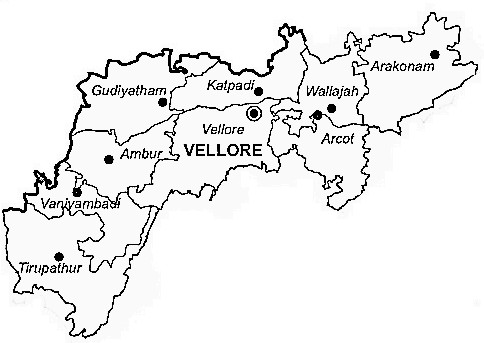
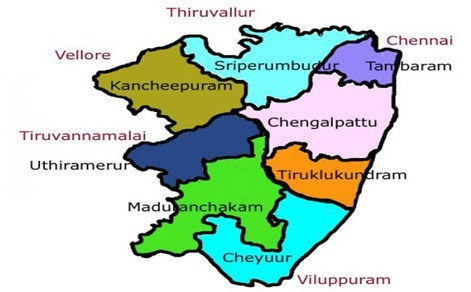
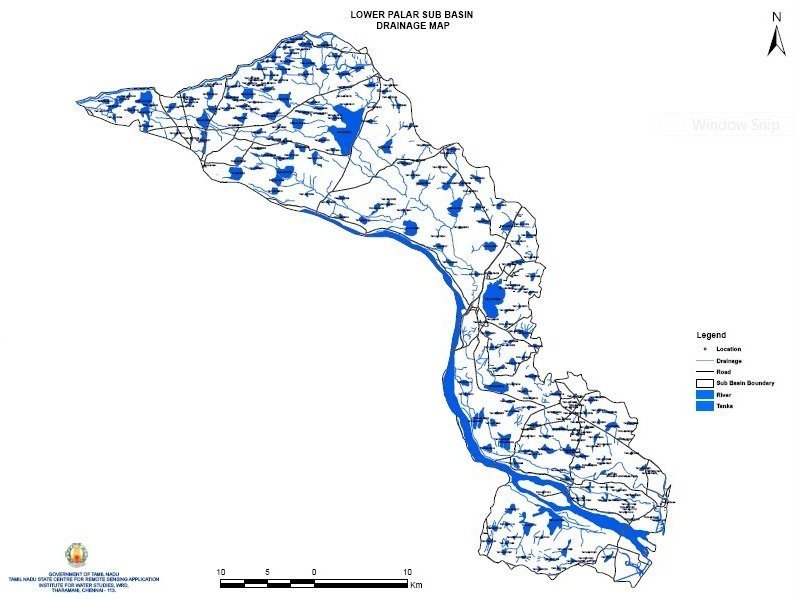
Lower Palar River Sub basin
2.1. Rainfall Pattern
The average Annual rainfall is 1161mm. The distribution of rainfall pattern is given below.
| S.No | Season | Normal Rainfall (in mm) | Seasonal Contribution (%) |
|---|---|---|---|
| 1 | Winter (Jan – Feb) | 29.5 | 3% |
| 2 | Summer (Mar – May) | 55.7 | 5% |
| 3 | South West Monsoon | 478.3 | 41% |
| 4 | North East Monsoon | 597.5 | 51% |
| Total | 1161.0 | 100% |
2.2. Major Soil Types
| S.No | Soil Type | Blocks Covered |
|---|---|---|
| 1 | Clay soil | Pavinjur and Chithamur |
| 2 | Red loamy soil | Sirukavripkkam, Walajabad, Uthiramerur, Kattangkolathur, Tiruporur, Tirukalukundram, Sriperumbudhur, Padapai and Chittlapakkam |
| 3 | Alluvial soil | Kancheepuram, Madhuranthagam |
| 4 | Problem Soil | Thirukazhikundram, Lathur |
Ayacut area
The registered ayacut area (Command Area) of Lower Palar Sub Basin is 27850.09 ha. Out of which 17015.41 ha is fully irrigated and 5104.62 ha is partially Irrigated this gives a total cropped area of 22120.03 ha. The remaining area of 5730.06 ha is gap area out of which 1298.00 ha is under Non Agriculture Purpose and 4432.06 ha area under cultivable fallow. The Major crops of the sub-basin are Paddy, Millets, Pulses Groundnut, Sesame and Sugar cane apart from these crops, perennial tree crops like Coconut, Mango, Sapota, Guava, Vegetables and Flowers.
2.4. Irrigation Potential of Lower Palar Sub Basin
TNIAMP (Tamil Nadu Irrigated Agriculture Modernization Project) in Lower Palar Sub Basin of Kancheepuram district is to be implemented in 7 Blocks namely Sirukaveripakkam, Walajabad, Sriperumbadur, Kundrathur, Kattankolathur, Lathur and Thirukazhikundram. The sub basin area is divided into 53 clusters consist of 253 number of tanks.
| Lower Palar Sub basin | Command Area (Ayacut) in hectares |
|---|---|
| Fully irrigated area | 17015.41 |
| Partially irrigated area | 5104.62 |
| Gap | 5730.06 |
| Total Ayacut | 27850.09 |
2.5. Block wise Tanks – Abstract
| SNo. | Taluk | Block | No. of Tanks | Ayacut in Ha. |
|---|---|---|---|---|
| 1. | Kancheepuram | Kancheepuram | 17 | 2336.99 |
| 2. | Walajabad | Walajabad | 63 | 7636.11 |
| 3. | Sriperumpudur | Sriperambathur | 24 | 1552.94 |
| 4. | Kundrathur | Thambaram | 04 | 506.33 |
| 5. | Kattankulathur | Chengalpattu | 28 | 2688.11 |
| 6. | Thirukkalukundram | Thirukkalukundram | 97 | 4985.85 |
| 7. | Lathur | Cheyyur | 20 | 2279.23 |
| Total | 253 | 21985.56 |
2.6. Details of Tanks under Retroactive Funding
| S.No | Blocks | No. of Tanks | Ayacut in ha. |
|---|---|---|---|
| 1. | Thirukkalukunram, Walajabad, Sriperambathur and Lathur | 35 | 5694.91 |
2.7. Anaicut Details
Only Thollazai Maduvau and Kollamedu have direct Ayacut of 169.59 ha. Therefore the total ayacut area of 27850.06 is the study area proposed for the TNIAMP interventions.
2.8. Cropping Pattern (consolidated)
| Name of the sub Basin | Lower Palar Fully Irrigated - 17015.41ha |
|---|---|
| Nodal District | Kancheepuram Partially Irrigated - 5104.62ha |
| Registered Ayacut Area | 27850.06 Gap - 5730.06ha |
| Total Ayacut Area | 27850.06 Ha |
| S.No | Crop | Without Project | With Project | Increasing | |||||||
| FI | PI | RF/G | Total | FI | PI | RF/G | Total | ||||
| I | Perennial crop | ||||||||||
| 1 | Coconut | 135 | 216 | 0 | 351 | 351 | 0 | 0 | 351 | 0 | |
| 2 | Mango | 0 | 85 | 0 | 85 | 85 | 0 | 0 | 85 | 0 | |
| 3 | Guava | 0 | 49 | 0 | 49 | 49 | 0 | 0 | 49 | 0 | |
| 4 | Cashew | 0 | 0 | 0 | 0 | 0 | 0 | 0 | 0 | 0 | |
| 5 | Casurina | 0 | 0 | 0 | 0 | 0 | 0 | 0 | 0 | 0 | |
| 6 | Flowers\Tube Rose | 0 | 0 | 0 | 0 | 0 | 0 | 0 | 0 | 0 | |
| 7 | Fodder | 0 | 0 | 0 | 0 | 0 | 0 | 0 | 0 | 0 | |
| Total | 135 | 350 | 0 | 485 | 485 | 0 | 0 | 485 | 0 | ||
| II | Annual Crop | ||||||||||
| 1 | Sugarcane | 365 | 434 | 0 | 799 | 799 | 0 | 0 | 799 | 0 | |
| 2 | Banana | 35 | 61 | 0 | 96 | 96 | 0 | 0 | 96 | 0 | |
| 3 | T.C. Banana | 0 | 0 | 0 | 0 | 0 | 0 | 0 | 0 | 0 | |
| Total | 400 | 495 | 0 | 895 | 895 | 0 | 0 | 895 | 0 | ||
| III | 1st crop | ||||||||||
| 1.a | Paddy | 6563 | 0 | 0 | 6563 | 0 | 0 | 0 | 0 | 0 | |
| 1.b | Paddy – SRI | 2766 | 0 | 0 | 2766 | 19000 | 0 | 0 | 19000 | 9671 | |
| 2 | Maize | 16 | 0 | 0 | 16 | 100 | 0 | 0 | 100 | 84 | |
| 3 | Ragi | 69 | 0 | 0 | 69 | 1500 | 0 | 0 | 1500 | 1431 | |
| 4 | Cumbu | 7 | 0 | 0 | 7 | 0 | 0 | 0 | 0 | -7 | |
| 5 | Minor Millets | 2 | 0 | 0 | 2 | 50 | 0 | 0 | 50 | 48 | |
| 6 | Black gram | 236 | 0 | 0 | 236 | 1081 | 0 | 0 | 1081 | 845 | |
| 7 | Green Gram | 79 | 0 | 0 | 79 | 250 | 0 | 0 | 250 | 171 | |
| 8 | Red Gram | 3 | 0 | 0 | 3 | 0 | 0 | 0 | -3 | ||
| 9 | Groundnut | 146 | 0 | 0 | 146 | 3000 | 0 | 0 | 3000 | 2854 | |
| 10 | Gingelly | 54 | 0 | 0 | 54 | 250 | 0 | 0 | 250 | 196 | |
| 11 | Tomato | 0 | 0 | 0 | 0 | 0 | 0 | 0 | 0 | ||
| 12 | Bhendi | 0 | 42 | 0 | 42 | 100 | 0 | 0 | 100 | 58 | |
| 13 | Brinjal | 0 | 59 | 0 | 59 | 100 | 0 | 0 | 100 | 41 | |
| 14 | Radish | 0 | 0 | 0 | 0 | 0 | 0 | 0 | 0 | 0 | |
| 15 | Chillies | 0 | 46 | 0 | 46 | 100 | 0 | 0 | 100 | 54 | |
| 16 | Beans | 0 | 0 | 0 | 0 | 0 | 0 | 0 | 0 | 0 | |
| 17 | Veg Cowpea | 0 | 0 | 0 | 0 | 0 | 0 | 0 | 0 | 0 | |
| 18 | Corinader | 0 | 0 | 0 | 0 | 0 | 0 | 0 | 0 | 0 | |
| 19 | Flowers | 0 | 42 | 0 | 42 | 100 | 0 | 0 | 100 | 58 | |
| 20 | Fodder | 0 | 16 | 0 | 16 | 50 | 0 | 0 | 50 | 34 | |
| 21 | Non Agric Purpose | 0 | 0 | 1298 | 1298 | 0 | 0 | 1298 | 1298 | 0 | |
| 22 | Fallow | 0 | 0 | 4941 | 4941 | 0 | 0 | 0 | 0 | ||
| Total | 9941 | 205 | 6239 | 16385 | 25681 | 0 | 1298 | 26979 | 15535 | ||
| Grand Total (I+II+III) | 10476 | 1050 | 6239 | 17765 | 27061 | 0 | 1298 | 28359 | 15535 | ||
| IV | 2 nd crop | ||||||||||
| 1.a | Paddy | 13668 | 2993 | 0 | 16861 | 0 | 0 | 0 | 0 | 0 | |
| 1.b | Paddy – SRI | 2232 | 0 | 2232 | 21000 | 0 | 0 | 21000 | 6571 | ||
| 2 | Ragi | 0 | 196 | 0 | 196 | 550 | 0 | 0 | 550 | 354 | |
| 3 | Maize | 0 | 6 | 0 | 6 | 50 | 0 | 0 | 50 | 44 | |
| 4 | Minor Millets | 0 | 0 | 0 | 0 | 50 | 0 | 0 | 50 | 50 | |
| 5 | Blackgram | 0 | 114 | 0 | 114 | 250 | 0 | 0 | 250 | 136 | |
| 6 | Greengram | 0 | 23 | 0 | 23 | 50 | 0 | 0 | 50 | 27 | |
| 7 | Groundnut | 0 | 122 | 0 | 122 | 300 | 0 | 0 | 300 | 178 | |
| Total | 15900 | 3454 | 19554 | 22250 | 0 | 0 | 22250 | 7360 | |||
| V | 3rd crop | ||||||||||
| 1.a | Paddy | 12955 | 0 | 0 | 12955 | 0 | 0 | 0 | 0 | 0 | |
| 1.b | Paddy – SRI | 3525 | 0 | 0 | 3525 | 21600 | 0 | 0 | 21600 | 5120 | |
| 2 | Ragi | 0 | 375 | 0 | 375 | 464 | 0 | 0 | 464 | 89 | |
| 3 | Minor Millets | 0 | 6 | 0 | 6 | 27 | 0 | 0 | 27 | 21 | |
| 4 | Blackgram | 0 | 272 | 0 | 272 | 450 | 0 | 0 | 450 | 178 | |
| 5 | Greengram | 0 | 155 | 0 | 155 | 250 | 0 | 0 | 250 | 95 | |
| 6 | Groundnut | 0 | 2950 | 0 | 2950 | 3500 | 0 | 0 | 3500 | 550 | |
| 7 | Gingelly | 0 | 173 | 0 | 173 | 420 | 0 | 0 | 420 | 247 | |
| 8 | Brinjal | 0 | 56 | 0 | 56 | 100 | 0 | 0 | 100 | 44 | |
| 9 | Bhendi | 0 | 47 | 0 | 47 | 100 | 0 | 0 | 100 | 53 | |
| 10 | Chillies | 0 | 79 | 0 | 79 | 150 | 0 | 0 | 150 | 71 | |
| Total | 16480 | 4113 | 0 | 20593 | 27061 | 0 | 0 | 27061 | 6468 | ||
| Great Grand Total | 42856 | 8617 | 6239 | 57712 | 76372 | 0 | 1298 | 77670 | 29363 | ||
| Cropping Intensity | 178% | ||||||||||
2.9. Crop Wise important Constraints and possible interventions
Based on walk through survey conducted and secondary data collected from Government records, the constraints faced by the farmers of Lower Palar sub basin are documented crop wise and respective interventions proposed.
3. Field interventions
3.1. Green Manure - Paddy (SRI)
Green manure application is a must to maintain the organic carbon content and humus in soil so that soil problems like salinity can be prevented; soil nutrient availability is enhanced; activity of beneficial macro and microbial organisms is favored. Hence this technology is to be popularized before raising rice crop to showcause the farmers on the merits of maintaining the soil health for better crop bio-environment.
| S.No | Technology | Total area ha) | Unit cost (Rs.) | Total cost (in lakhs) |
|---|---|---|---|---|
| 1. | Green Manure - Paddy (SRI) | 545 | 8000 | 43.60 |
Details of Unit Cost Split-up for Green Manure
| S.No | Particulars | Amount (Rs.) |
|---|---|---|
| 1. | Seed cost 40 kg/ha @ Rs. 50/kg | 2,000.00 |
| Grand Total | 2,000.00 |
Details of Unit Cost Split-up for Rice
| S. No | Particulars | Amount(Rs.) |
|---|---|---|
| 1 | Cost of Soil testing | 20.00 |
| 2 | Seed cost - 10 kg / ha @ Rs.30/kg | 300.00 |
| 3 | Cost of nursery raising | - |
| 4 | Cost of fertilizers (150:50:50 Kg NPK / ha) | |
| Urea - 300 kg/ha @ Rs.6/kg | 1,800.00 | |
| Muriate of Potash – 80 kg @ Rs.16/kg | 1,280.00 | |
| ZnSO4 25 kg @ Rs.40/kg | 1,000.00 | |
| 5 | Bio fertilizer & Bio inoculants | 1,600.00 |
| Grand Total | 6,000.00 |
3.1.1. SRI
| S.No | Technology | Total area (ha) | Unit cost (Rs.) | Total cost (in lakhs) |
|---|---|---|---|---|
| 1 | SRI | 495 | 6000 | 29.70 |
Water Management for Sustainable Paddy Production through AWD
Use of water saving technologies viz., Alternate Wetting and Drying (AWD) method of irrigation up to panicle initiation stage to increase Water Use Efficiency (WUE) and grain yield.
How to implement AWD?
A practical way to implement AWD safely is by using a ‘Field Water Tube’ (‘Pani Pipe’) to monitor the water depth on the field. The Field water tube will be place @ 3 per hectare since most of the paddy field in this Ayacut are fragmented.
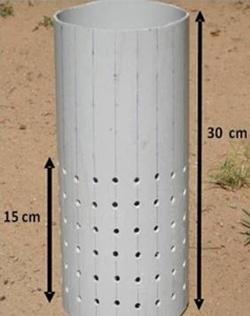
Field Water Tube made up of PVC. Note the holes on all sides upto 15 cm height.
Details of Unit Cost Split-up for Rice
| S.No | Particulars | Amount(Rs.) |
|---|---|---|
| 1 | Cost of Soil testing | 20.00 |
| 2 | Seed cost - 10 Kg / ha @ Rs.30/kg | 300.00 |
| 3 | Cost of nursery raising | - |
| 4 | Cost of fertilizers (150:50:50 Kg NPK / ha) | |
| Urea - 300 kg/ha @ Rs.6/kg | 1,800.00 | |
| Muriate of Potash – 80 kg @ Rs.16/kg | 1,280.00 | |
| ZnSO4 25 kg @ Rs.40/kg | 1,000.00 | |
| 5 | Bio fertilizer & Bio inoculants | 1,600.00 |
| Grand Total | 6,000.00 |
3.2. Pulse seed production programme: Production of TFL Seeds under farmers’ participatory approach to produce quality pulse seeds
In Kancheepuram district pulses are grown in an area of 1545 ha concentrating mostly in the seven blocks located at the Lower Palar sub basin. Presently the farmers are widely using the existing low yielding old varieties namely T-9, ADT 5, VBN 3, VBN 4 which are highly susceptible to Yellow Mosaic Virus (YMV) this may be due to the non availability of high yielding YMV resistant varieties in time. Hence, with an objective to increase the availability of High Yielding with YMV resistant quality, this particular intervention on pulses seed production is proposed.
| S.No | Technology | Total area (ha) | Unit cost (Rs.) | Total cost (in lakhs) |
|---|---|---|---|---|
| 1 | Pulses seed production hub (Black gram/ Green gram) | 150 | 6000 | 9.00 |
Details of Unit Cost Split-up for TFL Seeds
| S. No | Particulars | Amount (Rs.) |
|---|---|---|
| 1. | Cost of Soil testing | 20.00 |
| 2. | Seed cost with seed treatment - 20 kg / ha @ Rs.150/kg | 3,000.00 |
| 3. | DAP 25 kg / ha @ Rs.22.50/kg | 560.00 |
| 4. | Pulse Wonder 2 kg/ha @ Rs.220/kg | 440.00 |
| 5. | Cleaning and Packaging of seeds | 1,000.00 |
| 6. | Bio fertilizers and Bio inoculants | 980.00 |
| Grand Total | 6,000.00 |
3.3 Area enhancement, Area Expansion in Pulses and productivity enhancement of Pulses under crop diversification in gap areas
In-order to effectively utilize the available cultivable gap area in the Ayacut, the short duration and less water requirement crops like pulses (Black gram / Green gram) are to be promoted for area expansion which will ultimately increase the livelihood of the farmers of Lower Palar sub basin.
| S.No | Technology | Total area (ha) | Unit cost (Rs.) | Total cost (in lakhs) |
|---|---|---|---|---|
| 1 | Area expansion of pulses (Black gram/ Green gram) | 300 | 5,000 | 15.00 |
Details of Unit Cost Split-up for Area expansion in Pulses
| S. No | Particulars | Amount (Rs.) |
|---|---|---|
| 1. | Cost of Soil testing | 20.00 |
| 2. | Seed cost with seed treatment - 20 kg / ha @ Rs.150/kg | 3,000.00 |
| 3. | DAP 25 kg / ha @ Rs.22.50/kg | 560.00 |
| 4. | Pulse Wonder 2 kg/ha @ Rs.220/kg | 440.00 |
| 5. | Bio fertilizers and Bio inoculants | 980.00 |
| Grand Total | 5,000.00 |
3.4 Improved Cultivation Practices for Enhancing Production in Oilseed (Groundnut / Gingelly)
The details of the constrains faced by the groundnut farmers in the Lower Palar as below
- Specific varieties intended for specific season are not being adopted by the farmers as per the recommendations due to non availability of seeds during the season which leads to low productivity.
- Due to poor seed multiplication rate (1:4 or 1:5) in groundnut, the coverage of area by a particular variety is very poor compared to cereals. Viability of the seed is also lost within a short period.
- Wide fluctuation in market price due to import policy leads to lesser area coverage by the crop as well as the varieties.
- Hand weeding at optimum stage was not done due to scarcity of labours
- Earthing-up is not done by many farmers due to scarcity of labours.
- Direct purchase of groundnut pods (wet) by the traders delinks the quality of seed and supply chain.
- Farmers are not able to maintain optimum plant population of 33/m2 due to lack of knowledge and lack of adoption of recommended seed rate which poses poor establishment.
- Improper application of fertilizer and lack of micronutrient application apart from indiscriminate use of pesticides which raises the cost of cultivation and poor economic returns
Possible Interventions
- Selection of location specific groundnut and sesame varieties.
- Use of tractor drawn seed drillers for line sowing
- Demonstration of latest and efficient double row power weeders or low cost user friendly manual weeders.
- Application of Calcium Sulphate (Gypsum) @200 kg ha-1 as basal and @ 200 kg at peg formation ie on 40-45DAS.
- Model improved long handle hoe for timely Earthing-up.
- Supply of IPM kit
- Foliar application of TNAU Groundnut rich
- Demonstration of successful Gujarat Model Harvester and strippers
As because of the above mentioned constrains in oilseed production, the considerable area under cultivation is declining trend. Moreover the price for past one decade is not remunerative for the groundnut growers. Hence, the activity is proposed with an objective to enhance oilseed production in particular groundnut and sesame.
| S.No | Technology | Total area (ha) | Unit cost (Rs.) | Total cost (in lakhs) |
|---|---|---|---|---|
| 1 | Improved Cultivation Practices for Enhancing Production in Oilseed | 64 | 5000 | 3.20 |
Details of Unit Cost Split-up for oil seeds
| S. No | Particulars | Amount (Rs.) |
|---|---|---|
| 1. | Cost of Soil testing | 20.00 |
| 2. | Gypsum 400 kg / ha @Rs.5/kg | 2,000.00 |
| 3. | Fertilizer cost | 1,500.00 |
| 4. | Pheromone trap and lure for Spodopteralitura | 730.00 |
| 5. | Micro nutrient spray (DAP–2.5 kg, Ammonium sulphate – 1 kg, Borax – 500 gm and planofix–375 Ml) @ Rs.250 for 3 sprays. | 750.00 |
| Grand Total | 5,000.00 |
3.5 Sustainable Sugarcane Initiative (SSI)
Sugarcane is one of the commercial crops with higher water requirement of 2000-2500 mm. Unlike surface method of irrigation, the water use efficiency is extremely higher in drip method of irrigation, as this technology helps to supply the required quantity of irrigation water directly to the root zone besides reducing conveyance evaporation and distribution losses.
The Sustainable Sugarcane Initiative (SSI) aims at providing practical options to farmers in improving the productivity of land, water and labour, all at the same time. In addition, it reduces crop duration and provides factories a much longer period of crushing season and hence increasing employment to a longer period of time. SSI is also expected to reduce the overall pressure on water resources and contribute to recovery of ecosystems.
Objectives
- To minimize the usage of groundwater
- To save the labour cost, the drip irrigation system shall be adopted for sustained income to the farmers
| S.No | Technology | Total area (ha) | Unit cost (Rs.) | Total cost (in lakhs) |
|---|---|---|---|---|
| 1 | SSI | 60 | 1,00,000 | 60.00 |
Details of Unit Cost Split-up for SSI
| S. No | Particulars | Unit Cost (Rs.) | Amount (Rs.) | TNAU Cost (Rs/ha) |
|---|---|---|---|---|
| 1 | Drip cost as per the Govt. norms @ 75% subsidy | 85,600 | 85,600 | 64,200 |
| 2 | Cost of Seedlings/ha (15000 Nos/ha) | 1.5 | 22500 | 22500 |
| 3 | Water Soluble fertilizers | |||
| 12:61:00 – 100 kg | 100 | 10000 | 10000 | |
| 00:00:50 – 225 kg | 75 | 16875 | ||
| 4 | Bio Fertilizers & Bio pesticide | - | 1550 | 1550 |
| 5 | Sugarcane booster 5 kg/ha | 350 | 1750 | 1750 |
| Total | 138,475 | 100,000 | ||
3.6 Productivity Enhancement in Redgram Through Precision Farming Practice
In Kancheepuram district, the area under Redgram is comparatively lesser but the scope for redgram production is high due to high market preference among urban dwellers in adjacent cities like Chennai as farm fresh produce. Farmers of Kancheepuram district are reluctant to take-up redgram crop due to low yield potential of existing varieties in conventional farming practices. Hence, to enhance the yield and promote the farmers it is felt essential to introduce precision farming practice in red gram cultivation.
| S.No | Technology | Total area (ha) | Unit cost (Rs.) | Total cost (in lakhs) |
|---|---|---|---|---|
| 1 | Productivity Enhancement in Redgram Through Precision Farming Practice | 20 | 1,00,000 | 20.00 |
Details of Unit Cost Split-up for Red gram
| Sl. No | Particulars | Unit Cost (Rs.) | Amount (Rs.) | TNAU Cost (Rs/ha) |
|---|---|---|---|---|
| 1 | Drip cost as per the Govt. norms @ 75% Subsidy | 85600 | 85600 | 64200 |
| 2. | Cost of Seedlings and Transplanting | 20000 | 18000 | |
| 3. | Water Soluble fertilizers | |||
| Urea - 200 kg | 6 | 1200 | 1200 | |
| MAP-100 kg | 90 | 9000 | 9000 | |
| SOP- 50 kg | 75 | 3750 | 3750 | |
| 4 | Pulse Wonder 2 kg/ha | 220 | 440 | 440 |
| 5 | Bio fertilizer & Bio Pesticide | 2000 | 2000 | |
| 6 | Organic Manures viz. Vermicompost | 1500 | 1410 | |
| Total | 123490 | 100000 | ||
3.7 Production of vegetables under precision farming mode by adopting of IPM concept:
The proposed intervention may promote the vegetable growers to enhance area as well as profitable returns to the vegetables farmers.
| S.No | Technology | Total area (ha) | Unit cost (Rs.) | Total cost (in lakhs) |
|---|---|---|---|---|
| 1 | Production of vegetables under precision farming mode by adopting of IPM concept | 72 | 120000 | 86.40 |
Details of Unit Cost Split-up
| Sl. No | Particulars | Unit Cost (Rs.) | Amount (Rs.) | TNAU Cost (Rs/ha) |
|---|---|---|---|---|
| 1 | Drip cost as per the Govt. norms @ 75% subsidy | 100000 | 100000 | 75000 |
| 2 | Cost of Seed/Seedlings | 25000 | 25000 | |
| 3 | Water Soluble fertilizers | |||
| 19:19:19-100 kg | 75 | 7500 | 7500 | |
| Urea - 200 kg | 6 | 1200 | 0 | |
| MAP-50 kg | 90 | 4500 | 4500 | |
| SSP-100kg | 7.5 | 750 | 750 | |
| 4 | Bio fertilizer | 1750 | 1750 | |
| 5 | Mulching sheets & Laying | 5500 | 5500 | |
| Total | 146200 | 120000 | ||
3.8 TNAU High Density Planting with MI in Fruit Crops (Mango/Pomegranate)
Mango (Mangifera indica L.) is one of the high potential fruit crops in India. Even though mango has been grown in India for around 4000 years with the highest area, the yield is low comparing other countries. One of the main reasons for low productivity of mango (7.0t/ha) in India is the adoption of low density population per unit area as the trees were planted at wider spacing in earlier years such as 10-12m on either way. Control of excessive vegetative growth in the tree for increased productivity is the major principle of high density orchards.
Water and nutrients are two important inputs which need constant supply to the yielding trees for better productivity compiled with quality fruits. But, in practice, most of the mango growers are not taking care of these inputs and the trees are left to nature for water and nutrient thereby the state average productivity (4.3 t/ha) remaining low against the national productivity (7.1 t/ha) apart 75% of the mango area under in rainfed condition. The drip irrigation system is a boon to perennial crop particularly fruit crops, by which both the nutrient and water can be given in sustainable manner. The water requirement has been standardized for various stages of growth period. By the technology of fertigation, the nutrient management can be easily done using water soluble fertilizers with the advantage of applying them in minimal quantities at required stages even by weekly doses. The scope for establishing new mango/ pomegranate orchards among Kancheepuram district farmers with High density and MI system is high due to close access to wholesale markets in Chennai and Bangalore.
| S.No | Technology | Total area (ha) | Unit cost (Rs.) | Total cost (in lakhs) |
|---|---|---|---|---|
| 1 | TNAU High Density Planting with MI in Fruit Crops (Mango/Pomegranate) | 15 | 75,000 | 11.25 |
| Sl. No | Particulars | Unit Cost (Rs.) | Amount (Rs.) | TNAU Cost (Rs/ha) |
|---|---|---|---|---|
| 1 | Drip cost as per the Govt. norms @75% Subsidy | 34,664 | 34,664 | 26,000 |
| 2 | Cost of Seed/Seedlings (400 Nos/ha) | 70 | 28000 | 28000 |
| 3 | Water Soluble fertilizers (19:19:19, MAP, Urea) | 19500 | 19500 | |
| 4 | Bio inoculants & Bio fertilizers | 1500 | 1500 | |
| Total | 84,600 | 75,000 |
3.9 Formation of Pulse Commodity groups and federated to FPO (Seed to Sales) and later linking with Marketing Department.
| S.No | Technology | Total No. of Groups | Unit cost (Rs.) | Total cost (in lakhs) |
|---|---|---|---|---|
| 1 | Formation of Pulse Commodity groups and federated to FPO (Seed to sales) and later linking with Marketing Department. | 100 | 2,000 | 2.00 |
3.10 Promotion of Pesticide Free Vegetables in sub basins through climate resilience activity in model Bio villages known as pesticide free villages
The huge potential for pesticide free vegetables is in increasing trend among the urban dwellers. Since the sub basin area is adjacent to metropolitan city like Chennai, the promotion of pesticide free vegetables may enhance the area as well as profitable returns to the vegetables farmers. Hence, the market driven strategy like production of pesticide free vegetables will promote the vegetables growers to extend further area under vegetable cultivation. This may pave way for market driven farm production process. Make them engaged in the farming, thereby reduce migration to adjacent cities. The farmers may get premium price for their produce.
Pesticide Free Components
- Use of Biological agents for seed treatment and soil application
- Use of Pheromone traps for pest surveillance and management
- Use of botanicals as prophylactic measures for controlling insect pest
- Use of sticky traps for nocturnal and diurnal pest like moths and bugs
- Promoting trap crops along the borders
- Spraying bio formulations like Bacillus thuringiensis
| S.No | Technology | Total No. of Groups | Unit cost (Rs.) | Total cost (in lakhs) |
|---|---|---|---|---|
| 1 | Promotion of Pesticide Free Vegetables in sub basins through climate resilience activity in model Bio villages known as pesticide free villages | 100 | 2,500 | 2.50 |
4. IEC Activities
4.1 Capacity Building
4.1.1 Training to stakeholders
The stakeholders will be provided with Skill based trainings either through On-Campus / Off-campus trainings. The abstract of proposed trainings are as below.
| S.No | Particulars | Duration (days) | No/ batch | Total batch | Budget / batch | Total budget (lakhs) |
|---|---|---|---|---|---|---|
| 1. | Nursery technology for SRI paddy | 1 | 50 | 5 | 10,000 | 0.50 |
| 2. | Seed production in Pulses | 1 | 50 | 5 | 10,000 | 0.50 |
| 3. | SSI and Micro-Irrigation Technology in sugarcane | 1 | 50 | 5 | 10,000 | 0.50 |
| 4. | Pesticide free vegetable cultivation practices | 1 | 50 | 5 | 10,000 | 0.50 |
| 5. | Precision farming practices for vegetables | 1 | 50 | 5 | 10,000 | 0.50 |
| 6. | Precision farming practices for Red gram | 1 | 50 | 5 | 10,000 | 0.50 |
| 7. | GAP and HDP for fruit crops | 1 | 50 | 5 | 10,000 | 0.50 |
| Total | 4.00 |
4.1.2 Exposure visit
In-order to have practical knowledge on various improved farming practices prevailing across the District and State, it has been proposed to expose the stakeholders by organizing educational tours for having better cross learning.
4.2 IEC
4.2.1 Awareness creation
Organize awareness campaign
- Informal meetings with Farmers / Water Users Association through PRA methods – Focus group discussion and transect walk
- Ensure transparency
- Explain about the scheme – organization objectives, activities, project contribution and farmers share
- Emphasis the role of stake holders in the project
- Project the expected benefit
4.2.2 Documentation
Maintenance of records and registers
- Field note for each activity
- Daily memorandum sheet
- Receipt and issue of inputs
- Technical observations on soil, water and crop
4.2.3 IEC Equipments
- Computer / laptop
- Camera
- Computer accessories
4.2.3 Out sourcing vehicle charges
- Expenditure on TA /DA for the purpose of TN-IAM Project
- Fuel bill of university vehicle utilized for the project
- Hire charges of university vehicle utilized for this purpose
5 Management cost
Out sourcing of technical staff
Outsourcing of technical staff will be done as per the requirement and proposed intervention.
6 Year Wise Crop Based Activities
| S.No | Particulars | Area (Ha) | Total (Ha) | ||||
|---|---|---|---|---|---|---|---|
| I | II | III | IV | V | Total (Ha) | ||
| 1. | Green Manure-Paddy (SRI) | 150 | 120 | 100 | 100 | 75 | 545 |
| 2. | Water management for sustainable paddy production through AWD | 120 | 100 | 100 | 100 | 75 | 495 |
| 3. | Pulses seed production hub (Black gram/ Green gram) | 35 | 35 | 30 | 25 | 25 | 150 |
| 4. | Area expansion of pulses (Black gram/ Green gram) | 75 | 60 | 60 | 60 | 45 | 300 |
| 5. | Improved cultivation practices for enhancing production in oilseed (Groundnut/Sesame) | 12 | 15 | 15 | 12 | 10 | 64 |
| 6. | Sustainable Sugarcane Initiative (SSI) | 10 | 15 | 15 | 10 | 10 | 60 |
| 7. | Productivity enhancement in Redgram through precision farming practices | 5 | 4 | 4 | 4 | 3 | 20 |
| 8. | Pesticide free Vegetable cultivation through precision farming | 12 | 15 | 15 | 15 | 15 | 72 |
| 9. | TNAU High density planting with MI in fruit crops (Mango/Pomegranate) | 5 | 5 | 5 | 0 | 0 | 15 |
| Total | 424 | 369 | 344 | 326 | 258 | 1721 | |