Lower Vaigai
1. Introduction
1.1 About Krishi Vigyan Kendra, Ramanathapuram
The present day agriculture has already become technology propelled with lot of farm scientific innovations and technological practices emerging to increase the production and productivity of crops under various agro ecosystems. However holistic channelizing and adoption of developed and emerging technologies by the rainfed dry/dryland farmers can alone make agriculture a profitable venture. Further, Crop diversification has been conceptualized as a measure of optimal utilization of both rain water and ground water with emphasis on growing less water demanding, high remunerative crops. A dry farming system approach should consider both On-farm and Off-farm activities in a holistic way to ensure food security, sustainability, risk minimization, income and employment generation which ultimately helps in raising the livelihood security and economic status of the farming communities. Agricultural productivity is water centric as water plays a vital role in a crop production. In the recent years water has become one of the precious resources for agriculture as the state has utilized 97.5% of surface water.
In order to address the technological gap and emerging problems pertaining to agricultural and allied activities at the district level, the Farmers Science Centre, so called Krishi Vigyan Kendra (KVK) was initiated as the knowledge extension centre as per the national long term objectives, KVK, Ramanathapuram was initially stated as NATP-KVK during the year 2000 later as per the policy decision it was remanded into ICAR-KVK on April 2004 since then the KVK is fully supported under ICAR scheme with Tamil Nadu Agricultural University as the host institution. The centre is located between 9005'-9056' N Latitude and 78010'-78027' E Longitude on the National Highway (NH-49, Madurai - Rameswaram highway) with an MSL of 5.0 meters. The KVK is located in the headquarters (Ramanathapuram town) of the district at a distance of 4 km and 3 km from the central bus terminus and the Ramanathapuram railway station respectively. The operation administrative building is erected admits of the district Collectorate complex to have hi-end linkage with the state department functionaries in-order to perform the mandatory activities to the possible extent and reach of the agrarian folks. The operational jurisdiction of the KVK covers entire district encompassing 400 panchayat villages.
Mandates
The overall mandate of the KVK is to develop and disseminate location specific technological modules at district level through Technology Assessment, Refinement and Demonstration and to act as Knowledge and Resource Centre for agriculture and its allied activities. The specific activities to carry out this mandate are:
- Conducting on-farm testing to identify the location specificity of agricultural technologies under various farming systems
- Organizing frontline demonstrations to establish production potential of various crops and enterprises on the farmers' fields
- Organizing need based training of farmers to update their knowledge and skills in modern agricultural technologies related to technology assessment, refinement and demonstration, and training of extension personnel to orient them in the frontier areas of technology development.
- Creating awareness about improved technologies to larger masses through appropriate extension programmes
- Production and supply of good quality seeds and planting materials, livestock, poultry and fisheries breeds and products and various bio-products to the farming community.
- Work as resource and knowledge centre of agricultural technology for supporting initiatives of public, private and voluntary sector for improving the agricultural economy of the district.
Mission
- Evolving drought tolerant varieties suitable for alfisols under rainfed condition.
- Conduct research on soil health and fertility management.
- Developing land management and agronomic technologies suitable for dryland crops in alfisols.
- Focusing on weather based crop planning and plant protection strategies for rainfed crops.
- Transfer technologies from Farm to Field to Fork (F2F2F) and reaching the un-reached farmers.
2. About the Sub basin
The River Vaigai originates in Varshanadu hills of Western Ghats in Theni, District.The river travels about 322Km towards east through Theni, Dindugal, Madurai, Sivaganga, and Ramanathapuram Districts and finally empties itself into Palk Bay near Attrangarai Village in Ramnad Taluk. Vaigai river basin covers an area of about 7009.13 sq.km. and hilly area extends to 2101.68 sq.km. and located in the Theni, Dindigul, Madurai, Sivaganga, and Ramanathapuram Districts of Tamil Nadu. It lies between the geographic coordinates N.Lat. 915– 1020and E. Long. 7710– 7915and falls within the Survey of India degree sheets, 58G, 58F and 58K. The Vaigai river basin forms one of the important river basins of Southern Tamil Nadu with its fertile, lush green paddy fields and well developed irrigation system. Next to Cauvery river basin, this basin can be considered as the granary of Southern Tamil Nadu. Vaigai, the main river originating from Varushanadu valley with its tributaries forms a well defined, compact drainage basin. It has a varied climatic condition resulting often in unreliable rainfall, drought prone, sudden floods, etc. This gives rise to unpredictable water resources condition but for the Periyar reservoir water flowing through this basin due to the construction of the Periyar Trans basin scheme which made it possible to divert water from the Periyar basin in the State of Kerala to Tamil Nadu. The drainage pattern of this Vaigai river system comes under dendritic, sub dendritic and sub parallel types. The mountain slopes have sub dendritic to sub parallel types and are numerous in numbers while the plains have fewer number of drainages. The major tributaries, namely, Suriliyar, Theniar, Varattar - Nagalar, Varahanadhi, Manjalar - Marudhanadhi, Sirumalaiar and Sathaiyar etc. constitute their own sub basins of Vaigai river basins this basin has been divided into 7 sub basins as follows.
- 1. Varahanadhi
- 2. Suriliyar
- 3. Manjalar
- 4. Sirumalaiyar
- 5. Satahiyar
- 6. Uppar
- 7. Lower Vaigai
2.1. Lower Vaigai Sub basin
This sub basin stretches from Manamadurai to the tip of Mandapam coast and covers an area of 1063.88Sq. Km. the tail end of Vaigai River flows through this area and empties in to Ramnad big tank and the surplus enters into the sea. The area is flat plain terrain studded with 167 and more irrigation tanks. Parthibanur Regulator and Ramnad big tank are located in this area. Parthibanur regulator supplies water for irrigation of 27156Ha through left and right Bank canals and feeds 185 irrigation tanks. Ramnad big tank has a catchment area of about 37.22 Km2 and the capacity is about 17.5 Mcm. It irrigates an ayacut of 1603.58 Ha. The sub basin covers 8 blocks in 4 taluks of two Districts namely Sivagangai and Ramanathapuram districts of Tamil Nadu State.
2.2. Lower Vaigai Ayacut details
The registered Ayacut area of Lower vaigai Sub Basin is 5521.66 ha with the following details
| i.Under Anicut (1 Direct Ayacut) | 222.84ha |
| ii. System tanks (44 Tanks) | 3359.846 ha |
| iii. Non system tanks (15 Tanks) | 1938.97 ha |
| Total | 5521.66 ha |
| Fully irrigated | 3339.59 ha |
| Partially irrigated | 872.98 ha |
| Gap | 1309.09 ha |
| Total | 5521.66 ha |
|---|
The average rain fall of the district is 827 mm. The important crops grown in the district are Paddy, Pulses, Gingelly, Groundnut, Cotton and Horticulture crops like Brinjal, Bhendi, Chillies
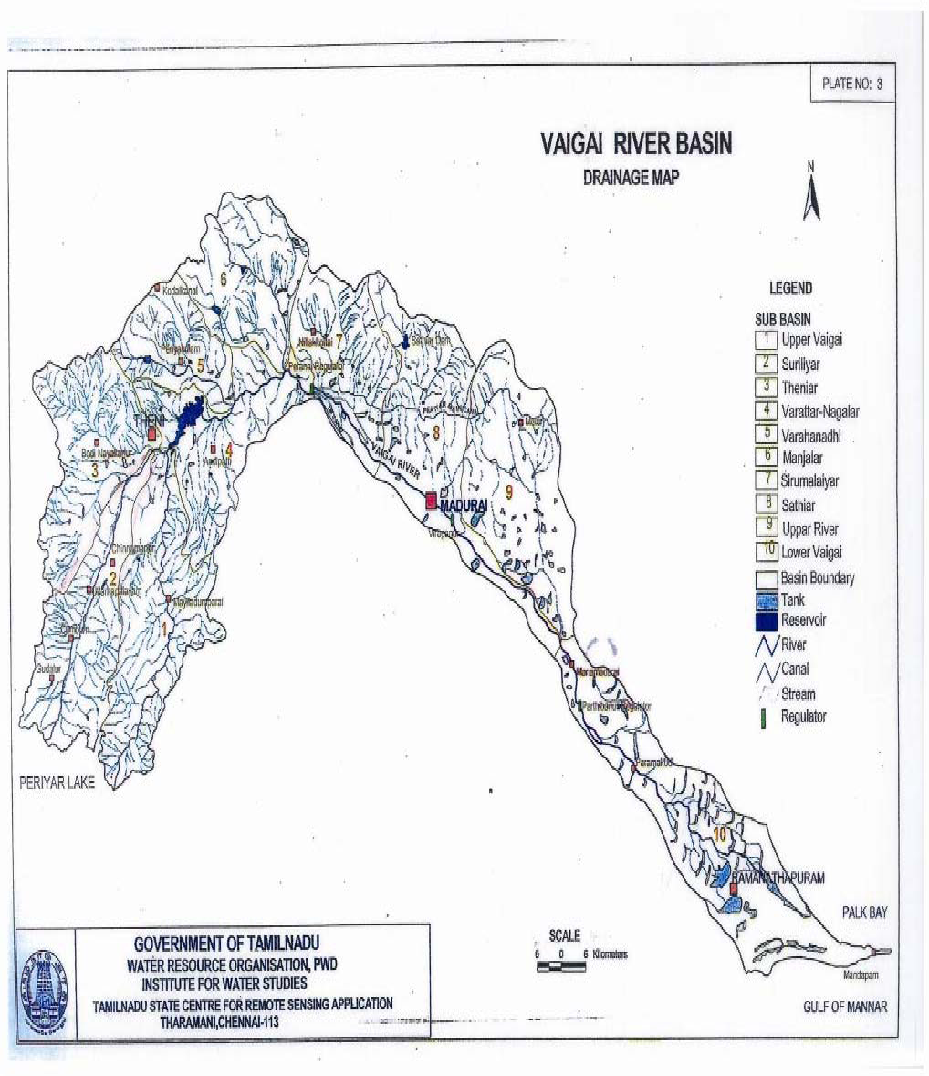
Lower Vaigai River Sub basin
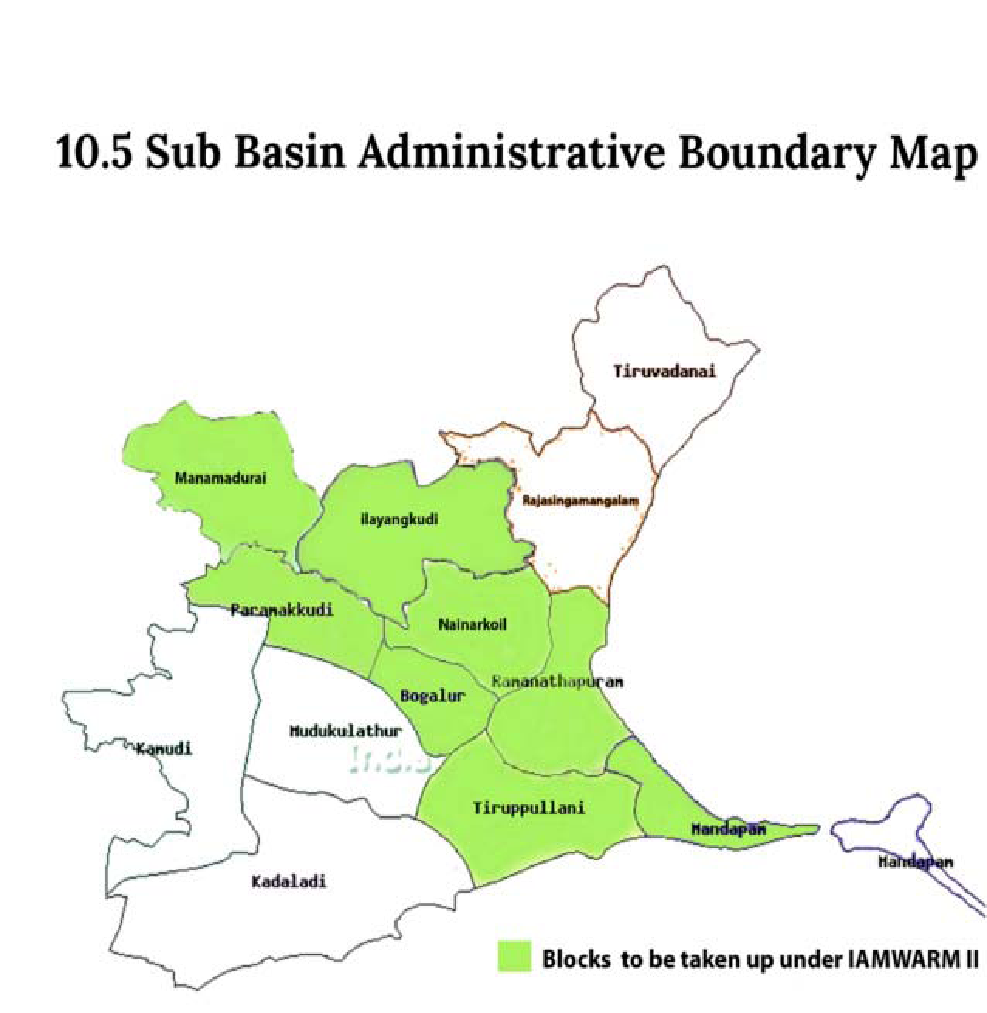
Sub basin Administrative Boundary
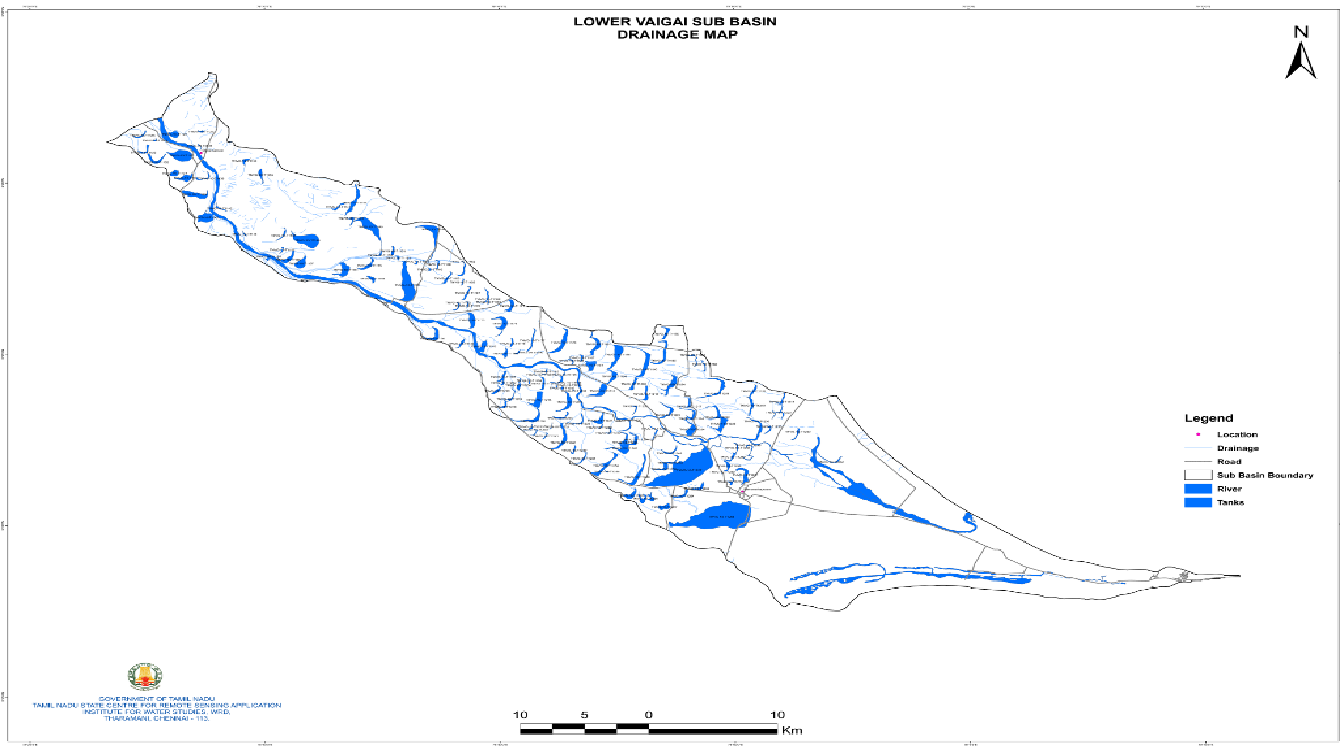
Lower Palar River Sub basin Drainage
2.3. Total registered ayacut area of the sub basin
List of blocks, taluks and district covered in lower vaigai sub basin:
| S. No | District | Taluks | Blocks | No of tanks | Ayacut in ha |
|---|---|---|---|---|---|
| 1. | Sivaganga | Manamadurai | Manamadurai | 20 | 2840.63 |
| 2. | Ilyankudi | Ilyankudi | 25 | 3545.98 | |
| 3. | Ramanathapuram | Paramakudi | Nainarkovil | 30 2 | 580.74 |
| 4. | Paramakudi | 4 | 467.49 | ||
| 5. | Bogalur | 34 | 1998.74 | ||
| 6. | Ramanathapuram | Ramnad | 26 | 6830.21 | |
| 7. | Thirupullani | 3 | 211.66 | ||
| 8. | Mandabam | 1 | 40.27 | ||
| Total | 143 | 18475 |
List of districts, blocks and taluks, tanks and ayacutdetailsproposed in this project
| S. No | Districts | Taluks | Blocks | No.of tanks | Ayacut |
|---|---|---|---|---|---|
| 1 | Sivaganga | Manamadurai | Manamadurai | 5 | 312.01 |
| 2 | Sivaganga | Ilyankudi | 1 | 55.70 | |
| 3. | Ramanathapuram | Paramakudi | Nainarkovil | 23 | 2104.71 |
| 4. | Bogalur | 8 | 93.77 | ||
| 5 | Ramanathapuram | Ramnad | 21 | 2692.36 | |
| 6 | Mandabam | 1 | 40.27 | ||
| Total | 59 | 5298.82 | |||
| Anicut | 1 | 222.84 | |||
| Total | 5521.66 |
LOWER VAIGAI SUB BASIN - BLOCK WISE TANK ABSTRACT
| S. No | District | Block | Taluk | No.ofTanks | Ayacut ha |
|---|---|---|---|---|---|
| 1 | Sivagangai | Manamadurai | Manamadurai | 5 | 312.010 |
| 2 | Sivagangai | Ilayangudi | Ilayangudi | 1 | 55.700 |
| 3 | Ramanathapuram | Nainorkoil | Paramakudi | 23 | 2104.710 |
| 4 | Ramanathapuram | Bogalur | Paramakudi | 8 | 93.766 |
| 5 | Ramanathapuram | Mandabam | Ramanathapuram | 1 | 40.270 |
| 6 | Ramanathapuram | Ramanathapuram | Ramanathapuram | 21 | 2692.360 |
| Total | 59 | 5298.816 | |||
| Tank Ayacut (Indirect) | 5298.816 ha | ||||
| Anicut Ayacut (Direct) | 222.840 ha | ||||
| Total Ayacut | 5521.656 ha |
Total Abstract
| S. No | District | Block | Taluk | No.ofTanks | Total Ayacut(ha) |
|---|---|---|---|---|---|
| 1. | Total Anicut Ayacut (Direct Ayacut) | Ramnad | Ramnad | - | 222.84 |
| 2 | System Tanks | Manamadurai | Manamadurai | 3 | 146.95 |
| 3 | Non System Tanks | Manamadurai | Manamadurai | 2 | 165.06 |
| 4 | Non System Tanks | Illayangudi | Illayangudi | 1 | 55.70 |
| 5 | System Tanks | Nainorkoil | Paramakudi | 19 | 1928.98 |
| 6 | Non System Tanks | Nainorkoil | Paramakudi | 4 | 175.73 |
| 7 | System Tanks | Bogalur | Paramakudi | 8 | 93.77 |
| 8 | Non System Tanks | Mandabam | Ramnad | 1 | 40.27 |
| 9 | System Tanks | Ramnad | Ramnad | 14 | 1190.15 |
| 10 | Non System Tanks | Ramnad | Ramnad | 7 | 1502.21 |
| Total | 59 | 5521.66 | |||
| Tank Ayacut (Indirect) | 5298.816 ha | ||||
| Anicut Ayacut (Direct) | 222.840 ha | ||||
| Total Ayacut | 5521.656 ha |
IAMWARM-II LOWER VAIGAI SUB BASIN BLOCK WISE TANK ABSTRACT
| S.No | Name of basin | Name of sub basin | Block | No.of Tanks | Registerdayacut in ha | Partially irrigated ha | Fully irrigated ha | Gap ha | Total | District |
|---|---|---|---|---|---|---|---|---|---|---|
| 1 | Lower Vaigai | Lower Vaigai | Manamadurai | 5 | 312.01 | 46.80 | 164.26 | 100.95 | 312.01 | Sivagangai |
| 2 | Lower Vaigai | Lower Vaigai | Illayangudi | 1 | 55.70 | 12.70 | 25.20 | 17.80 | 55.70 | Sivagangai |
| 3 | Lower Vaigai | Lower Vaigai | Nainorkoil | 23 | 2104.71 | 271.36 | 1539.99 | 293.36 | 2104.71 | Ramnad |
| 4 | Lower Vaigai | Lower Vaigai | Bogalur | 8 | 93.77 | 17.73 | 47.89 | 28.14 | 93.76 | Ramnad |
| 5 | Lower Vaigai | Lower Vaigai | Mandabam | 1 | 40.27 | 8.05 | 20.14 | 12.08 | 40.27 | Ramnad |
| 6 | Lower Vaigai | Lower Vaigai | Ramnad | 21 | 2692.36 | 480.86 | 1403.77 | 807.74 | 2692.37 | Ramnad |
| Total | 59 | 5298.82 | 837.50 | 3201.25 | 1260.07 | 5298.82 |
BLOCK WISE ANICUT ABSTRACT
| S.No | Name of basin | Name of sub basin | Block | No.ofAnicut | Registered ayacut in Ha | Partially irrigated Ha | Fully irrigated Ha | Gap Ha | Total | District |
|---|---|---|---|---|---|---|---|---|---|---|
| 1 | Lower Vaigai | Lower Vaigai | Ramanathapuram | 1 | 222.84 | 35.48 | 138.34 | 49.02 | 222.84 | Ramanathapuram |
| 1 | 222.84 | 35.48 | 138.34 | 49.02 | 222.84 |
BLOCK WISE TANK LIST
| S.No | Name of basin | Name of sub basin | Name of tank | Block | Registered ayacut in ha | Fully irrigated ha | Partially irrigated ha | Gap ha | Total | District |
|---|---|---|---|---|---|---|---|---|---|---|
| 1 | Lower Vaigai | Lower Vaigai | Nathaporaki | Manamaduri | 42.57 | 21.29 | 6.38 | 14.90 | 42.57 | Sivagangai |
| 2 | Lower Vaigai | Lower Vaigai | Manambakki | Manamaduri | 55.16 | 27.58 | 8.27 | 19.31 | 55.16 | Sivagangai |
| 3 | Lower Vaigai | Lower Vaigai | Vethiyarendal | Manamaduri | 49.22 | 24.61 | 7.38 | 17.23 | 49.22 | Sivagangai |
| 4 | Lower Vaigai | Lower Vaigai | Athanur | Manamaduri | 81.98 | 45.09 | 12.30 | 24.59 | 81.98 | Sivagangai |
| 5 | Lower Vaigai | Lower Vaigai | V.Karisalkulam | Manamaduri | 83.08 | 45.69 | 12.47 | 24.92 | 83.08 | Sivagangai |
| Nainorkoil Block Total | 312.01 | 164.26 | 46.80 | 100.95 | 312.01 | |||||
| 1 | Lower Vaigai | Lower Vaigai | Pidaranendal | Illayangudi | 55.70 | 25.20 | 25.20 | 17.80 | 68.20 | Sivagangai |
| Illyangudi Block Total | 55.70 | 25.20 | 25.20 | 17.80 | 68.20 | |||||
| 1 | Lower Vaigai | Lower Vaigai | Akkiramesi | Nainorkoil | 126.09 | 17.82 | 91.25 | 17.02 | 126.090 | Ramnad |
| 2 | Lower Vaigai | Lower Vaigai | Pagaiventri | Nainorkoil | 66.26 | 8.86 | 49.12 | 8.28 | 66.260 | Ramnad |
| 3 | Lower Vaigai | Lower Vaigai | Thiyagavanseri | Nainorkoil | 118.52 | 16.77 | 84.56 | 17.19 | 118.520 | Ramnad |
| 4 | Lower Vaigai | Lower Vaigai | Thethangal | Nainorkoil | 79.94 | 15.98 | 39.97 | 23.99 | 79.940 | Ramnad |
| 5 | Lower Vaigai | Lower Vaigai | Nagachi | Nainorkoil | 176.11 | 17.15 | 132.54 | 26.42 | 176.110 | Ramnad |
| 6 | Lower Vaigai | Lower Vaigai | Kiliyur | Nainorkoil | 194.02 | 23.58 | 144.25 | 26.19 | 194.020 | Ramnad |
| 7 | Lower Vaigai | Lower Vaigai | Soriyankulam | Nainorkoil | 8.22 | 0.32 | 6.87 | 1.03 | 8.220 | Ramnad |
| 8 | Lower Vaigai | Lower Vaigai | Kadambur | Nainorkoil | 49.54 | 4.11 | 38.25 | 7.18 | 49.540 | Ramnad |
| 9 | Lower Vaigai | Lower Vaigai | Vallam | Nainorkoil | 155.39 | 17.82 | 121.25 | 16.32 | 155.390 | Ramnad |
| 10 | Lower Vaigai | Lower Vaigai | Thurathiendal | Nainorkoil | 73.71 | 10 | 52.65 | 11.06 | 73.710 | Ramnad |
| 11 | Lower Vaigai | Lower Vaigai | Chithanendal | Nainorkoil | 61.76 | 10.3 | 43.12 | 8.34 | 61.760 | Ramnad |
| 12 | Lower Vaigai | Lower Vaigai | Vaniyavallam | Nainorkoil | 114.53 | 13.02 | 87.19 | 14.32 | 114.530 | Ramnad |
| 13 | Lower Vaigai | Lower Vaigai | P.Kodikulam | Nainorkoil | 106.36 | 7.98 | 87.21 | 11.17 | 106.360 | Ramnad |
| 14 | Lower Vaigai | Lower Vaigai | Manichiendal | Nainorkoil | 35.87 | 5.93 | 24.56 | 5.38 | 35.870 | Ramnad |
| 15 | Lower Vaigai | Lower Vaigai | Pandiyur | Nainorkoil | 94.45 | 13.14 | 68.56 | 12.75 | 94.450 | Ramnad |
| 16 | Lower Vaigai | Lower Vaigai | Kalladiyendal | Nainorkoil | 78.92 | 10.04 | 59.02 | 9.86 | 78.920 | Ramnad |
| 17 | Lower Vaigai | Lower Vaigai | Siragikottai | Nainorkoil | 112.21 | 28.05 | 67.33 | 16.83 | 112.212 | Ramnad |
| 18 | Lower Vaigai | Lower Vaigai | Arasadivandal | Nainorkoil | 13.38 | 9.89 | 2.09 | 1.4 | 13.380 | Ramnad |
| 19 | Lower Vaigai | Lower Vaigai | Puthukulam | Nainorkoil | 17.72 | 12.12 | 2.94 | 2.66 | 17.720 | Ramnad |
| 20 | Lower Vaigai | Lower Vaigai | Sathurvethamangalam | Nainorkoil | 207 | 158.23 | 20.82 | 27.95 | 207.000 | Ramnad |
| 21 | Lower Vaigai | Lower Vaigai | Perungalur | Nainorkoil | 61.40 | 45.56 | 8.16 | 7.68 | 61.400 | Ramnad |
| 22 | Lower Vaigai | Lower Vaigai | Mummudisathan | Nainorkoil | 106.24 | 80.84 | 10 | 15.4 | 106.240 | Ramnad |
| 23 | Lower Vaigai | Lower Vaigai | Sethukal | Nainorkoil | 47.07 | 35.65 | 6.48 | 4.94 | 47.070 | Ramnad |
| Nainorkoil Block Total | 2104.71 | 1539.99 | 271.36 | 293.362 | 2104.712 | Ramnad | ||||
| 1 | Lower Vaigai | Lower Vaigai | Averandal | Bogalur | 19.86 | 10.93 | 2.97 | 5.96 | 19.860 | Ramnad |
| 2 | Lower Vaigai | Lower Vaigai | Sembathiendal | Bogalur | 2.82 | 1.41 | 0.56 | 0.85 | 2.820 | Ramnad |
| 3 | Lower Vaigai | Lower Vaigai | Ganapathyendal | Bogalur | 4.937 | 2.47 | 0.99 | 1.48 | 4.940 | Ramnad |
| 4 | Lower Vaigai | Lower Vaigai | Pethanendal | Bogalur | 5.393 | 2.7 | 1.07 | 1.62 | 5.390 | Ramnad |
| 5 | Lower Vaigai | Lower Vaigai | Alagiaperumanendal | Bogalur | 4.624 | 2.31 | 0.92 | 1.39 | 4.620 | Ramnad |
| 6 | Lower Vaigai | Lower Vaigai | Parambakkulam | Bogalur | 41.675 | 20.84 | 8.33 | 12.5 | 41.670 | Ramnad |
| 7 | Lower Vaigai | Lower Vaigai | Erumaiparalai | Bogalur | 4.937 | 2.47 | 0.99 | 1.48 | 4.940 | Ramnad |
| 8 | Lower Vaigai | Lower Vaigai | Ilanthaikulam | Bogalur | 9.52 | 4.76 | 1.90 | 2.86 | 9.520 | Ramnad |
| Boglur Block Total | 93.766 | 47.890 | 17.730 | 28.140 | 93.760 | Ramnad | ||||
| 1 | Lower Vaigai | Lower Vaigai | Nochivayal | Ramnad | 27.38 | 13.69 | 5.48 | 8.21 | 27.380 | Ramnad |
| 2 | Lower Vaigai | Lower Vaigai | Karukudi | Ramnad | 46.25 | 23.13 | 9.24 | 13.88 | 46.250 | Ramnad |
| 3 | Lower Vaigai | Lower Vaigai | Chithur | Ramnad | 90.32 | 48.23 | 14.99 | 27.1 | 90.320 | Ramnad |
| 4 | Lower Vaigai | Lower Vaigai | Vannivayal | Ramnad | 48.55 | 24.28 | 9.7 | 14.57 | 48.550 | Ramnad |
| 5 | Lower Vaigai | Lower Vaigai | Sakkankudi | Ramnad | 51.4 | 25.7 | 10.28 | 15.42 | 51.400 | Ramnad |
| 6 | Lower Vaigai | Lower Vaigai | Kavanur | Ramnad | 118.19 | 69.1 | 13.63 | 35.46 | 118.190 | Ramnad |
| 7 | Lower Vaigai | Lower Vaigai | Karendal | Ramnad | 136.54 | 68.27 | 27.31 | 40.96 | 136.540 | Ramnad |
| 8 | Lower Vaigai | Lower Vaigai | Puthendal | Ramnad | 131.32 | 65.66 | 26.26 | 39.4 | 131.320 | Ramnad |
| 9 | Lower Vaigai | Lower Vaigai | Kooriyur | Ramnad | 180.02 | 90.01 | 36 | 54.01 | 180.020 | Ramnad |
| 10 | Lower Vaigai | Lower Vaigai | Kumariyendal | Ramnad | 72.15 | 40.08 | 10.42 | 21.65 | 72.150 | Ramnad |
| 11 | Lower Vaigai | Lower Vaigai | Kalathavur | Ramnad | 62.09 | 31.05 | 12.42 | 18.63 | 62.100 | Ramnad |
| 12 | Lower Vaigai | Lower Vaigai | Pappakudi | Ramnad | 87.88 | 43.94 | 17.58 | 26.36 | 87.880 | Ramnad |
| 13 | Lower Vaigai | Lower Vaigai | Kavarankulam | Ramnad | 79.71 | 39.86 | 15.94 | 23.91 | 79.710 | Ramnad |
| 14 | Lower Vaigai | Lower Vaigai | Peravoor | Ramnad | 69.69 | 34.85 | 13.93 | 20.91 | 69.690 | Ramnad |
| 15 | Lower Vaigai | Lower Vaigai | Othapanai | Ramnad | 46.03 | 23.02 | 9.2 | 13.81 | 46.030 | Ramnad |
| 16 | Lower Vaigai | Lower Vaigai | Pullankudi | Ramnad | 146.1 | 73.05 | 29.22 | 43.83 | 146.100 | Ramnad |
| 17 | Lower Vaigai | Lower Vaigai | Chitharkottai | Ramnad | 106.67 | 53.34 | 21.33 | 32 | 106.670 | Ramnad |
| 18 | Lower Vaigai | Lower Vaigai | Peruvayal | Ramnad | 292.45 | 146.23 | 58.48 | 87.74 | 292.450 | Ramnad |
| 19 | Lower Vaigai | Lower Vaigai | Sakkaravalanallur | Ramnad | 73.03 | 36.52 | 14.6 | 21.91 | 73.030 | Ramnad |
| 20 | Lower Vaigai | Lower Vaigai | Athiyuthu | Ramnad | 145.74 | 72.87 | 29.15 | 43.72 | 145.74 | Ramnad |
| 21 | Lower Vaigai | Lower Vaigai | Sakkarakottai | Ramnad | 680.85 | 95.7 | 380.89 | 204.26 | 680.85 | Ramnad |
| Ramnad Block Total | 2692.36 | 1403.77 | 480.86 | 807.74 | 2692.3 | |||||
| 1 | Lower Vaigai | Lower Vaigai | Therbogi | Mandabam | 40.270 | 20.140 | 8.050 | 12.080 | 40.270 | Ramnad |
| Mandabam Block Total | 40.270 | 20.140 | 8.050 | 12.080 | 40.270 |
Cluster wise tank details
| S.No | Region TankNo | Uniqueid | Tank_Name | FI | PI | Gap | Ayacutha | Latitude | Longitude | Village | Block |
|---|---|---|---|---|---|---|---|---|---|---|---|
| CLUSTER I | |||||||||||
| 1 | 2344 | TNVG-10-T1123 | Nathaporaki | 21.29 | 6.38 | 14.90 | 9.716596 | 78.454921 | Nathaporaki | Manamadurai | |
| 2 | 2342 | TNVG-10-T1129 | Manambakki | 27.58 | 8.27 | 19.31 | 9.702105 | 78.454111 | Manambakki | Manamadurai | |
| 3 | 2347 | TNVG-10-T1142 | Vethiyarendal | 24.61 | 7.38 | 17.23 | 9.642403 | 78.468096 | Vethiyarendal | Manamadurai | |
| 4 | 2324 | TNVG-10-T1136 | Athanur | 45.09 | 12.30 | 24.59 | 9.671884 | 78.456949 | Athanur | Manamadurai | |
| 5 | 2334 | TNVG-10-T1125 | V.Karisalkulam | 45.69 | 12.47 | 24.92 | 9.713963 | 78.435945 | V.Karisalkulam | Manamadurai | |
| 6 | 2110 | TNVG-10-T1141 | Pidaranendal | 25.20 | 12.70 | 17.80 | 9.643262 | 78.552311 | Vijayangudi | Illayangudi | |
| CLUSTER II | 189.46 | 59.50 | 118.75 | ||||||||
| 7 | 2451 | TNVG-10-T1174 | Vallam | 121.25 | 17.82 | 16.32 | 9.529478 | 78.668462 | Vallam | Nainorkoil | |
| 8 | 2452 | TNVG-10-T1182 | Pagaventri | 49.12 | 8.86 | 8.28 | 9.507382 | 78.655083 | Pagaventri | Nainorkoil | |
| 9 | 2453 | TNVG-10-T1179 | Kalladiyendal | 59.02 | 10.04 | 9.86 | 9.510908 | 78.675393 | Kalladiyendal | Nainorkoil | |
| 10 | 2454 | TNVG-10-T1184 | Soriyankulam | 6.87 | 0.32 | 1.03 | 9.500481 | 78.670891 | Soriyankulam | Nainorkoil | |
| 11 | 2456 | TNVG-10-T1177 | Siragikottai | 28.05 | 67.33 | 16.83 | 9.512969 | 78.689621 | Siragikottai | Nainorkoil | |
| CLUSTER III | 264.31 | 104.4 | 52.322 | ||||||||
| 12 | 2458 | TNVG-10-T1178 | Akkiramesi | 91.25 | 17.82 | 17.02 | 9.51112 | 78.710741 | Akkiramesi | Nainorkoil | |
| 13 | 2462 | TNVG-10-T1181 | Chithanendal | 43.12 | 10.3 | 8.34 | 9.508961 | 78.734291 | Chithanendal | Nainorkoil | |
| 14 | 2464 | TNVG-10-T1189 | Arasadivandal | 9.89 | 2.09 | 1.4 | 9.492293 | 78.717725 | Arasadivandal | Nainorkoil | |
| 15 | 2463 | TNVG-10-T1187 | Manichiendal | 24.56 | 5.93 | 5.38 | 9.496153 | 78.724779 | Manichiendal | Nainorkoil | |
| CLUSTER IV | 168.82 | 36.14 | 32.14 | ||||||||
| 16 | 2468 | TNVG-10-T1186 | Sathurvethamangalam | 158.23 | 20.82 | 27.95 | 9.499308 | 78.749835 | Sathurvethamangalam | Nainorkoil | |
| 17 | 2477 | TNVG-10-T1190 | Kiliyur | 144.25 | 23.58 | 26.19 | 9.491174 | 78.769112 | Kiliyur | Nainorkoil | |
| 18 | 2476 | TNVG-10-T1185 | P.Kodikulam | 87.21 | 7.98 | 11.17 | 9.500358 | 78.782585 | P.Kodikulam | Nainorkoil | |
| CLUSTER V | 389.69 | 52.38 | 65.31 | ||||||||
| 19 | 2465 | TNVG-10-T1191 | Pandiyur | 68.56 | 13.14 | 12.75 | 9.489029 | 78.731376 | Pandiyur | Nainorkoil | |
| 20 | 2467 | TNVG-10-T1196 | Mummudisathan | 80.84 | 10 | 15.4 | 9.478151 | 78.7468 | Mummudisathan | Nainorkoil | |
| 21 | 2466 | TNVG-10-T1210 | Nagachi | 132.54 | 17.15 | 26.42 | 9.464116 | 78.738407 | Nagachi | Nainorkoil | |
| CLUSTER VI | 281.94 | 40.29 | 54.57 | ||||||||
| 22 | 2479 | TNVG-10-T1212 | Therthankal | 39.97 | 15.98 | 23.99 | 9.460682 | 78.770404 | Therthankal | Nainorkoil | |
| 23 | 2478 | TNVG-10-T1202 | Thiyagavanseri | 84.56 | 16.77 | 17.19 | 9.470757 | 78.761672 | Thiyagavanseri | Nainorkoil | |
| 24 | 2480 | TNVG-10-T1220 | Thurathiendal | 52.65 | 10 | 11.06 | 9.446689 | 78.762724 | Thurathiendal | Nainorkoil | |
| CLUSTER VII | 177.18 | 42.75 | 52.24 | ||||||||
| 25 | 2497 | TNVG-10-T1171 | Vaniyavallam | 87.19 | 13.02 | 14.32 | 9.546853 | 78.674556 | Vaniyavallam | Nainorkoil | |
| CLUSTER VIII | 87.19 | 13.02 | 14.32 | ||||||||
| 26 | 2486 | TNVG-10-T1192 | Kadambur | 38.25 | 4.11 | 7.18 | 9.488502 | 78.811617 | Kadambur | Nainorkoil | |
| CLUSTER IX | 38.25 | 4.11 | 7.18 | ||||||||
| 27 | 2455 | TNVG-10-T1183 | Puthukulam | 12.12 | 2.94 | 2.66 | 9.501523 | 78.679346 | Puthukulam | Nainorkoil | |
| CLUSTER X | 12.12 | 2.94 | 2.66 | ||||||||
| 28 | 2475 | TNVG-10-T1175 | Sethukal | 35.65 | 6.48 | 4.94 | 9.520757 | 78.784775 | Sethukal | Nainorkoil | |
| CLUSTER XI | 35.65 | 6.48 | 4.94 | ||||||||
| 29 | 2482 | TNVG-10-T1224 | Perungalur | 45.66 | 8.16 | 7.68 | 9.441195 | 78.802629 | Perungalur | Nainorkoil | |
| CLUSTER XII | 45.66 | 8.16 | 7.68 | ||||||||
| 30 | 2509 | TNVG-10-T1209 | Averandal | 10.93 | 2.97 | 5.96 | 9.464305 | 78.66457 | Averandal | Bogalur | |
| 31 | 2510 | TNVG-10-T1200 | Ganapathyendal | 2.47 | 0.99 | 1.48 | 9.471598 | 78.668909 | Ganapathyendal | Bogalur | |
| 32 | 2542 | TNVG-10-T1237 | Sembathiendal | 1.41 | 0.56 | 0.85 | 9.425342 | 78.744435 | Sembathiendal | Bogalur | |
| 33 | 2524 | TNVG-10-T1231 | Pethanendal | 2.7 | 1.07 | 1.62 | 9.429384 | 78.70301 | Pethanendal | Bogalur | |
| 34 | 2530 | TNVG-10-T1207 | Alagiaperumanendal | 2.31 | 0.92 | 1.39 | 9.466829 | 78.711038 | Alagiaperumanendal | Bogalur | |
| 35 | 2545 | TNVG-10-T1258 | Parambakkulam | 20.84 | 8.33 | 12.5 | 9.385626 | 78.7422275 | Parambakkulam | Bogalur | |
| 36 | 2572 | TNVG-10-T1261 | Erumaiparalai | 2.47 | 0.99 | 1.48 | 9.382192 | 78.840022 | Erumaiparalai | Bogalur | |
| 37 | 2517 | TNVG-10-T1233 | Ilanthaikulam | 4.76 | 1.9 | 2.86 | 9.42855 | 78.68888 | Ilanthaikulam | Bogalur | |
| CLUSTER XIII | 47.89 | 17.73 | 28.14 | ||||||||
| 38 | 2562 | TNVG-10-T1229 | Karendal | 68.27 | 27.31 | 40.96 | 9023'00" | 78049'15" | Karendal | Ramnad | |
| 39 | 2561 | TNVG-10-T1234 | Kavanur | 69.1 | 13.63 | 35.46 | 9025'00" | 78048'00" | Kavanur | Ramnad | |
| 40 | 2555 | TNVG-10-T1239 | Karukudi | 23.13 | 9.24 | 13.88 | 9024'30" | 78046'25" | Karukudi | Ramnad | |
| CLUSTER XIV | 160.5 | 50.18 | 90.3 | ||||||||
| 41 | 2558 | TNVG-10-T1248 | Sakkankudi | 25.7 | 10.28 | 15.42 | 9025'00" | 78048'00" | Sakkankudi | Ramnad | |
| 42 | 2557 | TNVG-10-T1253 | Vannivayal | 24.28 | 9.7 | 14.57 | 9025'00" | 78048'00" | Vannivayal | Ramnad | |
| 43 | 2556 | TNVG-10-T1256 | Chithur | 48.23 | 14.99 | 27.1 | 9025'00" | 78048'00" | Chithur | Ramnad | |
| CLUSTER XV | 98.21 | 34.97 | 57.09 | ||||||||
| 44 | 2566 | TNVG-10-T1264 | Kooriyur | 90.01 | 36 | 54.01 | 9021'30" | 78048'00" | Kooriyur | Ramnad | |
| 45 | 2552 | TNVG-10-T1263 | Nochivayal | 13.69 | 5.48 | 8.21 | 9021'00" | 78050'00" | Acunthanvyal | Ramnad | |
| 46 | 2565 | TNVG-10-T1267 | Puthendal | 65.66 | 26.26 | 39.4 | 9070'36" | 78047'59" | Puthendal | Ramnad | |
| CLUSTER XVI | 169.36 | 67.74 | 101.62 | ||||||||
| 47 | 2563 | TNVG-10-T1222 | Kumariyenthal | 40.08 | 10.42 | 21.65 | 9.443611 | 78.820497 | Kumariyenthal | Ramnad | |
| 48 | 2576 | TNVG-10-T1219 | Peruvayal | 146.23 | 58.48 | 87.74 | 9.449676 | 78.844949 | Peruvayal | Ramnad | |
| 49 | 2579 | TNVG-10-T1214 | Sakkaravalanallur | 36.52 | 14.6 | 21.91 | 9.45589 | 78.86664 | Sakkaravalanallur | Ramnad | |
| CLUSTER XVII | 222.83 | 83.5 | 131.3 | ||||||||
| 50 | 2574 | TNVG-10-T1236 | Pullankudi | 73.05 | 29.22 | 43.83 | 9.425599 | 78.783369 | Pullankudi | Ramnad | |
| 51 | 2575 | TNVG-10-T1235 | Chitarkottai | 53.34 | 21.33 | 32 | 9.426157 | 78.857328 | Chitarkottai | Ramnad | |
| 52 | 2580 | TNVG-10-T1240 | Athiyuthu | 72.87 | 29.15 | 43.72 | 9.422024 | 78.877399 | Athiyuthu | Ramnad | |
| 53 | 2581 | TNVG-10-T1252 | Therbogi | 20.14 | 8.05 | 12.08 | 9.39722 | 78.901437 | Therbogi | Mandabam | |
| 54 | 2570 | TNVG-10-T1245 | Kavarankulam | 39.86 | 15.94 | 23.91 | 9.409265 | 78.834658 | Kavarankulam | Ramnad | |
| 55 | 2569 | TNVG-10-T1250 | Pappakudi | 43.94 | 17.58 | 26.36 | 9.399406 | 78.831164 | Pappakudi | Ramnad | |
| 56 | 2568 | TNVG-10-T1255 | Kalathavur | 31.05 | 12.42 | 18.63 | 9.391 | 78.828034 | Kalathavur | Ramnad | |
| 57 | 2573 | TNVG-10-T1249 | Othapanai | 23.02 | 9.2 | 13.81 | 9.403477 | 78.843462 | Othapanai | Ramnad | |
| CLUSTER XVIII | 357.27 | 142.9 | 214.34 | ||||||||
| 58 | 2571 | TNVG-10-T1262 | Peravur | 34.85 | 13.93 | 20.91 | 9.375574 | 78.830801 | Peravur | Ramnad | |
| 59 | 2582 | TNVG-10-T1268 | Sakkarakottai | 380.89 | 95.7 | 204.26 | 9.341202 | 78.822792 | Sakkarakottai | Ramnad |
2.4. Climate and Rainfall
Sivgangai the total rainfall of the district is 817.30mm. The North-East monsoon accounted for a highest proportion of 61.79 per cent of the total rainfall followed by South-West monsoon with 17.85 per cent. Summer rainfall also received in the district with 17.44 per cent of the total rainfall. Winter rainfall was almost negligent in the district i.e. 2.92 per cent.
The district of Ramanathapuram has a hot tropical climate temperature ranging from 22.3 °C (min) to 37.8 °C (max) and the relative humidity is high at 79% on an average and it ranges between 80 to 90% in coastal areas.District average annual rainfall is 827 mm, (from January to December) but the quantum of rainfall is not only uneven, but also erratic.
2.5. Soil type
2.5.1. Soil type-Sivagangai
The district consists of red loam, Laterite Soil, black soil, and red soil in major areas. The major soil types prevalent in Sivagangai district are sandy loam, clay loam and sandy clay loam. Further, red and black soils are found in Thiruppuvanam block. Also, they are deep to very deep soils and ideal for growing horticultural crops and very deep rooted perennial crops. The soils are well drained both internally and externally. They don’t possess the problems of alkalinity, calcareousness and salinity.
2.5.2. Soil type-Ramanathapuram
The soils of Ramanathapuram District includes sandy soil, clay soil, sandy clay soil, alluvial soil, sandy loam soil, coastal alluvial soil and red soil. The major soil type of the district is clay soil which covers about 1,82,463 ha i.e., 44.62 per cent. Next predominant soil type is coastal alluvial (71,357 ha) and sandy loam soil (63,602 ha). Coastal alluvium occurs in Ramanathapuram, Kadaladi, Thiruvadanai and Mudhukulathur taluks. Rameswaram Island contains mainly sandy soil i.e., 80 per cent
3. Cropping Pattern
Ramanathapuram
Paddy, groundnut, black gram, cotton and cholam are the major agricultural crops cultivated in the district. With regards to horticultural crops chilli and coconut are major crops grown. Besides other crops like ragi, cumbu, minor millets, sunflower, coriander and sugarcane are also grown in the district.
Sivagangai
Paddy, groundnut, black gram, coconut and sugarcane are the major agricultural crops cultivated in the district. With regards to horticultural crops cashew nut, banana, mango, guava and chilli and are major crops grown
Details of consolidated Land Holding Pattern in Ramanathapuram District
| Land holding pattern | Percentage (%) | Area (ha) |
|---|---|---|
| Marginal (less than 1ha,) | 76.18% | 240339 |
| Small (between1.1 to 2.0 ha) | 15.06% | 47513 |
| Small medium (between 2.1 to 4.0 ha) | 6.43% | 20286 |
| Medium (between 4.1 to 10.0 ha) | 2.11% | 6656 |
| Large( above10.0 ha) | 0.22% | 695 |
| Total | 100% | 315489 |
3.2. Land use pattern in sivagangai district
| S. No. | Land HoldingPattern | Illayangudi | Manamadurai |
|---|---|---|---|
| 1 | > 1 ha. | 6935.72 | 3745 |
| 2 | 1 - 2 ha. | 15173.45 | 10071 |
| 3 | 2.1 - 4 ha. | 21480.03 | 7626 |
| 4 | 4.1 – 10 ha. | 2756.36 | 632 |
| 5 | Above 10 ha. | 465.65 | 72 |
| Total | 46811.21 | 22146 |
3.3. Labour availability
Most of the agricultural labourers are engaged in Mahatma Gandhi Rural Guarantee Scheme and there is acute shortage of labourers during the peak periods of agricultural operations. Timely intercultural operations are not carried out properly and hence there is considerable yield loss of crops is obtained
3.4. Season wise crops grown in the sub-basin:
Paddy :
In Ramanathapuram District, paddy is main food crop cultivated in more than 63% of the net area sown. It is cultivated both as irrigated and rainfed. Rainfed sowing generally commences from August and will extend upto October. In early sown area, farmers used to raise medium and long duration varieties of paddy. There is no marked area for late sowing, but when the monsoon rains delayed, the sowing will be also taken up late. In the late sown areas medium and short duration paddy varieties are sown. In tankfed ayacut area Irrigated paddy is sown generally in August to November. Sometimes sowing will be further extended upto December according to the filling of rainwater in the tanks and also release of water from Vaigai Dam to the Vaigai fed system tanks.
Ragi:
Rainfed Ragi sowing is taken up during September and October. Irrigated Ragi is mainly sown in September to October in East Ramanathapuram where the crop is sown in tankfed ayacut.
Minor Millets:
Minor millets are generally sown between July to November and the area is spreaded over throughout the district.
Cotton:
Rainfed cotton sowing is taken up in September-October. The sowing will be extended sometimes upto December depending upon rainfall. Rice fallow cotton is generally sown in Paramakudi and Kamuthi taluks during January-February months.
Pluses:
Redgram is sown in June to August. Blackgram, Greengram and Cowpea are sown as rainfed crop in September, October months. Redgram is sown as mixed crop with millets and groundnut. Blackgram and Greengram are sown as pure crop as well as mixed crop in cotton and sugarcane. The Cowpea is sown as pure crop and also in some places as mixed crop with millets.
Groundnutand Gingelly:
Groundnut and Gingelly are cultivated mostly in Rainfed condition, during the month of December-January and April – May.
Chillies:
Chillies are cultivated in both rainfed and irrigated condition. Chillies are directly broadcasted in the month of September. The transplanted chillies will be taken in the fortnight of November.
3.5. Existing scenario of irrigation practices
During this year 2016-17, the rainfall received is too low and there is a deficit of 62 % of average rainfall through NEM. All the system and non system tanks are not filled with sufficient water for cultivation. Groundwater table goes to deeper layer that will not adequate to meet out the crop water requirement.
In sivagangai district the irrigated area of the district is 86604.33 hectares and it formed 76.36 per cent of the net sown area. Among the irrigation sources, tank ranked first with a proportion of 78.24 per cent of the irrigated area followed by open wells with 15.26 per cent of the irrigated area. Tube wells and supplementary wells were the other sources.
More number of wells followed by tanks in the district. The district consists of 7,493 open wells and 317 bore wells and 1,694 tanks. But all the wells are not supporting irrigation as they are normally dry during most part of the year. However, tanks formed the major source of irrigation as they got filled up during monsoon rains. A total of 1694 tanks were in the district of which 1192 are minor irrigation tanks and 502 are PWD tanks.
3.6. Lower Vaigai Sub Basin -Cropping Pattern:
| Name of the sub basin | : Lower Vaigai | Fully Irrigated | : | 3312.77 | ha | |||
| Nodal District | : Ramanathapuram | Partially Irrigated | : | 904.35 | ha | |||
| Registered Ayacut Area | : 5521.66 ha. | Gap | : | 1304.54 | ha | |||
| No.of Tanks | :59 | Total Ayacut Area | : | 5521.66 | ha | |||
| No.ofAnicut | :1 |
| S.No | Crop | Without Project | With Project | Increasing | ||||||
| FI | PI | Gap | Total | FI | PI | Gap | Total | |||
| III | 1st crop | |||||||||
| 1 | Paddy | 2178.31 | 689.86 | 0 | 2768.17 | 1421.40 | 0.0 | 0.0 | 1421.40 | -248.96 |
| 2 | Paddy -SRI | 733.06 | 151.60 | 0 | 884.65 | 2798.00 | 0.0 | 0.0 | 2798.00 | 296 |
| 3 | Maize | 0.0 | 0.0 | 0.0 | 0.0 | 0.0 | 0.0 | 0.0 | 0.0 | 0.0 |
| 4 | Pulses | 0.0 | 0.0 | 0.0 | 0.0 | 0.0 | 0.0 | 0.0 | 0.0 | 0.0 |
| 5 | Groundnut | 104.40 | 53.10 | 0.0 | 157.50 | 300.00 | 0.0 | 0.0 | 300.0 | 142.50 |
| 6 | Gingelly | 85.80 | 38.34 | 0.0 | 124.14 | 200.00 | 0.0 | 0.0 | 0.0 | 0.0 |
| 7 | Cotton | 109.50 | 28.80 | 0.0 | 138.30 | 300.00 | 0.0 | 0.0 | 0.0 | 0.0 |
| 8 | Bhendi | 4.90 | 2.80 | 0.0 | 7.70 | 25.00 | 0.0 | 0.0 | 25.0 | 17.30 |
| 9 | Brinjal | 10.80 | 3.85 | 0.0 | 14.65 | 25.00 | 0.0 | 0.0 | 25.0 | 10.35 |
| 10 | Chillies | 78.50 | 30.90 | 0.0 | 109.40 | 200.00 | 0.0 | 0.0 | 200.0 | 90.60 |
| 11 | Corinader | 7.50 | 5.10 | 0.0 | 12.60 | 25.00 | 0.0 | 0.0 | 25.00 | 12.40 |
| 12 | NonAgripurpose | 0.0 | 0.0 | 722.86 | 722.86 | 0.0 | 0.0 | 722.86 | 722.86 | 0.0 |
| 13 | Fallow | 0.0 | 0.0 | 581.69 | 581.69 | 0.0 | 0.0 | 0.0 | 0.00 | -581.69 |
| Total | 3312.76 | 904.35 | 1304.55 | 5521.66 | 5294.40 | 0.0 | 722.86 | 5517.26 | -4.40 | |
| Grand Total (I+II+III) | 3312.76 | 904.35 | 1304.55 | 5521.66 | 5294.40 | 0.0 | 722.86 | 1858.57 | 240 | |
| 2 nd crop | 0 | 0 | ||||||||
| 1 | Paddy | 0 | 0 | |||||||
| 2 | Paddy-SRI | 0 | 0 | |||||||
| 3 | Maize | 0 | 500.00 | 0.0 | 0.0 | 500.0 | 500.00 | |||
| 4 | Pulses | 0 | 625.00 | 0.0 | 0.0 | 625.00 | 625.00 | |||
| Total | 0 | 0 | 0.0 | 1125 | 0.0 | 0.0 | 1125.00 | 1125.00 | ||
| Great Grand Total | 3312.76 | 904.35 | 1304.55 | 5521.66 | 6419.40 | 0.0 | 722.66 | 6642.26 | 1120.60 | |
| Intensity % | 89.47% | 120.29% | ||||||||
|---|---|---|---|---|---|---|---|---|---|---|
These eight crops need to be focused for further development in the future, since there are scopes to increase their production.
- The crops like groundnut, coconut, gingelly and cotton showed a larger reduction of area over the period of time from 2010-11 to 2015-16, which might attributed to reduced production and productivity of the same. Reduction in area might be owed to reduction in rainfall over the years of time. The increase in drought prone areas in the district leads to decrease in the area of cultivation of major crops. All these crops are high water requirement crop, so the necessity of large quantity of water arises ultimately reduction in the cropping area.
- Among the potential crops, paddy, cholam, blackgram and chilli in the district showed an increasing trend in area except the crops like groundnut, coconut, cotton and gingelly, which showed declining trend. Though there is increase in area, the crops like paddy, blackgram and chilli showed the decreasing trend in production and also in productivity except for blackgram. In order to sustain the overall production of major crops in the district, there is a need to arrest further decline in area and adequate measures are to be taken to increase the productivity of the crops. Crops like groundnut, chilli, gingelly and cotton were in a declining trend in area, production and productivity which indicates that these crops should be given more importance so as to sustain the available area and to bridge the yield gap. Though, the production and productivity for some crops have been increased over the period, there are certain yield gaps, which can be overcome by the advanced production technologies that evolved during the recent times.
3.7. Special Issues
- Non adoption of SRI in rice and low productivity per unit area
- Lack of crop diversification
- Low productivity of pulses
- Low production of oilseed
- Lack of usage of modernized farm implements
- Lack of awareness about seed production techniques
- Lack of awareness of precision farming systems
3.8. Counter measures proposed
- Introduction of system of rice intensification in mechanized seed drill sowing for semi dry rice
- Drought tolerant oilseed crop production
- Increasing pulses area and production
- Precision farming in vegetables
3.9. Objectives
- To enhance the crop and water productivity
- To promote water saving technologies and mechanization in agriculture
- To increase the cropped area by crop diversification with drought mitigating technology
- To converge with line departments in overall improvement in total farm income.
- Sustaining soil health by promotion of INM/IPM
- To educate ayacut farmers on effective water utilization and to increase the area under irrigated crop.
- To expose the farming community to the climate smart Agriculture
4. Field interventions
4.1 Productivity enhancement of rice in sub basin
| S. No | Constraints | Technologies/ solutions to overcome the constraints |
|---|---|---|
| Paddy | ||
| 1 | Improper sowing methodsand more population | Use of tractor drawn Seed driller developed by the TNAU for large scale direct sowing area to maintain Plant Population and to have line sowing. Use of manual operated TNAU drum seeders for small scale direct sowing area to maintain Plant Population and to have line sowing.Organizing SRI Demonstrations in irrigated area. |
| 2 | Use of high seed rate with poor quality seeds | Distribution of Quality Seeds of preferable varieties like ADT 45, ADT 49, Co49, Co51, BPT 5204, Anna 4 .Training on thinning and SRI method of cultivation developed for rainfed conditions must be promoted. |
| 3 | Improper fertilizer & imbalance nutrient application | Application of Fertilisers as per soil Health card. Spraying of brown pigment microorganism (BPM) for partial drought tolerant. |
| 4 | Improper weed management | Popularizing the garden land weeder and motorized power weeder |
| 5 | Indiscriminate use of pesticide | Organising Farmers Field School |
| 6 | Labour shortage after implementation of MGNREGA | Combine the MGNREGA work with agricultural activities in private and public fund sharing mode. |
| 7 | Lower price to the produce | Fixing of minimum selling price in every year through adequate legal control. |
4.1.1 Green Manure-SRI
Promotion of green manure for sustaining the soil health in Lower Vaigai sub basin area
1. Background: In Sivagangai and Ramanathapuram most of area soils showing the fatigue of low organic carbon, which ultimately reduce the input use efficiency and yield of the crops. Green manures are the viable option to build-up the organic carbon and improve the physical properties and microbial population of the soil.
2. Justification/ Rationale: Promotion of green manure in large sale in this district is very essential to improve organic carbon status of the soil. Further promotion of green manure may reduce the fertilizer application
3. Scientific management techniques of allocating irrigation water, based on soil and climatic condition to achieve maximum crop production per unit of water applied over a unit area in unit time is very much essential under the present condition. System of Rice Intensification (SRI) is one of the scientific management tools to save the water and increases the productivity in rice cultivation.
SRI technique has the following advantages
- Saving of seed material 50-65 kg /ha.
- Saving of 300-400 mm of irrigation water
- Saving of 12-16 women labourers in weeding
- Adoption of SRI in rice system reduces the water requirement with yield increase of 15 -20%.
4.1.2 SRI-Pulses
Receiving good amount of rainfall the farmers are willing to go for pulse after rice and assured irrigated farmers regularly going for pulse cultivation. Timely seed availability of recent varieties is a major threat to the farmers of this lower vaigai basin.
SRI does not require the purchase of new seeds or use of new high – yielding varieties. SRI requires only skillful management of the factors of production. Production and distribution of hybrid, seed and high yielding varieties is highly essential. The district is dry belt in the state. So the popularization of semi dry rice varieties in the district will help the farmers go for area expansion.
4.1.2. Increasing the Productivity and Production of Semi -Dry Rice
Rainfed and semidry rice occupied larger extend in Ramanathapuram, Sivagangai, Kanchipuram, Chengalpattu, Tiruvarur, Krishnakiri and Virudhunagar districts. Rainfed rice cultivation mainly depends on rainfall and in semidry seeds are pre-monsoon sown and put under rainfed conditions for a period of 30 -45 days. Later it was converted into wet situation by irrigating from the tanks. Main rainfed/semidry rice growing season in these area is Sep-Dec (NE Monsoon). The prevailing climatic variability and less frequent rainfall event leads to severe intermittent and terminal drought and badly affected the rice cultivation in rainfed ecosystem.
Paddy is one of the major crops being grown in this District. Since productivity of paddy mainly depends on the use of quality seed materials, under conventional system of rice cultivation, poor water management and continuous flooding of water resulted with poor aeration, root activity, tiller production and finally low production. Mismanagement of water also increases the wastage of water in command areas. The low yield of rice also will be due to poor weed management that increased the competition between crop and weeds.
Standardize the sowing window for rainfed rice to combat weather variability
The past five year weather data clearly indicated that there was change in rainfall event and intensity, which severely affecting the sowing time in the rainfed area. In order to optimize the sowing time under changing climate sowing time will be tested by staggered sowing method and based on the germination, growth and yield the right time of sowing will be optimized
| S. No. | Technology | Area(ha) | Unit cost(Rs.) | Total cost( Rs. In lakhs) |
|---|---|---|---|---|
| 1. | Green manure – Rice | 50 | 8000 | 4.00 |
| 2. | SRI-Pulses | 50 | 8000 | 4.00 |
| 3. | SRI/Semi dry rice | 500 | 6000 | 30.00 |
Details of unit cost: Green Manure
| S. No. | Particulars | Amount (Rs.) |
|---|---|---|
| 1. | Seed cost 40 kg/ha @ Rs. 50/kg | 2000.00 |
| Grand Total | 2000.00 |
Details of unit cost: Rice
| S. No | Particulars | Amount(Rs.) |
|---|---|---|
| 1 | Cost of Soil testing | 20.00 |
| 2 | Seed cost - 10 kg / ha @ Rs.30/kg | 300.00 |
| 3 | Cost of nursery raising | - |
| 4 | Cost of fertilizers (150:50:50 kg NPK /ha) | |
| Urea - 300 kg/ha @ Rs.6 /kg | 1,800.00 | |
| Muriate of Potash – 80 kg @ Rs.16/kg | 1,280.00 | |
| ZnSO4 25 kg @ Rs.40/kg | 1,000.00 | |
| 5 | Bio fertilizer & Bio inoculants | 1,600.00 |
| Grand Total | 6,000.00 |
Details of unit cost: Rice Fallow Pulses
| S.No | Particulars | Amount(Rs) |
|---|---|---|
| 1. | Seed cost 20 kg/ha @ Rs. 100/kg | 2000.00 |
| Grand Total | 2000.00 |
4.2. Area enhancement of pulses: Improved production technology for Pulses Production Background
Promotion of cultivation of pulses in this district is the primary objective. The productivity of pulses can be increased by the adoption of improved practices, latest varieties, post-harvest techniques etc. The other pulses like black gram and green gram area also growing in a considerable area. The productivity of the crop is increased by increasing the production of black and green gram. The increase in production will be through adoption of advanced techniques like supply of quality seeds, supply of inputs for pulse cultivation and bio control agents for disease management.
Enhancement of production, productivity of pulses, reduction of input costs and minimizing the post-harvest losses necessitates the following:
Project Strategy
The project envisages enhancement of production, productivity of pulses, reduction in input costs and minimizing the post-harvest losses by way of following technological intervention with demonstrations approach.
- Enhancement of area, production and productivity of pulses and distribution of seeds
- Reduction of costs of inputs, labour and optimum utilization of inputs
- Dissemination of technologies to the farmer.
| S. No. | Technology | Area(ha) | Unit cost(Rs.) | Total cost( Rs. In lakhs) |
|---|---|---|---|---|
| 1. | Improving pulses production | 25 | 5000 | 1.25 |
Details of unit cost: Area expansion pulses
| S. No | Particulars | Amount(Rs.) |
|---|---|---|
| 1. | Cost of Soil testing | 20.00 |
| 2. | Seed cost with seed treatment - 20 kg / ha @ Rs.150/kg | 3,000.00 |
| 3. | DAP 25 kg / ha @ Rs.22.50/kg | 560.00 |
| 4. | Pulse Wonder 2 kg/ha @ Rs.220/kg | 440.00 |
| 5. | Bio fertilizers and Bio inoculants | 980.00 |
| Grand Total | 5,000.00 |
4.3. Demonstration of improved production techniques with various oil seed crops with prime focus on improving productivity, encouraging crop diversification
1. Background
Groundnut is a second most important crop in this district and it was frequently affected by soil moisture stress. In this context overcome the moisture stress providing drought tolerant variety seeds to the farmers is prerequisite for sustain the groundnut area and increase the production in this district
2. Justification/ Rationale
Enhance the groundnut production and productivity timely supply of quality seed is the prime important. So in order to ensure the seed availability strengthening the groundnut seed production through farmers’ participatory mode is the viable option to meet out the seed demand of farmers of this district
Groundnut is one of the principal economic crops of the world ranking 13th among the food crops and it has been accepted by Indians as a vegetable oil crop. The crop is distributed throughout the district except hilly blocks. The promotion of oil seed crops in the district would envisage assured income to the growers. The supply of critical inputs to the farmers will help the livelihood of the people.
Ground nut is the major oil seed crop. Due to its prime importance in the district, the farmers are cultivating these crops as a rain fed crop. Though the crop is grown in larger area the productivity of the crop is not up to the potential yield of the crop. Introduction of new varieties, supply of inputs and other fertilizers and chemicals will increase the production and productivity.
Designer seed technology for improving drought tolerant technology in gingelly crops
Seed treatment and seed pelleting technology enhances the drought tolerant mechanism
| S. No. | Technology | Area(ha) | Unit cost(Rs.) | Total cost( Rs. In lakhs) |
|---|---|---|---|---|
| 1. | Demonstration of improved production technologies in oilseed crops | 100 | 5000 | 5.00 |
Details of unit cost: Oil seeds
| S. No | Particulars | Amount(Rs.) |
|---|---|---|
| 1. | Cost of Soil testing | 20.00 |
| 2. | Gypsum 400 kg / ha @Rs.5/kg | 2,000.00 |
| 3. | Fertilizer cost | 1,500.00 |
| 4. | Pheromone trap and lure for Spodopteralitura | 730.00 |
| 5. | Micro nutrient spray (DAP–2.5 kg, Ammonium sulphate – 1 kg, Borax – 500 gm and planofix–375 Ml) @ Rs.250 for 3 sprays. | 750.00 |
| Grand Total | 5,000.00 |
4.4. Production of Vegetables under precision farming mode by adopting of IPM concept:
Under this water scarce situation, by adopting precision farming techniques productivity of Chilli will be increased apart from increase in WUE. Precision farming is an approach where inputs, including water and fertilizers, are applied in precise amounts to maximize yields by reducing water use, residues in soil and water, and chemical sprays, and substantially increased average yields compared to traditional cultivation techniques. Precision farming provides a new solution to balance productivity with environmental concerns. Based on advanced information technology, it includes describing and modeling variation in soils and plant species and integrating agricultural practices to meet site specific requirements. The strategies of precision farming are
- Reduction in fertilizer, chemical and seed costs
- Increase in yields
- Improvement in the quality of the crop
- Longer working hours and high labour productivity.
| S. No. | Technology | Area(ha) | Unit cost(Rs.) | Total cost( Rs. In lakhs) |
|---|---|---|---|---|
| 1. | Precision farming vegetables | 2 | 120000 | 2.40 |
Details of unit cost: Vegetables
| S. No | Particulars | Amount (Rs.) |
|---|---|---|
| 1. | Drip cost as per the Govt. norms @ 75 % subsidy | 75,000.00 |
| 2. | Cost of Seed/Seedlings | 25,000.00 |
| 3. | Water Soluble fertilizers | |
| 19:19:19-100 kg @ Rs.75/kg | 7,500.00 | |
| Urea - 200 kg @ Rs.6/kg | - | |
| MAP-50 kg @ Rs.90/kg | 4,500.00 | |
| SSP-100kg @ Rs.7.5/kg | 750.00 | |
| 4. | Bio fertilizer | 1,750.00 |
| 5. | Mulching sheets & Laying | 5,500.00 |
| Grand Total | 1,20,000.00 |
4.5. Formation of pulses commodity groups to enhance the pulse production and increase the income generation
1. Background: In Recent and past experience whenever receiving good amount of rainfall the farmers are willing to go for pulse after rice and assured irrigated farmers regularly going for pulse cultivation. Timely seed availability of recent varieties is a major threat to the farmers of this lower vaigai basin.
2. Justification/ Rationale: Supply of quality seed is the prime important. So in order to increase pulse production supply of quality seed in the subsidized rate is very essential to increase the pulse production in this district and increasing market prize for pulses
| S. No. | Technology | Groups | Unit cost(Rs.) | Total cost(Rs. In lakhs) |
|---|---|---|---|---|
| 1. | Formation of Pulse commodity groups and federated to FPO (Seed to sales) and later linking with the Marketing Dept. | 25 | 2000 | 0.50 |
4.6. Promotion of Pesticide Free vegetables in sub-basins through climate resilience activity in model Bio Villages known as pesticide free Village
Rainfed and irrigated chillies and other vegetables like brinjal and bhendi are frequently application pesticides for insecticides and fungicides it is hazards to human health to change the pesticide application to alternate eco-friendly economic application of bio-control agents and plant products to increase Pesticide Free Village cluster groups in this sub basin
| S. No. | Technology | Groups | Unit cost(Rs.) | Total cost(Rs. In lakhs) |
|---|---|---|---|---|
| 1. | Promotion of Pesticide Free vegetables in sub-basins through climate resilience activity in model Bio Villages known as pesticide free Village | 50 | 2500 | 1.25 |
4.7. Farm implements
Seed drill for enhancing rice, pulse and groundnut productivity
1. Background: In lower vaigai subbasin rice is a major crop and followed by groundnut and pulses. Most of the area coming under semidry and rainfed cultivation and lands are small holding. Seed drill sowing Timely sowing with in moisture conditions but non-availability tractor and seed drill at a time and small land holdings may affected the seed drill sowing. Power tiller/mini tractor operated seed drill is an alternate way to overcome the above problem
2. Justification/ Rationale: Power tiller/ mini tractor operated seed drill is an alternate technology to the small and marginal farmers. So popularizing the power tiller operated seed drill is a viable option to enhance the rice, groundnut and pulse production in this sub basin
5. Information, Education & Communication (IEC charges) including Awareness creation, documentation and IEC equipment
5. 1. Capacity building
5.1.1. Training to stake holders
Under the head of Capacity Building, imparting training to all the beneficiaries either as off-campus or as on-campus and exposure visit to the farmers is planned.
| Sl. No. | Particulars | Duration (days) | No/batch | Total batch | Budget / batch | Total budget (lakhs) |
|---|---|---|---|---|---|---|
| 1. | Nursery technology for SRI paddy | 1 | 50 | 10 | 10,000 | 1.50 |
| 2. | Seed production in Pulses | 1 | 50 | 5 | 10,000 | 1.00 |
| 3. | Precision farming practices for vegetables | 1 | 50 | 10 | 10,000 | 1.50 |
| Total | 4.00 |
4.1.2. Exposure visit
In-order to have practical knowledge on various improved farming practices prevailing across the District and State, it has been proposed to expose the stakeholders by organizing educational tours for having better cross learning.
5.2. IEC Measures including Awareness creation, documentation and IEC equipment
5.2.1. Awareness Creation:
- Informal meetings with Farmers / Water Users Association through PRA methods – Focus group discussion and transect walk
- Ensure transparency
- Explain about the scheme – organization objectives, activities, project contribution and farmers share
- Emphasis the role of stake holders in the project
- Project the expected benefit
Sustainability of clusters
- Link each cluster with local Non Governmental Organization
- Form bylaws for each cluster and practice Non agricultural activity (Thrift)
- Identify income generation activities for each cluster preferably agri based (eg) Vermi compost, seedling production, Mushroom cultivation, value addition.
Organizing field days at Harvest
- Involve all the members
- Provide the yield statistics by actual harvest in the presence of farmer
- Involve all the line department officials
- Organize informal exhibition at field on the field by depicting all the activities to achieve the productivity
- Involve local press people to give wide publicity
Post Implementation Stage
- Analyze the collected data
- Document all the activities related to each stakeholder
- Organize awareness campaign for next season
- Engage the beneficiary as spokesman for technology transfer
- Finalize II year activities
- Prepare the activity chart month wise
- Work out the input requirement
- Finalize the budget requirement
- Evaluate the first year activities based on the achievements of physical and financial target
- Make necessary modification based on farmers feed back
- Provide market linkage for better price
- Utilize the services of Agri Business and Farm Advisory Cell
- Record on soil health
5.2.2. Documentation
- Field note for each activity
- Maintenance of records and registers
- Daily memorandum sheet
- Receipt and issue of inputs
- Technical observations on soil, water and crop
5.2.3. IEC Equipments
- Purchase of Laptop, Camera and computer accessories
5.2.4. Outsourcing of vehicle
- Expenditure on TA /DA for the purpose of TNIAM Project
- Fuel bill of university vehicle utilized for the project
- Hire charges of university vehicle utilized for this purpose.
6. Management Cost:
- Out sourcing of technical staff
6.1 Out sourcing of technical staff
Outsourcing of technical staff will be done as per the requirement and proposed intervention
7. Year Wise Crop Based Activities
| S. No. | Interventions | I Year | II year | III year | IV year | V year | VI year | Total |
|---|---|---|---|---|---|---|---|---|
| 1 | GM-SRI | 15 | 10 | 10 | 10 | 5 | 0 | 50 |
| SRI-Pulses | 15 | 10 | 10 | 10 | 5 | 0 | 50 | |
| SRI/Semidry rice | 100 | 100 | 100 | 100 | 100 | 0 | 500 | |
| 2 | Area expansion of pulses | 5 | 5 | 5 | 5 | 5 | 0 | 25 |
| 3 | Oil seed cultivation with improved practices | 30 | 20 | 20 | 20 | 10 | 0 | 100 |
| 4 | Vegetable and Banana under precision farming and IPM concept | 2 | 0 | 0 | 0 | 0 | 0 | 2 |
| Total | 167 | 145 | 145 | 145 | 125 | 0 | 727 |
Total Budget (Year wise) for lower vaigai Sub-basin (in lakhs)
P-Physical in ha, F-Financial in rupees
| S. No | Particulars | Unit cost Rs/ha | I Year | II Year | III Year | IV Year | V Year | VI Year | Total | |||||||
| A | Activities | P | F | P | F | P | F | P | F | P | F | P | F | P | F | |
| 1 | GM-SRI | 8000 | 15 | 1.20 | 10 | 0.80 | 10 | 0.80 | 10 | 0.80 | 5 | 0.40 | 0 | 0.00 | 50 | 4.00 |
| SRI-Pulses | 8000 | 15 | 1.20 | 10 | 0.80 | 10 | 0.80 | 10 | 0.80 | 5 | 0.40 | 0 | 0.00 | 50 | 4.00 | |
| SRI/semi dry rice | 6000 | 100 | 6.00 | 100 | 6.00 | 100 | 6.00 | 100 | 6.00 | 100 | 6.00 | 0 | 0.00 | 500 | 30.00 | |
| 2 | Area Enhancement, Area Expansion and productivity enhancement of pulses (Rice Fallow Pulses) under crop diversification in gap areas: | 5000 | 5 | 0.25 | 5 | 0.25 | 5 | 0.25 | 5 | 0.25 | 5 | 0.25 | 0 | 0.00 | 25 | 1.25 |
| 3 | Demonstration of improved production techniques with various oil seed crops with prime focus on improving productivity, encouraging crop diversification | 5000 | 30 | 1.50 | 20 | 1.00 | 20 | 1.00 | 20 | 1.00 | 10 | 0.50 | 0 | 0.00 | 100 | 5.00 |
| 4 | Vegetable and Banana under precision farming and IPM concept | 120000 | 2 | 2.40 | 0 | 0.00 | 0 | 0.00 | 0 | 0.00 | 0 | 0.00 | 0 | 0.00 | 2 | 2.40 |
| 5 | Formation of Pulse commodity groups and federated to FPO (Seed to sales) and later linking with the Marketing Dept. | 2000 | 5 | 0.10 | 5 | 0.10 | 5 | 0.10 | 5 | 0.10 | 5 | 0.10 | 0 | 0.00 | 25 | 0.50 |
| 6 | Promotion of Pesticide Free vegetables in sub-basins through climate resilience activity in model Bio Villages known as pesticide free Village | 2500 | 10 | 0.25 | 10 | 0.25 | 10 | 0.25 | 10 | 0.25 | 10 | 0.25 | 0 | 0.00 | 50 | 1.25 |
| Total A | 182 | 12.90 | 160 | 9.20 | 160 | 9.20 | 160 | 9.20 | 140 | 7.90 | 0 | 0.00 | 802 | 48.40 | ||
| B | Implements for farm mechanization | |||||||||||||||
| 7 | Others-Tractor drawn seed drill | 75000 | 5 | 3.75 | 5 | 3.75 | 0 | 0.00 | 0 | 0.00 | 0 | 0.00 | 0 | 0.00 | 10 | 7.50 |
| 8 | Groundnut Stripper | 40000 | 5 | 2.00 | 5 | 2.00 | 0 | 0.00 | 0 | 0.00 | 0 | 0.00 | 0 | 0.00 | 10 | 4.00 |
| Total B | 10 | 5.75 | 10 | 5.75 | 0 | 0.00 | 0 | 0.00 | 0 | 0.00 | 0 | 0.00 | 20 | 11.50 | ||
| Sub Total (A+B) | 192 | 18.65 | 170 | 14.95 | 160 | 9.20 | 160 | 9.20 | 140 | 7.90 | 0 | 0.00 | 822 | 59.90 | ||
| II | IEC & CB | |||||||||||||||
| 1 Capacity building | ||||||||||||||||
| 1 | a)Training to stake holders | 1.00 | 1.00 | 1.00 | 0.50 | 0.50 | 0.00 | 4.00 | ||||||||
| 2 | b)Exposure visit | 0.50 | 0.50 | 0.50 | 0.00 | 0.00 | 0.00 | 1.50 | ||||||||
| 3 | IEC: | 0.00 | ||||||||||||||
| 4 | a)Awareness creation | 0.50 | 0.50 | 0.50 | 0.25 | 0.10 | 0.00 | 1.85 | ||||||||
| 5 | b) Documentation | 0.40 | 0.40 | 0.40 | 0.10 | 0.10 | 0.10 | 1.50 | ||||||||
| d) IEC Equipments | 0.75 | 0.00 | 0.00 | 0.00 | 0.00 | 0.00 | 0.75 | |||||||||
| e) out sourcing of vehicle and TA | 0.65 | 0.65 | 0.65 | 0.65 | 0.65 | 0.40 | 3.65 | |||||||||
| Total | 3.80 | 3.05 | 3.05 | 1.50 | 1.35 | 0.50 | 13.25 | |||||||||
| F | Management cost | |||||||||||||||
| Out sourcing of technical staff | 2.25 | 1.80 | 1.23 | 1.22 | 0.82 | 0.00 | 7.32 | |||||||||
| Total | 2.25 | 1.80 | 1.23 | 1.22 | 0.82 | 0.00 | 7.32 | |||||||||
| Over all Total | 24.70 | 19.80 | 13.48 | 11.92 | 10.07 | 0.50 | 80.47 | |||||||||
|---|---|---|---|---|---|---|---|---|---|---|---|---|---|---|---|---|
Abstract - Lower Vaigai
| S.No | Intervention details | Unit cost Rs/ha | P | F |
|---|---|---|---|---|
| I | A.Field Interventions | |||
| 1 | GM-SRI | 8000 | 50 | 4.00 |
| SRI-Pulses | 8000 | 50 | 4.00 | |
| Semi dry Rice | 6000 | 500 | 30.00 | |
| 2 | Area Enhancement, Area Expansion and productivity enhancement of pulses (Rice Fallow Pulses) under crop diversification in gap areas: | 5000 | 25 | 1.25 |
| 3 | Demonstration of improved production techniques with various oil seed crops with prime focus on improving productivity, encouraging crop diversification | 5000 | 100 | 5.00 |
| 4 | Production of vegetable under precision farming mode by adopting of IPM concept. | 120000 | 2 | 2.40 |
| 5 | Formation of Pulse commodity groups and federated to FPO (Seed to sales) and later linking with the Marketing Dept. | 2000 | 25 | 0.50 |
| 6 | Promotion of Pesticide Free vegetables in sub-basins through climate resilience activity in model Bio Villages known as pesticide free Village | 2500 | 50 | 1.25 |
| B.Implements for farm mechanization | ||||
| 7 | Tractor drawn seed drill | 75000 | 10 | 7.50 |
| 8 | Groundnut stripper | 40000 | 10 | 4.00 |
| Sub Total (A+B) | 822 | 59.90 | ||
| II | IEC & CB | |||
| 1 | Capacity Building | |||
| a). Training to stake holders | 4.00 | |||
| b).Exposure visit | 1.50 | |||
| 2 | IEC | |||
| a).Awareness Creation activities | 1.85 | |||
| b).Documentation | 1.50 | |||
| c).IEC equipments | 0.75 | |||
| d) Outsourcing of vehicle and TA | 3.65 | |||
| Sub Total | 13.25 | |||
| III | Management cost (Unit cost/ Group) | |||
| Out sourcing of technical staff | 7.32 | |||
| Sub Total | 7.32 | |||
| Over all Total (I+II+III) | 80.47 |