1.1 About the Station
The Rice Research Station is located at Tiruvurkuppam village which lies between Thiruvallur and Chennai in the Chennai- Arakkonam rail way route. This is one among the lead centre for Rice Research for identifying and releasing suitable drought tolerant rice varieties for dry tracts of North Eastern zone of Tamil Nadu. The main mandate of the RRS (Rice Research Station) is to undertake basic and strategic research on rice, conducting research on improved crop production technologies like irrigation management, nutrient management, pest and disease management and production of quality seeds in rice.
So for 13 rice varieties released and among them TKM 1, TKM 2, TKM 6, TKM 9, TKM 10, TKM 11 and TKM 12 are famous in the dry tracts of Thiruvallur and Kancheepuram districts of Tamil Nadu. TKM 6 rice is internationally famous for its universal donor for stem borer resistant. TKM 13 is recently released (2015) which replaces BPT 5204 for its quality, yield improvement and pest and disease tolerance.
1.2 About the Nagariyar river sub-basin
The total Geographical area within Tamil Nadu is 6118.34 sq.km. It covers in survey of India topo sheets 57’O’, 57’P’, 66’C’ and 66 ‘P’. Kosasthalaiyar sub-basin lies at the centre of Chennai sub-basin and in between Araniyar sub-basin and Cooum sub-basin. Kosasthalaiyar river originates from surplus weir of Kaveripakkam Tank which is one of irrigation tank fed by Palaranicut in Vellore District. Kosasthalaiyar river finally confluence into the Bay of Bengal near Ennore Creek.
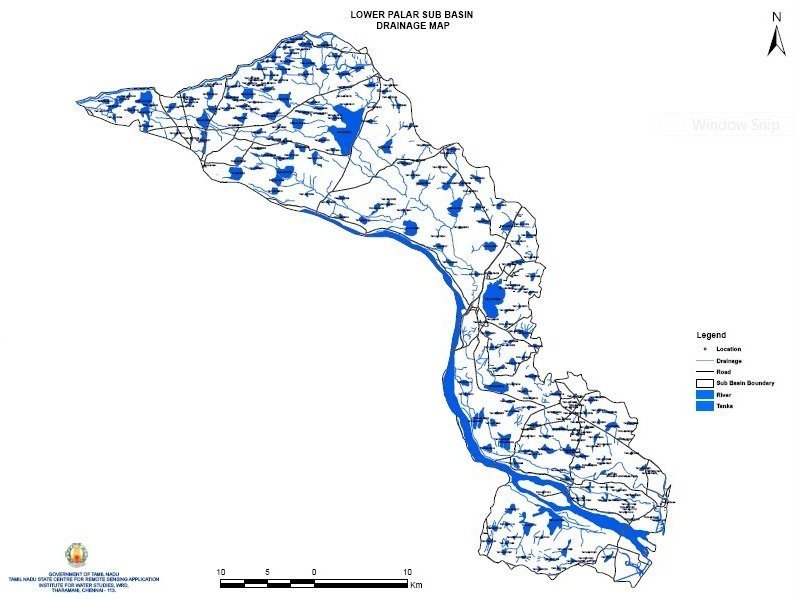
Lava river and Kusa river are the two tributaries to Nagari river. Lava river originates from Krishnapuram reservoir in Chittoor District of Andhra Pradesh and Kusa river originates from the catchement of Pullur hills in Chittoor District of Andhra Pradesh. Lava and Kusa river are joining at Pallipet and it becomes Nagari river. The Nagari river lies in latitude 13 ‘19’00” N and longitude of 79’29’30” E and runs for a length of about 69 Km upto Poondi reservoir. The Nagariyar sub basin covers an area of 236.79 sq. km and having catchment area of 3225 Sq.km in which 790 sq.km in Andhra Pradesh and 2435 sq.km in Tamil Nadu. The Taluks covered in Nagariyar sub-basin are Pallipet, Tiruttani and Tiruvallur of Thiruvallur District.
1.2.1 Irrigation potential of the sub-basin
| Category |
Pallipet |
Tiruttani |
Total |
| Fully irrigated area(ha) |
753.95 |
292.04 |
1045.99 |
| Partially irrigated area(ha) |
187.75 |
38.47 |
226.22 |
| Gap(ha) |
191.68 |
76.94 |
268.62 |
| Total ayacut area (ha) |
1133.38 |
407.45 |
1540.83 |
1.3. Details of Cluster Village in Nagariyar sub-basin
Cluster I – Pallipet Taluk of Tiruvallur District
| S.No. |
IWS.no |
Unique-ID |
Name of tank |
Name of village |
Name of Block |
Ayacut (ha) |
| 1 |
1070 |
TNCH-03-TO247 |
Podhaturpet Tank |
Podaturpet |
Pallipat |
228.37 |
| 2 |
1067 |
TNCH-03-TO179 |
Sanakuppam Tank |
Sanakuppam |
Pallipat |
40.49 |
| 3 |
1063 |
TNCH-03-TO137 |
Pallipet Tank |
Pallipat |
Pallipat |
276.92 |
| 4 |
1064 |
TNCH-03-T0154 |
Karimbedu Tank |
Karimbedu |
Pallipat |
126.70 |
| 5 |
1075 |
TNCH-03-T0253 |
Athimanjeripet Tank |
Athimanjeripet |
Pallipat |
97.54 |
| 6 |
1069 |
TNCH-03-T0181 |
Perumanallur Tank |
Perumanallur |
Pallipat |
92.31 |
| 7 |
1077 |
TNCH-03-T0274 |
Nedungal Tank |
Nedungal |
Pallipat |
44.33 |
| 8 |
1074 |
TNCH-03-T0236 |
Pandaravedu Tank |
Pandaravedu |
Pallipat |
85.83 |
| 9 |
1068 |
TNCH-03-T0190 |
MadhikettanOdai Tank |
Thirumalrajpet |
Pallipat |
140.89 |
|
|
|
|
Total |
|
1133.38 |
1.3.1 Cluster II – Tiruttani taluk of Tiruvallur district
| S.No. |
IWS. No. |
Unique-id |
Name of tank |
Name of village |
Name of Block |
Ayacut (ha) |
| 1 |
1091 |
TNCH-03-TO279 |
SanthanaGopalapuram Tank |
SNG Puram |
Tiruttani |
41.36 |
| 2 |
1078 |
TNCH-03-TO266 |
Nemili Tank |
Nemili |
Tiruttani |
160.98 |
| 3 |
1073 |
TNCH-03-TO235 |
Nallattur Tank |
Nallattur |
Tiruttani |
64.87 |
| 4 |
1071 |
TNCH-03-T0233 |
Chivada Tank |
Chivada |
Tiruttani |
140.24 |
|
|
|
|
|
Total |
407.45 |
1.3.2 Details of walk through survey - Nagariyar sub-basin
| Sl.No |
Name of the tank |
Name of the Block |
Date of walk throughsurvey |
| 1 |
Pandravedu, Podarturpet, Nadungal |
Pallipat |
27.10.2015 |
| 2 |
Pallipat, MadhilettanOdai, Karimbedu |
Pallipat |
28.10.2015 |
| 3 |
Athimanjeri, Perumanallore, Sanakuppam |
Pallipat |
29.10.2015 |
| 4 |
Chivada, Nallatur |
Tirutani |
02.11.2015 |
| 5 |
SanthanagopalapuramNemili |
Tirutani |
03.11.2015 |
The officials of all the line departments’ viz., Water Resources Department, Agriculture, Horticulture, Animal husbandry, Fisheries, Agriculture Engineering, and Agricultural Marketing participated in the walk through survey as per the programme detailed above. The following observations were made during the survey.
- Strengthening of the tank bunds
- De silting of the tank and supply channel
- Repair works in the sluice and weir
- Lining of field channel
- Fixing of boundary stone
- The soil type is red loam, black loam, sandy loam, clayey and swampy with respect to Thiruvallur district
- Major agricultural crops cultivated are Paddy and Sugarcane and horticultural crop like Mango are grown
- Wild boar damage is menace in Paddy and Sugarcane crops
- Vegetable cultivation is a constraint due to water logging condition
- More emphasis on livestock management
1.4 Cropping Pattern
The registered Ayacut area of Nagariyar sub-basin is 1540.83 ha out of which 1272.21 ha under cropped area and 268.62 ha comes under gap area, without any permanent gap area. The major crops cultivated in these sub basins are Paddy and Sugarcane which require more water.
| Name of the subbasin |
: Nagariyar |
Fully Irrigated |
1045.99 |
ha |
| District |
: Tiruvallur |
Partially Irrigated |
226.22 |
ha |
| Registered Ayacut |
1540.83 |
Gap |
268.62 |
ha |
| Total Ayacut Area |
1540.83 |
ha |
|
| Crop |
Without Project |
With Project |
| FI |
PI |
RF/Gap |
Total |
FI |
PI |
RF/Gap |
Total |
| I) Perennial crops |
|
|
|
|
|
|
|
|
| Coconut |
0 |
40.00 |
0 |
40.00 |
|
|
|
|
| Mango |
0 |
152.00 |
0 |
152.00 |
|
3 |
|
3 |
| Others |
0 |
5.00 |
0 |
5.00 |
|
|
|
|
| Total |
0 |
197.00 |
0 |
197.00 |
|
|
|
|
| II) Annual crops |
|
|
|
|
|
|
|
|
| Sugarcane |
521.00 |
78.70 |
0 |
599.70 |
6 |
|
|
6 |
| Banana |
2.00 |
0 |
0 |
2.00 |
|
|
|
|
| Total |
523.00 |
78.70 |
0 |
601.70 |
|
|
|
|
| III) 1st crop |
|
|
|
|
|
|
|
|
| Paddy |
169.00 |
0 |
0 |
169.00 |
|
|
|
|
| Paddy SRI |
75.90 |
0 |
0 |
75.90 |
|
|
|
|
| Cumbu |
0 |
6.00 |
0 |
6.00 |
|
|
|
|
| Ragi |
0 |
26.00 |
0 |
26.00 |
|
|
|
|
| Maize |
0 |
0 |
0 |
0 |
|
|
|
|
| Minor Millets |
0 |
0 |
0 |
0 |
|
|
|
|
| Red Gram |
0 |
44.30 |
0 |
44.30 |
|
|
|
|
| Black Gram |
0 |
19.84 |
0 |
19.84 |
|
|
|
|
| Green Gram |
0 |
0 |
0 |
0 |
|
|
|
|
| Other pulses |
0 |
0 |
0 |
0 |
|
|
|
|
| Groundnut |
0 |
20.00 |
0 |
20.00 |
|
|
|
|
| Gingelly |
0 |
0 |
0 |
0 |
|
|
|
|
| Brinjal |
3 |
0 |
0 |
3.00 |
|
|
|
|
| Bhendi |
3 |
0 |
0 |
3.00 |
|
|
|
|
| Chillies |
0 |
12.00 |
0 |
12.00 |
|
2 |
|
2 |
| Flowers |
2 |
36.90 |
0 |
38.90 |
|
|
|
|
| Fodder Crops |
0 |
0 |
0 |
0 |
|
|
|
|
| Non Agrl. Purposes |
0 |
0 |
57.10 |
57.10 |
|
|
|
|
| Fallow |
0 |
0 |
199.80 |
199.80 |
|
|
|
|
| Total |
252.90 |
165.04 |
256.90 |
674.84 |
|
|
|
|
| Gr. Total(I+II+III) |
775.90 |
440.74 |
256.90 |
1473.54 |
|
|
|
|
| IInd crop |
|
|
|
|
|
|
|
|
| Paddy |
195.00 |
25.20 |
0 |
220.20 |
15 |
|
|
15 |
| Paddy SRI |
31.00 |
0 |
0 |
31.00 |
|
|
|
|
| Ragi |
0 |
16.00 |
0 |
16.00 |
|
|
|
|
| Maize |
0 |
23.60 |
0 |
23.60 |
|
|
|
|
| Minor Millets |
0 |
0 |
0 |
0 |
|
|
|
|
| Black Gram |
0 |
61.80 |
0 |
61.80 |
|
4 |
|
4 |
| Green Gram |
0 |
40.20 |
0 |
40.20 |
|
|
|
|
| Groundnut |
0 |
27.00 |
0 |
27.00 |
|
|
|
|
| Total |
226.00 |
194.00 |
0 |
420.00 |
|
|
|
|
| IIIrd crop |
|
|
|
|
|
|
|
|
| Paddy |
161.00 |
15.00 |
0 |
176.00 |
10 |
|
|
10 |
| Paddy SRI |
15.10 |
0 |
0 |
15.10 |
|
|
|
|
| Black Gram |
0 |
0 |
0 |
|
|
|
|
|
| Total |
176.00 |
15.00 |
0 |
191.00 |
25 |
15 |
|
40 |
| Gr.Total |
1178.00 |
650.00 |
257 |
2085.00 |
|
|
|
|
| Cropping Intensity |
|
|
|
141.5% |
|
|
|
|
2.Constraints identified in the Tiruvallur District (Nagariyar sub-basin)
An analysis of the area, production and yield of rice during the period between 1996-97 and 2012-13 shows that the area under paddy was above one lakh ha up to the year 1999-2000 and then slightly declined to 66734 ha during 2004-05 and then started fluctuating between 70,000 and 97,000 ha up to 2012-13. Rice production in the district was hovering between 2 lakhs and 4 lakhs tonnes during the periods between 1996-97 and 2012-13. Yield data shows the same pattern as that of production up to 2008-09 and after that shows a different pattern. Hence yield gap analysis revealed that, average potential yield of all the varieties was calculated as 5526.67 kg/ha and the average yield of all varieties at the farm level was calculated as 4801 kg/ha. Over all yield gap was calculated as 5526.67 – 4801 = 1086.83 kg/ha. (CCPC, Director, CARDS, TNAU, 2016).
Possible constraints to achieve the potential yield levels may be attributed to factors related to urbanization, crop diversification, industrialization etc., Apart from these the combined and interacting effects of temperature, radiation, and precipitation changes with the positive effect of CO2, the negative effects of O3 and other pollutants, also determines the productivity levels.
The productivity in agriculture dependent on the availability of water resources, whether it is reliable rainfall or irrigation from surface or groundwater sources. Competition for water from urban areas, industry affects the productivity in agriculture. The scenario of employment decides the availability of labour for agriculture which in turn affects the productivity. Continuous cropping without addition of adequate manure affecting the fertility of soil which is the major limiting factor for the productivity of crops.Hence, any interventions proposed to improve paddy cultivation in the district by addressing these constraints will provide good scope to enhance the crop yield up to 20 percent.
Objectives
- To promote water saving technologies (SRI / Precision farming) in agricultural and horticultural crops for large scale adoption..
- To enhance crop and water productivity.
- To increase the cropped area by Crop diversification.(Improved Production Technologies
Issues
Rice
- Low yield due to use of traditional cultivars
- Low water use efficiency
- Imbalanced application of nutrients
- Micronutrient deficiency in soil of Tiruvallur district is high for Zn (53.8%). Availability of zinc may be reduced by water logging and where root growth is restricted. Cool wet weather, low light intensity or high soil nitrogen, phosphorus or copper may intensify the deficiency.
- Zinc deficiency being an important nutrient constraint which decreases tillering, increases spikelet sterility and time to crop maturity in rice.
- Poor population maintenance
- Non adoption of SRI in paddy
Pulses
- Low yield due to use of traditional cultivars and low fertilizer use efficiency
Sugarcane
- Low yield due to use of traditional technologies Non-judicious use of water and low water use efficiency
- Improper use of nutrients
- Poor millable canes
- Labour shortage
Mango
- Low yield due to use of traditional cultivars
- Low improved and innovative Technology adoption
- Lack of awareness of postharvest technology management(effective/ efficient marketing)
Suggestive measures proposed
- Improved production/climate resilient technologies in rice
- Improved Production/Micro Irrigation/IPM Technologies in Pulses
- Sustainable Sugarcane Initiative (SSI)
- Precision farming in Mango with high density planting
3. Field Interventions
3.1. Improved Production Technology in Rice cultivation
| Sl.No |
Technology |
Area (ha) |
Unit Cost (Rs./ha) |
Budget(Rs. In lakh) |
| 1 |
IPT in Rice cultivationGreen manure + SRI |
25 |
8000 |
2.00 |
Green manure application is must to maintain the organic carbon content and humus in soil so that soil problems like salinity can be prevented, soil nutrient availability is enhanced, and activity of beneficial macro and microbial organisms are favoured. Hence, this technology is to be popularized before raising the rice crop to show cause the farmers on the merits of maintaining the soil health for better crop bio-environment.
Details of Unit Cost Split-up: Green manure
| S.No. |
Particulars |
Amount (Rs.) |
| 1. |
Seed cost 40 kg/ha @ Rs. 50/kg |
2000.00 |
|
Grand Total |
2000.00 |
Details of Unit Cost Split-up: SRI
| S. No |
Particulars |
Amount(Rs.) |
| 1 |
Cost of Soil testing |
20.00 |
| 2 |
Seed cost - 10 kg / ha @ Rs.30/kg |
300.00 |
| 3 |
Cost of nursery raising |
- |
| 4 |
Cost of fertilizers (150:50:50 kg NPK / ha) |
|
Urea - 300 kg/ha @ Rs.6 /kg |
1,800.00 |
|
Muriate of Potash – 80 kg @ Rs.16/kg |
1,280.00 |
|
ZnSO4 25 kg @ Rs.40/kg |
1,000.00 |
| 5 |
Bio fertilizer & Bio inoculants |
1,600.00 |
|
Grand Total |
6,000.00 |
3.1.2. SRI
Zinc is important for the formation and activity of chlorophyll and in the functioning of several enzymes and the growth hormone, auxin. Zinc application increases the crop growth rate and yield of rice. To increase water use efficiency adopting safe AWDI using field water tube.
| Sl.No |
Technology |
Area(Ha) |
Unit Cost (Rs./ha) |
Budget(Rs. In lakh) |
| 1 |
SRI (AWDI) |
45 |
6000 |
2.70 |
Details of Unit Cost Split-up: SRI
| S. No |
Particulars |
Amount(Rs.) |
| 1 |
Cost of Soil testing |
20.00 |
| 2 |
Seed cost - 10 kg / ha @ Rs.30/kg |
300.00 |
| 3 |
Cost of nursery raising |
- |
| 4 |
Cost of fertilizers (150:50:50 kg NPK / ha) |
|
Urea - 300 kg/ha @ Rs.6 /kg |
1,800.00 |
|
Muriate of Potash – 80 kg @ Rs.16/kg |
1,280.00 |
|
ZnSO4 25 kg @ Rs.40/kg |
1,000.00 |
| 5 |
Bio fertilizer & Bio inoculants |
1,600.00 |
|
Grand Total |
6,000.00 |
3.2. Area Enhancement, Area Expansion and productivity enhancement of pulses under crop diversification in gap areas:
Farmers are not adopting the latest crop production technologies like use of improved high yielding varieties and latest technologies in pulses. Hence it is proposed to conduct demonstration involving improved technologies in pulses viz., use of seeds of high yielding varieties, balanced nutrition and scientific water management. Under this, cost of critical inputs like seeds and nutrients are included.
| Sl.No |
Technology |
Area (ha) |
Unit Cost (Rs./ha) |
Budget(Rs. In lakh) |
| 1 |
Area Enhancement, Area Expansion and productivity enhancement of pulses |
5 |
5000 |
0.25 |
Details of Unit Cost Split-up– Area expansion in pulses
| S. No |
Particulars |
Amount(Rs.) |
| 1. |
Cost of Soil testing |
20.00 |
| 2. |
Seed cost with seed treatment - 20 kg / ha @ Rs.150/kg |
3,000.00 |
| 3. |
DAP 25 kg / ha @ Rs.22.50/kg |
560.00 |
| 4. |
Pulse Wonder 2 kg/ha @ Rs.220/kg |
440.00 |
| 5. |
Bio fertilizers and Bio inoculants |
980.00 |
|
Grand Total |
5000.00 |
3.3. Sustainable Sugarcane Initiative (SSI)
Sustainable Sugarcane Initiative is a method of sugarcane production which involves using less seed material, less water and efficient use of externally applied nutrients and land to achieve more yields. Driven by farmers, SSI is an alternate to conventional seed material, water and space intensive Sugarcane cultivation. The improved crop production technologies in sugarcane cultivation will be demonstrated to maximize the yield.
| Sl.No |
Technology |
Area (ha) |
Unit Cost (Rs./ha) |
Budget(Rs. In lakh) |
| 1 |
SSI |
5 |
100000 |
5.00 |
Details of Unit Cost Split-up– SSI
| S. No |
Particulars |
Amount (Rs.) |
| 1. |
Drip cost as per the Govt. norms @ 75% subsidy |
64,200.00 |
| 2. |
Cost of Seedlings/ha (15000 Nos./ha) @ Rs.1.5 |
22,500.00 |
| 3. |
Water Soluble fertilizers |
|
12:61:00 – 100 kg @ Rs.100/kg |
10,000.00 |
|
00:00:50 – 225 kg @ Rs.75/kg |
| 4. |
Bio Fertilizers & Bio pesticide |
1,550.00 |
| 5. |
Sugarcane booster 5 kg/ha @ s.350/kg |
1,750.00 |
|
Grand Total |
1,00,000.00 |
3.4. Introduction of new technologies in fruit crops by demonstrating TNAU High density planting with drip fertigation in Mango/Pomegranate
The improved crop production technologies viz., high density planting with drip fertigation will be demonstrated in two ha.
| S.No. |
Technology |
Total area (ha) |
Unit cost (Rs.) |
Total cost(in lakhs) |
| 1 |
Precision farming in Mango(High density planting with MI) |
2 |
75000 |
1.50 |
Details of Unit Cost Split-up– PF in Mango with High density planting
| S.No |
Particulars |
Amount (Rs.) |
| 1. |
Drip cost as per the Govt. norms @75% Subsidy |
26,000.00 |
| 2. |
Cost of Seed/Seedlings (400 Nos./ha) |
28,000.00 |
| 3. |
Water Soluble fertilizers (19:19:19, MAP, Urea) |
19,500.00 |
| 4. |
Bio inoculants & Bio fertilizers |
1,500.00 |
|
Grand Total |
75,000.00 |
4. Information, Education & Communication (IEC charges) including Awareness creation, Documentation and IEC equipment
4.1. Capacity building
4.1.1. Training to stakeholders
Under this activity, imparting training to all the beneficiaries either as off-campus or as on-campus is planned.
| Sl. No. |
Particulars |
Duration (days) |
No/batch |
Total batch |
Total budget (lakhs) |
| 1. |
Improved production technology in rice through SRI |
1 |
50 |
2 |
0.10 |
| 2. |
Improved production technology in rice through SRI and AWD |
1 |
50 |
2 |
0.10 |
| 3. |
Improved production technology in pulses |
1 |
50 |
2 |
0.10 |
| 4. |
Sustainable Sugarcane Initiative |
1 |
50 |
2 |
0.10 |
| 5. |
Precision farming in Mango with HDP |
1 |
50 |
2 |
0.10 |
4.1.2. Exposure visit
In-order to have practical knowledge on various improved farming practices prevailing across the District and State, it has been proposed to expose the stakeholders by organizing educational tours for having better cross learning.
4.2. IEC
4.2.1. Awareness Creation - Organize awareness campaign
- Informal meetings with Farmers / Water Users Association through PRA methods – Focus group discussion and transect walk
- Ensure transparency
- Explain about the scheme – organization objectives, activities, project contribution and farmers share
- Emphasis the role of stake holders in the project
- Project the expected benefit
4.2.3 Maintenance of records and registers
- Field note for each activity
- Daily memorandum sheet
- Receipt and issue of inputs
- Technical observations on soil, water and crop
4.2.4. IEC Equipments
- Purchase of Laptop, camera and Computer accessories
4.2.4. Out sourcing vehicle charges
- Expenditure on TA /DA for the purpose of TNIAMP
- Fuel bill of university vehicle utilized for the project
- Hire charges of university vehicle utilized for this purpose
5. Management cost
5.1. Outsourcing of technical staff
Outsourcing of technical staff is included in TNAU sub basin plan to carry out the field activities and to create zone of influence in sub basin area.
6. Year Wise Activities
| S. No. |
Particulars |
Area (ha) |
Total(ha) |
| I year |
II year |
| 1. |
IPT in Rice cultivation(GM+SRI) |
10 |
15 |
25 |
|
SRI |
20 |
25 |
45 |
| 2 |
IPT in Pulses(Area expansion) |
3 |
2 |
5 |
| 3 |
SSI |
2 |
3 |
5 |
| 4 |
Precision farming in Mango |
2 |
0 |
2 |
|
|
37 |
45 |
82 |
Total Budget (Year wise) for Nagariyar Sub-basin
P-Physical in ha F-Financial in rupees
| S. No |
Particulars |
I Year |
II Year |
III Year |
IV Year |
V Year |
VI Year |
Total |
| A |
Field Interventions |
Unit cost Rs/ha |
P |
F |
P |
F |
P |
F |
P |
F |
P |
F |
P |
F |
P |
F |
| 1 |
GM-SRI |
8000 |
10 |
0.80 |
15 |
1.20 |
0 |
0.00 |
0 |
0.00 |
0 |
0.00 |
0 |
0.00 |
25 |
2.00 |
|
SRI |
6000 |
20 |
1.20 |
25 |
1.50 |
0 |
0.00 |
0 |
0.00 |
0 |
0.00 |
0 |
0.00 |
45 |
2.70 |
| 2 |
Area Enhancement, Area Expansion and productivity enhancement of pulses under crop diversification in gap areas: (Black gram/greengram) |
5000 |
3 |
0.15 |
2 |
0.10 |
0 |
0.00 |
0 |
0.00 |
0 |
0.00 |
0 |
0.00 |
5 |
0.25 |
| 3 |
Sustainable Sugarcane Initiative (SSI) |
100000 |
2 |
2.00 |
3 |
3.00 |
0 |
0.00 |
0 |
0.00 |
0 |
0.00 |
0 |
0.00 |
5 |
5.00 |
| 4 |
TNAU High density planting with MI in Mango/Pomegranate |
75000 |
2 |
1.50 |
0 |
0.00 |
0 |
0.00 |
0 |
0.00 |
0 |
0.00 |
0 |
0.00 |
2 |
1.50 |
|
Total |
|
37 |
5.65 |
45 |
5.80 |
0 |
0.00 |
0 |
0.00 |
0 |
0.00 |
0 |
0.00 |
82 |
11.45 |
| B |
Implements for farm mechanization |
|
|
|
|
|
|
|
|
|
|
|
|
|
|
|
| 1 |
Cono weeder |
|
0 |
0.00 |
0 |
0.00 |
0 |
0.00 |
0 |
0.00 |
0 |
0.00 |
0 |
0.00 |
0 |
0.00 |
|
Total(A+B) |
|
37 |
5.65 |
45 |
5.80 |
0 |
0 |
0 |
0 |
0 |
0 |
0 |
0 |
82 |
11.45 |
| E |
IEC & CB |
|
|
|
|
|
|
|
|
|
|
|
|
|
|
|
| 1 |
Capacity Building |
|
|
|
|
|
|
|
|
|
|
|
|
|
|
|
|
a. Training to Stakeholders |
|
|
0.25 |
|
0.20 |
|
0.00 |
|
0.00 |
|
0.00 |
|
0.00 |
|
0.45 |
|
b. Exposure visit |
|
|
0.10 |
|
0.10 |
|
0.00 |
|
0.00 |
|
0.00 |
|
0.00 |
|
0.20 |
| 2 |
IEC |
|
|
|
|
|
|
|
|
|
|
|
|
|
|
|
|
a. Awareness creation |
|
|
0.00 |
|
0.00 |
|
0.00 |
|
0.00 |
|
0.00 |
|
0.00 |
|
0.00 |
|
b.Documentation |
|
|
0.10 |
|
0.10 |
|
0.05 |
|
0.00 |
|
0.05 |
|
0.05 |
|
0.35 |
|
c. IEC equipments |
|
|
0.30 |
|
0.00 |
|
0.00 |
|
0.00 |
|
0.00 |
|
0.00 |
|
0.30 |
|
d.Out sourcing charges on vehicles |
|
|
0.25 |
|
0.25 |
|
0.05 |
|
0.05 |
|
0.10 |
|
0.10 |
|
0.80 |
|
Total |
|
|
1.00 |
|
0.65 |
|
0.10 |
|
0.05 |
|
0.15 |
|
0.15 |
|
2.10 |
| F |
Management cost |
|
|
|
|
|
|
|
|
|
|
|
|
|
|
|
| 1 |
Out sourcing of technical staff |
|
|
1.20 |
|
1.20 |
|
0.00 |
|
0.00 |
|
0.00 |
|
0.00 |
|
2.40 |
|
Total |
|
|
1.20 |
|
1.20 |
|
0.00 |
|
0.00 |
|
0.00 |
|
0.00 |
|
2.40 |
|
Over all Total |
|
|
7.85 |
|
7.65 |
|
0.10 |
|
0.05 |
|
0.15 |
|
0.15 |
|
15.95 |
NAGARIYAR SUB-BASIN ABSTRACT
| S.No |
Intervention details |
Unit cost Rs/ha |
P |
F |
| I |
A. Field Interventions |
| 1 |
Green manure - SRI |
8000 |
25 |
2.00 |
|
System of Rice Intensification |
6000 |
45 |
2.70 |
| 2 |
Area Enhancement, Area Expansion and productivity enhancement of pulses under crop diversification in gap areas: |
5000 |
5 |
0.25 |
| 3 |
Promotion of Sustainable Sugarcane Initiative (SSI) in sub basin under precision farming approach. Scaling up SSI through joint venture with the nearby Sugar mills. |
100000 |
5 |
5.00 |
| 4 |
Introduction of new technologies in fruit crops by demonstrating TNAU High density planting with drip fertigaiton in Mango/Pomegranate etc., |
75000 |
2 |
1.50 |
|
B. Implements for farm mechanization |
|
|
|
| 5 |
Conoweeder |
1000 |
0 |
0.00 |
|
Sub Total (A+B) |
|
82 |
11.45 |
| II |
Information Education Communication (IEC) Measures &Capacity Building |
|
|
|
| 1 |
Capacity Building |
|
|
|
|
Training to stakeholders |
|
|
0.45 |
|
Exposure visit |
|
|
0.20 |
| 2 |
IEC |
|
|
|
|
Awareness creation |
|
|
0.00 |
|
Documentation |
|
|
0.35 |
|
IEC Equipments |
|
|
0.30 |
|
Outsourcing charges on vehicles |
|
|
0.80 |
|
Total |
|
|
2.10 |
| III |
Management cost |
|
|
|
| 1 |
Outsourcing of technical cost |
|
|
2.40 |
|
Total |
|
|
2.40 |
|
Over all total (I+II+III) |
|
|
15.95 |