1. Introduction
A. About National Pulses Research Centre
National Pulses Research Centre (NPRC), under the aegis of Tamil Nadu Agricultural University was established in 1979 at Vamban in Pudukkottai district. It is the lead centre for the research on pulses in the state. This is one of the identified centres under All India Co-ordinated Research Project (AICRP) on Pulses under Indian Council of Agricultural Research (ICAR). Since its inception, the centre has made significant progress in all spheres of pulses research to improve the yield, stability and food quality of the major pulse crops suited for the rainfed and less fertile soils in the state. To evolve high yielding, pest and disease resistant pulse varieties, to evolve technologies for maximizing productivity by proper agronomic management practices in pulses and to develop technologies for effectively managing the major insect pests and diseases of pulses with these mandates NPRC is functioning.
So far NPRC released 16 varieties including Redgram 3, Blackgram 8, Greengram 3, Cowpea 2 and Varagu one varieties. The technologies viz., application of 25 kg and 12.5 kg of potash to irrigated and rainfed pulses respectively and sulphur @ 20 kg/ha increases the yield of blackgram and greengram and foliar spray of 2 % DAP at pre-flowering, flowering and pod filling stages has significantly increased the grain yield in blackgram and greengram crops were developed. High yielding and Yellow Mosaic Virus (YMV) and leaf crinkle diseases resistance varieties such as TNAUBlackgram VBN 6 and TNAUBlackgram VBN 8 were released.
B. Basic information about the sub-basin
Ponnanaiyar sub basin comes under the Cauvery river basin. It has 10375.94 ha ayacut area which comprise of anicut, tanks and direct ayacut. This sub basin consists of six blocks viz., Manapparai, Vaiyampatti, Manikandam and Tiruverumbur in Tiruchirapalli district and Viralimalai and Annavasal in Pudukkottai district. This basin has 87 non system and system tanks, 15 channels and 14 anicuts.
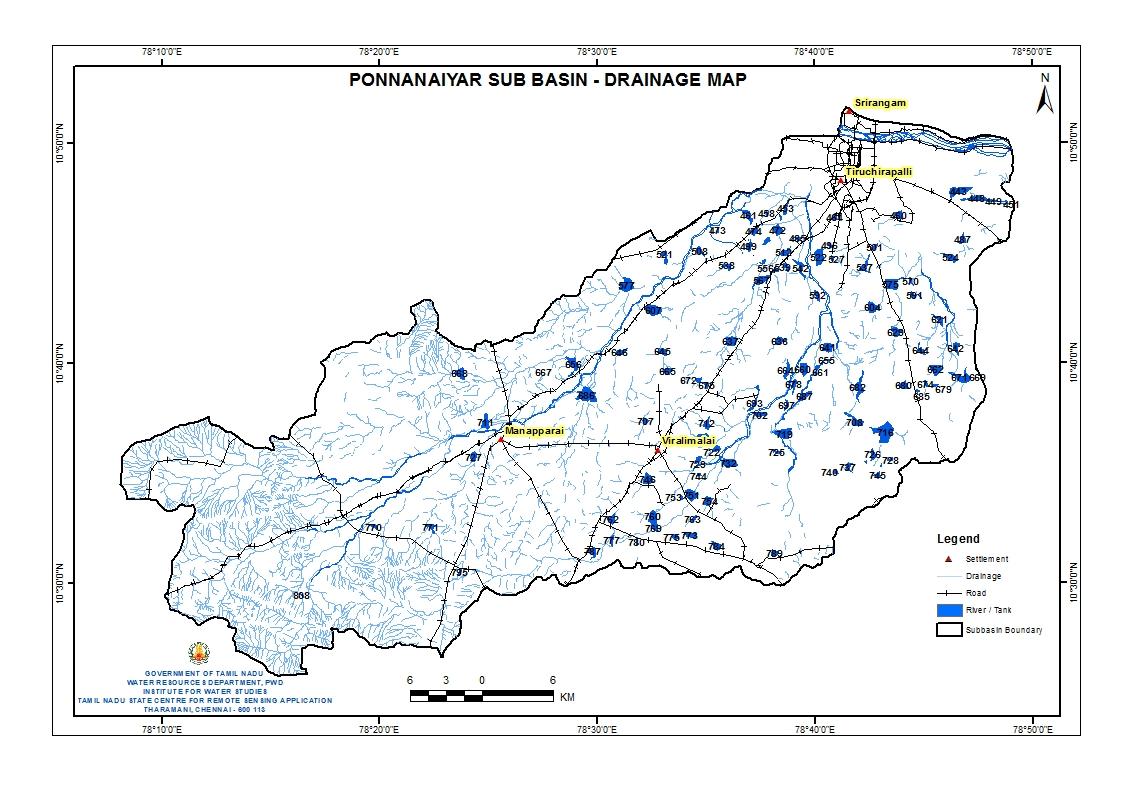
(i) Area
| Particulars |
Pudukkottai |
Tiruchirapalli |
Total |
| Fully irrigated area |
1724.85 ha |
5775.26 ha |
7500.11 ha |
| Partially irrigated area |
610.79 ha |
1409.89 ha |
2020.68 ha |
| Gap |
547.70 ha |
2054.28 ha |
2601.98 ha |
| Total ayacut area |
2883.34 ha |
7538.23 ha |
10375.94 ha |
(ii) Villages covered under Ponnanaiyar sub-basin
| Name of the District |
Name of the Block |
Name of the Villages |
| Pudukkottai |
Viraalimalai |
Agarapatti, Neerpalani, Kathaloor, Mullaiyur, Madhayanaipatti, Perambur, Thennambadi, Vilapatti, Vittamapatti, Boodakudi, Kodumbaloor, Letchumanampatti, Theravur, Vemmani, Avaiyarpatti, Avoor, Rajagiri, Kalkudi, Kumaramangalam, Mathur, Pakkudi, Sooriyur, Velur, Viraloor |
| Annavaasal |
Thirunallur, Kattakudi, Kothirapatty, Easwarankoil Punginipatty |
| Tiruchirapalli |
Manapparai |
Sevalur, Pannappatti, Samudram, A.Reddiyappati |
| Vaiyampatty |
A.Reddiapatti, Chettiyapatty, Vengaikurichi, Vaiyampatti, Elamanam, Muhavanoor |
| Manikandam |
Navalurkuttapatti, Tayanur, Kallakudi, Kothamangalam Alundur, Kolukkattaikudi, Thorakkudi, Paganur, Kumaravadi, Arayakudi, Esanapatti, Manikandam, Senguruchi, Ponngudi, Panjapur, Meikkudi, Olaiour, Sathanur, Vadugapatty, Udayanpatty |
| Tiruverumbur |
Suriyur, Koothapar, Krishna samutharam, Edamalai pattipudur, Sempattu, Gundur, Puthur, Thiru vilarchiapatti, Navalpattu |
(iii) Climate and Rainfall distribution
| S. No |
Season |
Average Rainfall(mm) |
| 1. |
South West Monsoon |
346.40 |
| 2. |
North East Monsoon |
403.20 |
| 3. |
Summer |
199.20 |
| 4. |
Winter |
50.60 |
|
Total |
999.40 |
(iv) Cropping pattern
| S. No. |
Source |
Season |
Period |
| 1. |
Wet Land condition |
Kuruvai |
June - July |
|
|
Samba |
September - October |
| 2. |
Dry land condition |
Kharif |
April- September |
|
|
Rabi |
October - March |
2. Details of walk through survey - Ponnanaiyar Sub Basin
| S. No |
Name of the Village |
Date of walk throughsurvey |
| 1 |
Kodumbalur |
14.12.2015 |
| 2 |
Viralur and Thennambadi |
15.12.2015 |
| 3 |
Thirunallar |
17.12.2015 |
| 4 |
Perambur |
18.12.2015 |
The officials of all the line departments’ viz., Public works department, Agriculture, Horticulture, Animal husbandry, Fisheries, Agriculture Engineering, and Agricultural Marketing participated in the walk through survey as per the programme detailed above. The following observations were made during the survey
| Constraints and Challenges |
Counter Measures |
| Low yield in rice, pulses and cereals due to use of traditional varieties and practicing traditional methods of cultivation |
Popularization of SRI and mechanized planting in rice cultivationUsage of latest varieties and technologies Use of water saving technologies to enhance WUEIncreasing pulses production by adopting SPI |
| Problem soils |
Reclamation of problem soils by lime and gypsum application Enrichment of soil fertility through distribution of Green manure crop seeds , providing vermicasting permanent structure and application of farmyard manure and biofertilizers |
| Adverse climatic conditionsand water stress |
Suitable drought resistance varieties and varieties which are require low water will be recommended to the needy areas. Drought management agronomic / cultural practices will be introduced in these locations. |
| Limited availability and distribution of certified seed from GovernmentSources / private. High cost of hybrid seeds. |
Encouraging farmers to go for seed production in their field itselfModel seed village concept and to train the farmers in crop seed productionSupply of seeds through National seeds corporation and other private sources will also be arranged by following the World Bank procurement norm |
| Improper irrigation practices (Flood irrigation) |
SRI Technique in Paddy crop will be popularized among the farmers through SRI demonstrations. Drip irrigation will be introduced for the crops like Maize and redgram. |
| Capacity Building / Exposure visit |
Adoption of Integrated Farming System (IFS)Farmers will be educated on risk aversion through trainings, capacity building programmes. Demonstrations will be laid in the farmers’ field for important crops like Paddy, Maize, Groundnut, pulses etc. to educate the farmers on various production technologies to be adopted. Farmer from these areas have to be visited nearest state to see the technology adapted in the same field problem to create awareness among the farmers. |
3 Cropping Pattern
District: Pudukkottai
| Name of the sub Basin |
Ponnanaiyar |
| Nodal District |
Pudukkottai |
| Registered Ayacut Area |
2891.85 ha |
| Total Ayacut Area |
2891.85 ha |
| Fully Irrigated |
1751.58 ha |
| Partially Irrigated |
598.91 ha |
| Gap |
541.36 ha |
| S.No |
Crop |
Without Project |
With Project |
Increasing |
| FI |
PI |
RF/G |
Total |
FI |
PI |
RF/G |
Total |
| I |
Perennial crop |
|
|
|
|
|
|
|
|
|
| 1 |
Coconut |
0.00 |
0.00 |
0.00 |
0.00 |
0.00 |
0.00 |
0.00 |
0.00 |
0.00 |
| 2 |
Mango |
0.00 |
0.00 |
0.00 |
0.00 |
0.00 |
0.00 |
0.00 |
0.00 |
0.00 |
| 3 |
Guava |
0.00 |
0.00 |
0.00 |
0.00 |
0.00 |
0.00 |
0.00 |
0.00 |
0.00 |
| 4 |
Cashew |
0.00 |
0.00 |
0.00 |
0.00 |
0.00 |
0.00 |
0.00 |
0.00 |
0.00 |
| 5 |
Casurina |
0.00 |
0.00 |
0.00 |
0.00 |
0.00 |
0.00 |
0.00 |
0.00 |
0.00 |
| 6 |
Flowers\Tube Rose |
0.00 |
0.00 |
0.00 |
0.00 |
0.00 |
0.00 |
0.00 |
0.00 |
0.00 |
| 7 |
Fodder |
0.00 |
0.00 |
0.00 |
0.00 |
0.00 |
0.00 |
0.00 |
0.00 |
0.00 |
|
Total |
0.00 |
0.00 |
0.00 |
0.00 |
0.00 |
0.00 |
0.00 |
0.00 |
0.00 |
| II |
Annual Crop |
|
|
|
|
|
|
|
|
|
| 1 |
Sugarcane |
0.00 |
0.00 |
0.00 |
0.00 |
0.00 |
0.00 |
0.00 |
0.00 |
0.00 |
| 2 |
Banana |
0.00 |
0.00 |
0.00 |
0.00 |
0.00 |
0.00 |
0.00 |
0.00 |
0.00 |
| 3 |
T.C. Banana |
0.00 |
0.00 |
0.00 |
0.00 |
0.00 |
0.00 |
0.00 |
0.00 |
0.00 |
|
Total |
0.00 |
0.00 |
0.00 |
0.00 |
0.00 |
0.00 |
0.00 |
0.00 |
0.00 |
| III |
1st crop |
0.00 |
0.00 |
0.00 |
0.00 |
0.00 |
0.00 |
0.00 |
0.00 |
0.00 |
| 1. a |
Paddy |
0.00 |
0.00 |
0.00 |
0.00 |
0.00 |
0.00 |
0.00 |
0.00 |
0.00 |
| b |
Paddy – SRI |
0.00 |
0.00 |
0.00 |
0.00 |
0.00 |
0.00 |
0.00 |
0.00 |
0.00 |
| 2 |
Maize |
0.00 |
0.00 |
0.00 |
0.00 |
0.00 |
0.00 |
0.00 |
0.00 |
0.00 |
| 3 |
Pulses |
0.00 |
0.00 |
0.00 |
0.00 |
0.00 |
0.00 |
0.00 |
0.00 |
0.00 |
| 4 |
Groundnut |
0.00 |
0.00 |
0.00 |
0.00 |
0.00 |
0.00 |
0.00 |
0.00 |
0.00 |
| 5 |
Cumbu |
0.00 |
0.00 |
0.00 |
0.00 |
0.00 |
0.00 |
0.00 |
0.00 |
0.00 |
| 6 |
Tomato |
0.00 |
0.00 |
0.00 |
0.00 |
0.00 |
0.00 |
0.00 |
0.00 |
0.00 |
| 7 |
Bhendi |
0.00 |
0.00 |
0.00 |
0.00 |
0.00 |
0.00 |
0.00 |
0.00 |
0.00 |
| 8 |
Brinjal |
0.00 |
0.00 |
0.00 |
0.00 |
0.00 |
0.00 |
0.00 |
0.00 |
0.00 |
| 9 |
Gourds |
0.00 |
0.00 |
0.00 |
0.00 |
0.00 |
0.00 |
0.00 |
0.00 |
0.00 |
| 10 |
Radish |
0.00 |
0.00 |
0.00 |
0.00 |
0.00 |
0.00 |
0.00 |
0.00 |
0.00 |
| 11 |
Curry leaf |
0.00 |
0.00 |
0.00 |
0.00 |
0.00 |
0.00 |
0.00 |
0.00 |
0.00 |
| 12 |
Cluster Beans |
0.00 |
0.00 |
0.00 |
0.00 |
0.00 |
0.00 |
0.00 |
0.00 |
0.00 |
| 13 |
Greens |
0.00 |
0.00 |
0.00 |
0.00 |
0.00 |
0.00 |
0.00 |
0.00 |
0.00 |
| 14 |
Watermelon |
0.00 |
0.00 |
0.00 |
0.00 |
0.00 |
0.00 |
0.00 |
0.00 |
0.00 |
| 15 |
Tapiaco |
0.00 |
0.00 |
0.00 |
0.00 |
0.00 |
0.00 |
0.00 |
0.00 |
0.00 |
| 16 |
Chillies |
0.00 |
0.00 |
0.00 |
0.00 |
0.00 |
0.00 |
0.00 |
0.00 |
0.00 |
| 17 |
Beans |
0.00 |
0.00 |
0.00 |
0.00 |
0.00 |
0.00 |
0.00 |
0.00 |
0.00 |
| 18 |
Veg Cowpea |
0.00 |
0.00 |
0.00 |
0.00 |
0.00 |
0.00 |
0.00 |
0.00 |
0.00 |
| 19 |
Corinader |
0.00 |
0.00 |
0.00 |
0.00 |
0.00 |
0.00 |
0.00 |
0.00 |
0.00 |
| 20 |
Crossandra |
0.00 |
0.00 |
0.00 |
0.00 |
0.00 |
0.00 |
0.00 |
0.00 |
0.00 |
| 21 |
Fodder Cholam |
0.00 |
0.00 |
0.00 |
0.00 |
0.00 |
0.00 |
0.00 |
0.00 |
0.00 |
| 22 |
Fallow |
0.00 |
0.00 |
0.00 |
0.00 |
0.00 |
0.00 |
0.00 |
0.00 |
0.00 |
|
Total |
0.00 |
0.00 |
0.00 |
0.00 |
0.00 |
0.00 |
0.00 |
0.00 |
0.00 |
|
Grand Total (I+II+III) |
0.00 |
0.00 |
0.00 |
0.00 |
0.00 |
0.00 |
0.00 |
0.00 |
0.00 |
| IV |
2 nd crop |
|
|
|
|
|
|
|
|
|
| 1. a |
Paddy |
625.00 |
0.00 |
0.00 |
625.00 |
|
0.00 |
0.00 |
0.00 |
625.00 |
| b |
Paddy - SRI |
531.00 |
0.00 |
0.00 |
531.00 |
1800.00 |
0.00 |
0.00 |
1800.00 |
-1269.00 |
| 2 |
Maize |
0.00 |
0.00 |
0.00 |
0.00 |
200.00 |
0.00 |
0.00 |
200.00 |
-200.00 |
| 3 |
Pulses |
253.58 |
264.00 |
220.00 |
737.58 |
325.00 |
410.00 |
0.00 |
735.00 |
2.58 |
| 4 |
Groundnut |
342.00 |
334.91 |
321.36 |
998.27 |
420.00 |
445.00 |
0.00 |
865.00 |
133.27 |
| 5 |
Bhendi |
0.00 |
0.00 |
0.00 |
0.00 |
0.00 |
0.00 |
0.00 |
0.00 |
0.00 |
|
Total |
1751.58 |
598.91 |
541.36 |
2891.85 |
2745.00 |
855.00 |
0.00 |
3600.00 |
-708.15 |
| V |
3rd crop |
|
|
|
|
|
|
|
|
|
| 1. a |
Paddy |
0.00 |
0.00 |
0.00 |
0.00 |
0.00 |
0.00 |
0.00 |
0.00 |
0.00 |
| b |
Paddy - SRI |
0.00 |
0.00 |
0.00 |
0.00 |
200.00 |
0.00 |
0.00 |
200.00 |
0.00 |
| 2 |
Pulses |
0.00 |
0.00 |
0.00 |
0.00 |
115.00 |
220.00 |
0.00 |
335.00 |
0.00 |
| 3 |
Groundnut |
0.00 |
0.00 |
0.00 |
0.00 |
135.00 |
290.00 |
0.00 |
425.00 |
0.00 |
|
Total |
1751.58 |
0.00 |
0.00 |
0.00 |
0.00 |
0.00 |
0.00 |
960.00 |
0.00 |
|
Grand Total |
3503.16 |
598.91 |
541.36 |
2891.85 |
2745.00 |
855.00 |
0.00 |
4560.00 |
1668.15 |
|
Cropping Intensity |
|
|
|
100.00% |
|
|
|
157.68% |
|
District: Tiruchirapalli
| Name of the sub Basin |
Ponnanaiyar |
| District |
Tiruchirapalli |
| Registered Ayacut Area |
7438.459 ha |
| Total Ayacut Area |
7215.699ha |
| Fully Irrigated |
1750.578ha |
| Partially Irrigated |
4323.546ha |
| Gap |
1141.775ha |
| S.No |
Crop |
Without Project |
With Project |
Increasing |
| FI |
PI |
RF/G |
Total |
FI |
PI |
RF/G |
Total |
| I |
Perennial crop |
|
|
|
|
|
|
|
|
|
| 1 |
Coconut |
0.00 |
11.20 |
0.00 |
11.20 |
0.00 |
11.20 |
0.00 |
11.20 |
0.00 |
| 2 |
Mango |
0.00 |
0.00 |
0.00 |
0.00 |
0.00 |
0.00 |
0.00 |
0.00 |
0.00 |
| 3 |
Guava |
0.00 |
0.00 |
0.00 |
0.00 |
0.00 |
0.00 |
0.00 |
0.00 |
0.00 |
| 4 |
Cashew |
0.00 |
0.00 |
0.00 |
0.00 |
0.00 |
0.00 |
0.00 |
0.00 |
0.00 |
| 5 |
Casurina |
0.00 |
0.00 |
0.00 |
0.00 |
0.00 |
0.00 |
0.00 |
0.00 |
0.00 |
| 6 |
Flowers\Tube Rose |
0.00 |
0.00 |
0.00 |
0.00 |
0.00 |
0.00 |
0.00 |
0.00 |
0.00 |
| 7 |
Fodder |
0.00 |
0.00 |
0.00 |
0.00 |
0.00 |
0.00 |
0.00 |
0.00 |
0.00 |
|
Total |
0.00 |
0.00 |
0.00 |
0.00 |
0.00 |
0.00 |
0.00 |
0.00 |
0.00 |
| II |
Annual Crop |
|
|
|
|
|
|
|
|
|
| 1 |
Sugarcane |
0.00 |
7.00 |
0.00 |
7.00 |
0.00 |
7.00 |
0.00 |
7.00 |
0.00 |
| 2 |
Banana |
0.00 |
0.00 |
0.00 |
0.00 |
0.00 |
0.00 |
0.00 |
0.00 |
0.00 |
| 3 |
T.C. Banana |
0.00 |
0.00 |
0.00 |
0.00 |
0.00 |
0.00 |
0.00 |
0.00 |
0.00 |
|
Total |
0.00 |
0.00 |
0.00 |
0.00 |
0.00 |
0.00 |
0.00 |
0.00 |
0.00 |
| III |
1st crop |
0.00 |
0.00 |
0.00 |
0.00 |
0.00 |
0.00 |
0.00 |
0.00 |
0.00 |
| 1. a |
Paddy |
2992.09 |
318.38 |
0.00 |
3310.47 |
2366.90 |
39.65 |
0.00 |
2406.55 |
-903.92 |
| b |
Paddy – SRI |
2292.94 |
216.09 |
0.00 |
2509.03 |
4594.39 |
48.17 |
0.00 |
4642.56 |
2133.53 |
| 2 |
Maize |
0.00 |
0.00 |
0.00 |
0.00 |
0.00 |
0.00 |
0.00 |
0.00 |
0.00 |
| 3 |
Pulses |
36.09 |
1.80 |
0.00 |
37.89 |
71.73 |
2.00 |
0.00 |
73.73 |
35.84 |
| 4 |
Groundnut |
102.85 |
67.74 |
0.00 |
170.59 |
144.76 |
68.00 |
0.00 |
212.76 |
42.17 |
| 5 |
Cumbu |
7.49 |
16.00 |
0.00 |
23.49 |
6.00 |
20.00 |
0.00 |
26.00 |
2.51 |
| 6 |
Tomato |
7.00 |
2.00 |
0.00 |
9.00 |
9.50 |
3.00 |
0.00 |
12.50 |
3.00 |
| 7 |
Bhendi |
0.00 |
0.00 |
0.00 |
0.00 |
0.00 |
0.00 |
0.00 |
0.00 |
0.00 |
| 8 |
Brinjal |
0.00 |
0.00 |
0.00 |
0.00 |
0.00 |
0.00 |
0.00 |
0.00 |
0.00 |
| 9 |
Gourds |
0.00 |
0.00 |
0.00 |
0.00 |
0.00 |
0.00 |
0.00 |
0.00 |
0.00 |
| 10 |
Radish |
0.00 |
0.00 |
0.00 |
0.00 |
0.00 |
0.00 |
0.00 |
0.00 |
0.00 |
| 11 |
Curry leaf |
0.00 |
0.00 |
0.00 |
0.00 |
0.00 |
0.00 |
0.00 |
0.00 |
0.00 |
| 12 |
Cluster Beans |
0.00 |
0.00 |
0.00 |
0.00 |
0.00 |
0.00 |
0.00 |
0.00 |
0.00 |
| 13 |
Greens |
0.00 |
0.00 |
0.00 |
0.00 |
0.00 |
0.00 |
0.00 |
0.00 |
0.00 |
| 14 |
Watermelon |
0.00 |
0.00 |
0.00 |
0.00 |
0.00 |
0.00 |
0.00 |
0.00 |
0.00 |
| 15 |
Tapiaco |
0.00 |
0.00 |
0.00 |
0.00 |
0.00 |
0.00 |
0.00 |
0.00 |
0.00 |
| 16 |
Chillies |
5.00 |
5.00 |
0.00 |
10.00 |
7.50 |
7.00 |
0.00 |
14.50 |
4.50 |
| 17 |
Beans |
0.00 |
0.00 |
0.00 |
0.00 |
0.00 |
0.00 |
0.00 |
0.00 |
0.00 |
| 18 |
Veg Cowpea |
0.00 |
0.00 |
0.00 |
0.00 |
0.00 |
0.00 |
0.00 |
0.00 |
0.00 |
| 19 |
Corinader |
0.00 |
0.00 |
0.00 |
0.00 |
0.00 |
0.00 |
0.00 |
0.00 |
0.00 |
| 20 |
Crossandra |
0.00 |
0.00 |
0.00 |
0.00 |
0.00 |
0.00 |
0.00 |
0.00 |
0.00 |
| 21 |
Fodder Cholam |
0.00 |
0.00 |
0.00 |
0.00 |
0.00 |
0.00 |
0.00 |
0.00 |
0.00 |
| 22 |
Fallow |
0.00 |
0.00 |
0.00 |
0.00 |
0.00 |
0.00 |
0.00 |
0.00 |
0.00 |
|
Total |
0.00 |
0.00 |
0.00 |
0.00 |
0.00 |
0.00 |
0.00 |
0.00 |
0.00 |
|
Grand Total (I+II+III) |
0.00 |
0.00 |
0.00 |
0.00 |
0.00 |
0.00 |
0.00 |
0.00 |
0.00 |
| IV |
2 nd crop |
|
|
|
|
|
|
|
|
|
| 1. a |
Paddy |
0.00 |
0.00 |
0.00 |
0.00 |
0.00 |
0.00 |
0.00 |
0.00 |
0.00 |
| b |
Paddy - SRI |
0.00 |
0.00 |
0.00 |
0.00 |
0.00 |
0.00 |
0.00 |
0.00 |
0.00 |
| 2 |
Maize |
0.00 |
0.00 |
0.00 |
0.00 |
0.00 |
0.00 |
0.00 |
0.00 |
0.00 |
| 3 |
Pulses |
0.00 |
0.00 |
0.00 |
0.00 |
0.00 |
0.00 |
0.00 |
0.00 |
0.00 |
| 4 |
Groundnut |
0.00 |
0.00 |
0.00 |
0.00 |
0.00 |
0.00 |
0.00 |
0.00 |
0.00 |
| 5 |
Bhendi |
0.00 |
0.00 |
0.00 |
0.00 |
0.00 |
0.00 |
0.00 |
0.00 |
0.00 |
|
Total |
0.00 |
0.00 |
0.00 |
0.00 |
0.00 |
0.00 |
0.00 |
0.00 |
0.00 |
| V |
3rd crop |
|
|
|
|
|
|
|
|
|
| 1. a |
Paddy |
0.00 |
0.00 |
0.00 |
0.00 |
0.00 |
0.00 |
0.00 |
0.00 |
0.00 |
| b |
Paddy - SRI |
0.00 |
0.00 |
0.00 |
0.00 |
0.00 |
0.00 |
0.00 |
0.00 |
0.00 |
| 2 |
Pulses |
0.00 |
0.00 |
0.00 |
0.00 |
0.00 |
0.00 |
0.00 |
0.00 |
0.00 |
| 3 |
Groundnut |
0.00 |
0.00 |
0.00 |
0.00 |
0.00 |
0.00 |
0.00 |
0.00 |
0.00 |
|
Total |
0.00 |
0.00 |
0.00 |
0.00 |
0.00 |
0.00 |
0.00 |
0.00 |
0.00 |
|
Great Grand Total |
5443.46 |
645.21 |
1141.77 |
6088.67 |
7200.78 |
206.02 |
0.00 |
7406.8 |
1668.15 |
|
Cropping Intensity |
|
|
|
84.55% |
|
|
|
102.68% |
|
4. Field Interventions
4.1 Productivity Enhancement in Rice by Green manure-rice- pulses sequence
Paddy occupies a prime position in ensuring food security in Tamil Nadu. Paddy productivity is moderate as more than 70% of the area of rice is under rained condition. So, it is necessary to increase the paddy production by using appropriate production technologies like growing of Greenmanure crops, SRI and Pulses. Use of Water saving technologies Viz., Alternate wetting and drying (AWDI) method of irrigation up to panicle initiation stage to increase Water Use Efficiency (WUE) and grain yield.
A modern water saving technology in rice: Safe Alternate Wetting and Drying Irrigation (AWDI)
Alternate Wetting and Drying is a well known terminology with regard to rice irrigation. But the concept of intermittent irrigation is changed completely based on the depletion levels below the surface. Several researches across globe have proved that flooding is not at all advantageous for increasing the rice productivity. IRRI thro’its Irrigated Rice Research Consortium introduced the Alternate Wetting and Drying Irrigation (AWDI) technique for considerable water saving in rice. The Water Technology Centre of TNAU has evaluated the AWDI technology across the state and evolved the safe AWDI for rice
Methodology:
For adopting the safe AWDI, the depth of ponded water on the field is monitored using a ‘Field Water Tube’ which is made of 40-cm long plastic pipe having a diameter of 15 cm which is perforated with holes on all sides. The tube is dug in the soil so that 15 cm protrudes above the soil surface and the soil from inside is removed so that the bottom of the tube is visible. The water table inside the tube is to be same as outside the tube.
The results of network experiments on safe AWDI conducted by the WTC of Tamil Nadu Agricultural University for the past three years revealed that safe AWDI of 10 cm depletion in light soils and 15 cm in heavy soils may be adopted as safe AWDI for improving the water use efficiency in rice. The ponding depth was 5cm after reaching the threshold level. The following observations were also recorded.
- In rice cultivation, conventional flooding should be avoided which consumes huge quantity of irrigation water (as high as 1573 mm)
- The Alternate Wetting and Drying Irrigation (AWDI) will be an appropriate technology for water saving in rice. This technology saves up to 30 percent of irrigation water with an yield increment up to 20 percent.
- 4-5 irrigations were reduced under AWDI when compared to conventional method.
- Considering the depletion levels in AWDI, irrigation once in 6-7 days in sandy loam soils and 8-9 days in clay loam soils may be adopted for improved WUE and productivity of rice.
Interventions suggested:
In all the rice growing regions, flooding shall be avoided and the water level beneath the surface may be monitored initially thro’ field water tubes installed @ 5 tubes/ha for standardizing the safe AWDI level. Then the frequency of irrigation could be recommended based on the number of days for each region and soil type.
| S. No |
Technology |
Area (ha) |
Unit Cost (Rs./ ha) |
Budget (Rs. In lakh) |
| 1 |
GM-SRI-Pulses |
300 |
10000 |
30.00 |
Details of unit cost: Green Manure
| S. No. |
Particulars |
Amount (Rs.) |
| 1. |
Seed cost 40 kg/ha @ Rs. 50/kg |
2000.00 |
|
Grand Total |
2000.00 |
Details of unit cost :Rice
| S. No |
Particulars |
Amount(Rs.) |
| 1 |
Cost of Soil testing |
20.00 |
| 2 |
Seed cost - 10 kg / ha @ Rs.30/kg |
300.00 |
| 3 |
Cost of nursery raising |
- |
| 4 |
Cost of fertilizers (150:50:50 kg NPK / ha) |
|
Urea - 300 kg/ha @ Rs.6 /kg1 |
800.00 |
|
Muriate of Potash – 80 kg @ Rs.16/kg |
1,280.00 |
|
ZnSO4 25 kg @ Rs.40/kg |
1,000.00 |
| 5 |
Bio fertilizer & Bio inoculants |
1,600.00 |
|
Grand Total |
6,000.00 |
Details of unit cost :Rice Fallow Pulses
| S. No |
Particulars |
Amount(Rs) |
| 1. |
Seed cost 20 kg/ha @ Rs. 100/kg |
2000.00 |
|
Grand Total |
2000.00 |
4.2 Pulse seed production programme: Production of TFL Seeds under farmers’ participatory approach to produce quality pulse seeds
Pulses are one of the most important food components in maintaining the health of the human beings. Tamil Nadu is a deficit State in pulses requirement. More incidence of yellow mosaic virus in the traditional varieties and non availability of quality seed material during the peak season are few constrains in pulse production.
| S. No |
Technology |
Area (ha) |
Unit Cost(Rs./ ha) |
Budget(Rs. In lakh) |
| 1 |
TFL seed production in pulses |
400 |
6000 |
24.00 |
Details of unit cost for TFL Pulse
| S. No |
Particulars |
Amount (Rs.) |
| 1. |
Cost of Soil testing |
20.00 |
| 2. |
Seed cost with seed treatment - 20 kg / ha @ Rs.150/kg |
3,000.00 |
| 3. |
DAP 25 kg / ha @ Rs.22.50/kg |
560.00 |
| 4. |
Pulse Wonder 2 kg/ha @ Rs.220/kg |
440.00 |
| 5. |
Cleaning and Packaging of seeds |
1,000.00 |
| 6. |
Bio fertilizers and Bio inoculants |
980.00 |
|
Grand Total |
6,000.00 |
4.3 Area enhancement, area Expansion in Pulses and productivity enhancement of pulses under crop diversification in gap areas
With a decreasing area under cultivation, the possibility to improve the production of pulses through the adoption of high yielding and resistant varieties with improved packages of practices. Being a short duration crop, more crop to be raised for more yield.
| S. No |
Technology |
Area (ha) |
Unit Cost(Rs./ ha) |
Budget(Rs. In lakh) |
| 1 |
Area Expansion in Pulses |
350 |
5000 |
17.50 |
Details of unit cost for area expansion of pulses:
| S. No |
Particulars |
Amount(Rs.) |
| 1. |
Cost of Soil testing |
20.00 |
| 2. |
Seed cost with seed treatment - 20 kg / ha @ Rs.150/kg |
3,000.00 |
| 3. |
DAP 25 kg / ha @ Rs.22.50/kg |
560.00 |
| 4. |
Pulse Wonder 2 kg/ha @ Rs.220/kg |
440.00 |
| 5. |
Bio fertilizers and Bio inoculants |
980.00 |
|
Grand Total |
5,000.00 |
4.4. Demonstration of improved production techniques with various oil seed crops with prime focus on improving productivity, encouraging crop diversification (Groundnut/Seasame)
Groundnut is traditionally cultivated in the district under irrigated and rainfed conditions. The area under rainfed cultivation is almost three times the area under irrigated groundnut cultivation. Enhancing the productivity of groundnut with improved crop production technologies viz., seed drill sowing to optimize the plant density per unit area, split application gypsum to facilitate peg penetration and micronutrient spray to reduce the pop pods in groundnut are envisaged.
| S. No |
Technology |
Area (ha) |
Unit Cost(Rs./ ha) |
Budget(Rs. In lakh) |
| 1 |
Improved production technology in groundnut |
75 |
5000 |
3.75 |
Details of unit cost for oil seed
| S. No |
Particulars |
Amount(Rs.) |
| 1. |
Cost of Soil testing |
20.00 |
| 2. |
Gypsum 400 kg / ha @Rs.5/kg |
2,000.00 |
| 3. |
Fertilizer cost |
1,500.00 |
| 4. |
Pheromone trap and lure for Spodoptera litura |
730.00 |
| 5. |
Micro nutrient spray (DAP–2.5 kg, Ammonium sulphate – 1 kg, Borax – 500 gm and planofix–375 Ml) @ Rs.250 for 3 sprays. |
750.00 |
|
Grand Total |
5,000.00 |
4.5 Promotion of redgram under cropping sequence in vegetables:
Major reasons for low productivity of redgram are inadequate availability of quality seeds, use of old and traditional varieties, low adoption of recent production technologies, sowing under rainfed conditions etc. Considering the production constraint, the production and productivity of redgram can be increased significantly by adopting location specific, target oriented production strategy.
| S. No |
Technology |
Area (ha) |
Unit Cost(Rs./ ha) |
Budget(Rs. In lakh) |
| 1 |
Promotion of redgram under cropping sequence in vegetables |
50 |
`10000 |
5.00 |
Details of unit cost for cropping sequence of Redgram:
| S. No |
Particulars |
Amount (Rs.) |
| 1. |
Cost of Seeds / Seedlings |
10000.00 |
|
Grand Total |
10000.00 |
4.6 Improving productivity of Toor Dhal (Redgram) under precision farmingtechniques including IPM approach
The improved crop production technologies in redgram cultivation will be demonstrated to maximize the yield under precision farming.
| S. No |
Technology |
Area (ha) |
Unit Cost (Rs./ ha) |
Budget (Rs. In lakh) |
| 1 |
Precision farming in Red gram |
40 |
`100000 |
40.00 |
Details of unit cost for redgram in precision farming:
| S. No |
Particulars |
Amount (Rs.) |
| 1. |
Drip cost as per the Govt. norms @ 75% Subsidy |
64,200.00 |
| 2. |
Cost of Seedlings and Transplanting |
18,000.00 |
| 3. |
Water Soluble fertilizers |
|
|
Urea - 200 kg @ Rs.6/kg |
1,200.00 |
|
MAP-100 kg @ Rs.90/kg |
9,000.00 |
|
SOP- 50 kg @ Rs.75/kg |
3,750.00 |
| 4. |
Pulse Wonder 2 kg/ha @ Rs.220/kg |
440.00 |
| 5. |
Bio fertilizer & Bio Pesticide |
2,000.00 |
| 6. |
Organic Manures viz. Vermicompost |
1,410.00 |
|
Grand Total |
1,00,000.00 |
4.7 Formation of Pulse commodity groups and federated to FPO (Seed to sales) and later linking with the Marketing Dept.
Pulse producers commodity groups will be formed to facilitate the farers to get fair price. In this regard guidance will be given for the commodity group formation.
| S.No |
Technology |
Total groups |
Unit Cost(Rs./ ha) |
Budget(Rs. In lakh) |
| 1 |
Formation of Pulse commodity groups and federated to FPO (Seed to sales) and later linking with the Marketing Dept. |
100 |
`2000 |
2.00 |
4.8. Promotion of Pesticide Free vegetables in sub-basins through climate resilience activity in model Bio Villages known as pesticide free Village
| S.No |
Technology |
Area (ha) |
Unit Cost(Rs./ ha) |
Budget(Rs. In lakh) |
| 1 |
Promotion of Pesticide Free vegetables in sub-basins through climate resilience activity in model Bio Villages known as pesticide free Village |
40 |
2500 |
1.00 |
5. Information, Education & Communication (IEC charges) including Awareness creation, documentation and IEC equipment
5. 1. Capacity building
5.1.1. Training to stake holders
Under the head of capacity building, imparting training to all the beneficiaries either as off-campus or as on-campus and exposure visit to the farmers is planned.
| S. No. |
Particulars |
Duration (days) |
No/batch |
Total batch |
Budget / batch |
Total budget (lakhs) |
| 1. |
Nursery technology for SRI paddy |
1 |
50 |
5 |
10,000 |
0.50 |
| 2. |
Pesticide free vegetable cultivation practices |
1 |
50 |
5 |
10,000 |
0.50 |
| 3. |
Production of TFL Seeds |
1 |
50 |
5 |
10,000 |
1.00 |
| 4. |
Area Enhancement, Area Expansion and productivity enhancement of pulses |
1 |
50 |
5 |
10,000 |
1.00 |
| 5. |
Demonstration of improved production techniques with various oil seed crops |
1 |
50 |
10 |
10,000 |
0.50 |
| 6. |
Improving productivity of Toor Dhal (Red Gram) under precision farming |
1 |
50 |
10 |
10,000 |
0.50 |
|
|
|
|
|
Total |
4.00 |
5.1.2. Exposure visit
In-order to have practical knowledge on various improved farming practices prevailing across the District and State, it has been proposed to expose the stakeholders by organizing educational tours for having better cross learning.
5.2. IEC Measures including Awareness creation, documentation and IEC equipment
5.2.1. Awareness Creation:
- Informal meetings with Farmers / Water Users Association through PRA methods – Focus group discussion and transect walk
- Ensure transparency
- Explain about the scheme – organization objectives, activities, project contribution and farmers share
- Emphasis the role of stake holders in the project
- Project the expected benefit
5.2.2. Documentation
- Field note for each activity
- Maintenance of records and registers
- Daily memorandum sheet
- Receipt and issue of inputs
- Technical observations on soil, water and crop
5.2.3. IEC Equipments
- Purchase of Laptop, Camera and computer accessories
5.2.4. Outsourcing of vehicle
- Expenditure on TA /DA for the purpose of TNIAM Project
- Fuel bill of university vehicle utilized for the project
- Hire charges of university vehicle utilized for this purpose.
6. Management Cost:
6.1. Outsourcing of technical cost
Outsourcing of technical staff will be done as per the requirement and proposed intervention.
7. Year Wise Crop Based Activities
| S. No. |
Particulars |
Area (ha) |
Total (ha) |
| I year |
II year |
III year |
IVyear |
V year |
VIyear |
| 1. |
GM-Rice- Pulses |
100 |
50 |
50 |
50 |
50 |
0 |
300 |
| 2 |
TFL seed production |
150 |
75 |
75 |
50 |
50 |
0 |
400 |
| 3 |
Area Expansion in Pulses |
100 |
75 |
75 |
50 |
50 |
0 |
350 |
| 4 |
Improved production technology in groundnut |
25 |
20 |
10 |
10 |
10 |
0 |
75 |
| 5 |
Improved production technology in redgram |
10 |
10 |
10 |
10 |
10 |
0 |
50 |
| 6 |
Precision farming in Redgram |
10 |
10 |
10 |
5 |
5 |
0 |
40 |
|
Total |
395 |
240 |
230 |
175 |
175 |
0 |
1215 |
Total Budget (Year wise) for Ponnanaiyar Sub basin (in lakhs )
P-Physical in ha, F-Financial in rupees
| S. No |
Particulars |
UnitCost Rs/ha |
I Year |
II Year |
III Year |
IV Year |
V Year |
VI Year |
Total |
| A |
Field intervention |
|
P |
F |
P |
F |
P |
F |
P |
F |
P |
F |
P |
F |
P |
F |
| 1 |
GM-SRI-Pulses |
10000 |
100 |
10.00 |
50 |
5.00 |
50 |
5.00 |
50 |
5.00 |
50 |
5.00 |
0 |
0.00 |
300 |
30.00 |
| 2 |
Pulse seed production programme: Production of TFL Seeds under farmers participatory approach to produce quality pulse seeds |
6000 |
150 |
9.00 |
75 |
4.50 |
75 |
4.50 |
50 |
3.00 |
50 |
3.00 |
0 |
0.00 |
400 |
24.00 |
| 3 |
Area Enhancement, Area Expansion and productivity enhancement of pulses under crop diversification in gap areas: |
5000 |
100 |
5.00 |
75 |
3.75 |
75 |
3.75 |
50 |
2.50 |
50 |
2.50 |
0 |
0.00 |
350 |
17.50 |
| 4 |
Demonstration of improved production techniques with various oil seed crops with prime focus on improving productivity, encouraging crop diversification |
5000 |
25 |
1.25 |
20 |
1.00 |
10 |
0.50 |
10 |
0.50 |
10 |
0.50 |
0 |
0.00 |
75 |
3.75 |
| 5 |
Promotion of Red Gram (Toor Dhal) under cropping sequence in vegetables |
10000 |
10 |
1.00 |
10 |
1.00 |
10 |
1.00 |
10 |
1.00 |
10 |
1.00 |
0 |
0.00 |
50 |
5.00 |
| 6 |
Improving productivity of Toor Dhal (Red Gram) under precision farming techniques including IPM approach |
100000 |
10 |
10.00 |
10 |
10.00 |
10 |
10.00 |
5 |
5.00 |
5 |
5.00 |
0 |
0.00 |
40 |
40.00 |
| 7 |
Formation of Pulse commodity groups |
2000 |
20 |
0.40 |
20 |
0.40 |
20 |
0.40 |
20 |
0.40 |
20 |
0.40 |
0 |
0.00 |
100 |
2.00 |
| 8 |
Promotion of Pesticide Free vegetables in sub-basins through climate resilience activity in model Bio Villages known as pesticide free Village. |
2500 |
10 |
0.25 |
10 |
0.25 |
10 |
0.25 |
5 |
0.13 |
5 |
0.13 |
0 |
0.00 |
40 |
1.00 |
|
Sub total A |
|
425 |
36.90 |
270 |
25.90 |
260 |
25.40 |
200 |
17.53 |
200 |
17.53 |
0 |
0.00 |
1355 |
123.25 |
|
B.Implements for farm mechanization |
|
|
|
|
|
|
|
|
|
|
|
|
|
|
|
| 1 |
Cono weeder |
1000 |
100 |
1.00 |
50 |
0.50 |
50 |
0.50 |
50 |
0.50 |
50 |
0.50 |
0 |
0.00 |
300 |
3.00 |
| 2 |
Groundnut long hand hoe |
150 |
25 |
0.04 |
25 |
0.04 |
25 |
0.04 |
25 |
0.04 |
25 |
0.04 |
0 |
0.00 |
125 |
0.19 |
|
Sub Total B |
|
125 |
1.04 |
75 |
0.54 |
75 |
0.54 |
75 |
0.54 |
75 |
0.54 |
0 |
60.00 |
425 |
3.19 |
|
Total (A+B) |
|
550 |
37.94 |
345 |
26.44 |
335 |
25.94 |
275 |
18.06 |
275 |
18.06 |
0 |
0.00 |
1780 |
126.44 |
| II |
IEC & CB |
|
|
|
|
|
|
|
|
|
|
|
|
|
|
|
| 1 |
Capacity Building |
|
|
|
|
|
|
|
|
|
|
|
|
|
|
|
|
a). Training to stake holders |
|
|
1.00 |
|
1.00 |
|
1.00 |
|
0.50 |
|
0.50 |
|
0.00 |
|
4.00 |
|
b). Exposure visit |
|
|
0.50 |
|
0.50 |
|
0.50 |
|
0.00 |
|
0.00 |
|
0.00 |
|
1.50 |
| 2 |
IEC |
|
|
|
|
|
|
|
|
|
|
|
|
|
|
|
|
a).Awareness Creation |
|
|
0.50 |
|
0.50 |
|
0.50 |
|
0.25 |
|
0.10 |
|
0.00 |
|
1.85 |
|
b). Documentation |
|
|
0.40 |
|
0.40 |
|
0.40 |
|
0.10 |
|
0.10 |
|
0.10 |
|
1.50 |
|
c).IEC equipments |
|
|
0.75 |
|
0.00 |
|
0.00 |
|
0.00 |
|
0.00 |
|
0.00 |
|
0.75 |
|
d). Out sourcing charges on vehicles |
|
|
0.65 |
|
0.65 |
|
0.65 |
|
0.65 |
|
0.65 |
|
0.30 |
|
3.55 |
|
Total |
|
|
3.80 |
|
3.05 |
|
3.05 |
|
1.50 |
|
1.35 |
|
0.40 |
|
13.15 |
| III |
Out sourcing of technical staff |
|
|
4.17 |
|
2.95 |
|
2.90 |
|
1.96 |
|
1.94 |
|
0.04 |
|
13.96 |
|
Over all Total |
|
|
45.91 |
|
32.44 |
|
31.89 |
|
21.52 |
|
21.35 |
|
0.44 |
|
153.55 |
Abstract - Ponnanaiyar
| S.No |
Intervention details |
Unit cost Rs/ha |
P |
F |
| I |
A. Field Interventions |
|
|
|
| 1 |
Productivity enhancement in rice |
|
|
|
|
Green manure - SRI – Pulses |
10000 |
300 |
30.00 |
| 2 |
Pulse seed production programme : Production of TFL Seeds under farmers participatory approach to produce quality pulse seeds |
6000 |
400 |
24.00 |
| 3 |
Area Enhancement, Area Expansion and productivity enhancement of pulses under crop diversification in gap areas: |
5000 |
350 |
17.50 |
| 4 |
Demonstration of improved production techniques with various oil seed crops with prime focus on improving productivity, encouraging crop diversification |
5000 |
75 |
3.75 |
| 5 |
Promotion of Red Gram(Toor Dhal) under cropping sequence in vegetables |
10000 |
50 |
5.00 |
| 6 |
Improving productivity of Toor Dhal (Red Gram) under precision farming techniques including IPM approach |
100000 |
40 |
40.00 |
| 7 |
Formation of Pulse commodity groups and federated to FPO (Seed to sales) and later linking with the Marketing Department |
2000 |
100 |
2.00 |
| 8 |
Promotion of Pesticide Free vegetables in sub-basins through climate resilience activity in model Bio Villages known as pesticide free Village. |
2500 |
40 |
1.00 |
|
Total A |
|
1355 |
123.25 |
|
B. Implements for farm mechanization |
|
|
|
| 1 |
Conoweeder |
1000 |
300 |
3.00 |
| 2 |
Groundnut Long Hand hoe |
150 |
125 |
0.19 |
|
Total B |
|
425 |
3.19 |
|
Sub Total (A+B) |
|
1780 |
126.44 |
| II |
Information Education Communication (IEC) Measures &Capacity Building |
|
|
|
| 1 |
Capacity Building |
|
|
|
|
a. Training to stakeholders |
|
|
4.00 |
|
b. Exposure visit |
|
|
1.50 |
| 2 |
IEC |
|
|
|
|
a. Awareness creation |
|
|
1.85 |
|
b. Documentation |
|
|
1.50 |
|
c. IEC Equipments |
|
|
0.75 |
|
d. Outsourcing charges on vehicles |
|
|
3.55 |
|
Total |
|
|
13.15 |
| III |
Management cost |
|
|
|
| 1 |
Outsourcing of technical cost |
|
|
13.96 |
|
Total |
|
|
13.96 |
|
Over all total (I+II+III) |
|
|
153.55 |