Varaghanadhi
1. Introduction
1.1About the Centre
Horticultural College and Research Institute, Periyakulam is a premier institute for horticultural education and research under the umbrella of Tamil Nadu Agricultural University. The institute was established as a Fruit Research Station in 1957 at Periyakulam, Theni District. In the year 1971, this station was upgraded as Horticultural Research Station, which marked the expansion of the research mandate to all major horticultural crops. Further, in 1990, this centre was elevated as Horticultural College and Research Institute, a full – fledged teaching and research institute for Horticulture.
The Horticultural College and Research Institute (HC&RI), a constituent college of Tamil Nadu Agricultural University, is located at Periyakulam, in the National High Way (45 B) in Tamil Nadu. The famous Upper Pallny hill ranges featuring nearby offers natural beauty and scenic frontage to this unique institute. Geographically, the college campus is situated at 10ºN latitude with an elevation of 300 m MSL. The edapho climatic conditions are quite congenial for the cultivation of an array of horticultural crops. This institute provides both teaching and research opportunities and technology transfer of high order in an exceptionally pleasant environment. Over 90.15 hectares of college farm lands cater to the needs of teaching, research, training, seed production and plant propagation activities. This centre released 55 varieties in different crops viz. Mango, Sapota, Acid lime, Manila Tamarind, Tomato, Moringa, Bitter gourd, Snake gourd, Vegetables, Cowpea and Davana. Besides, this centre developed the following technologies for horticultural crops.
- Ultra High Density planting for fruit crops
- Flower induction in fruit crops
- Micronutrient spray for Mango
- Precision farming in vegetables
1.2 About the sub basin
Varaghanadhi river originates from Berijam Lake in Kodaikanal of Dindigul district and runs through Periyakulam Taluk of Theni district. The Sothuparai Reservoir was constructed across Varaghanadhi in Periyakulam Taluk. There are Two Tributaries namely Kallar and Pambar also join with Varaghanadhi river. There is a Boulder anicut namely Kallaranicut across Kallar river and there are two anicuts namely Alaghuparai anicut and Nandhiyapuram anicut across Pambar river. In addition one anicut namely Kukkullar anicut across Kukkullar river which originates from Murugamalai and confluences with Varaghanadhi through Nandhiyapuram tank surplus. The Varaghanadhi river after supply of water through anicuts and channels to the ayacut area confluences with Vaigai river near Gullapuram village. Now eighteen Tanks, Five anicuts and 12 supply channels are proposed to be taken up under TNIAMP
Varaganathi Ayacut details
The registered Ayacut area of Varaganadhi Sub Basin is 1858.57 Hawith the following details
| i. Under tanks (18 tanks Ayacut) | 543.65 Ha |
| ii. Under Anicut (5 Nos-Direct Ayacut) | 552.90 Ha |
| iii Under supply channels (Direct Ayacut) | 762.02 Ha |
| Total | 1858.57 Ha |
|---|
| Fully irrigated | 836.36 ha |
| Partially irrigated | 557.57 ha |
| Gap | 464.64 ha |
| Total | 1858.57 ha |
|---|
The average rain fall of the district is 829.8 mm. The important crops grown in the district are paddy, maize, pulses, sorghum, ground nut, Cotton, sugarcane and Horticulture crops like Mango, Banana, Sapota, Tamarind, Acidlime, Cocoa, Betelvine, Tomato, Brinjal, Bhendi, Moringa, Cucurbits and Onion.
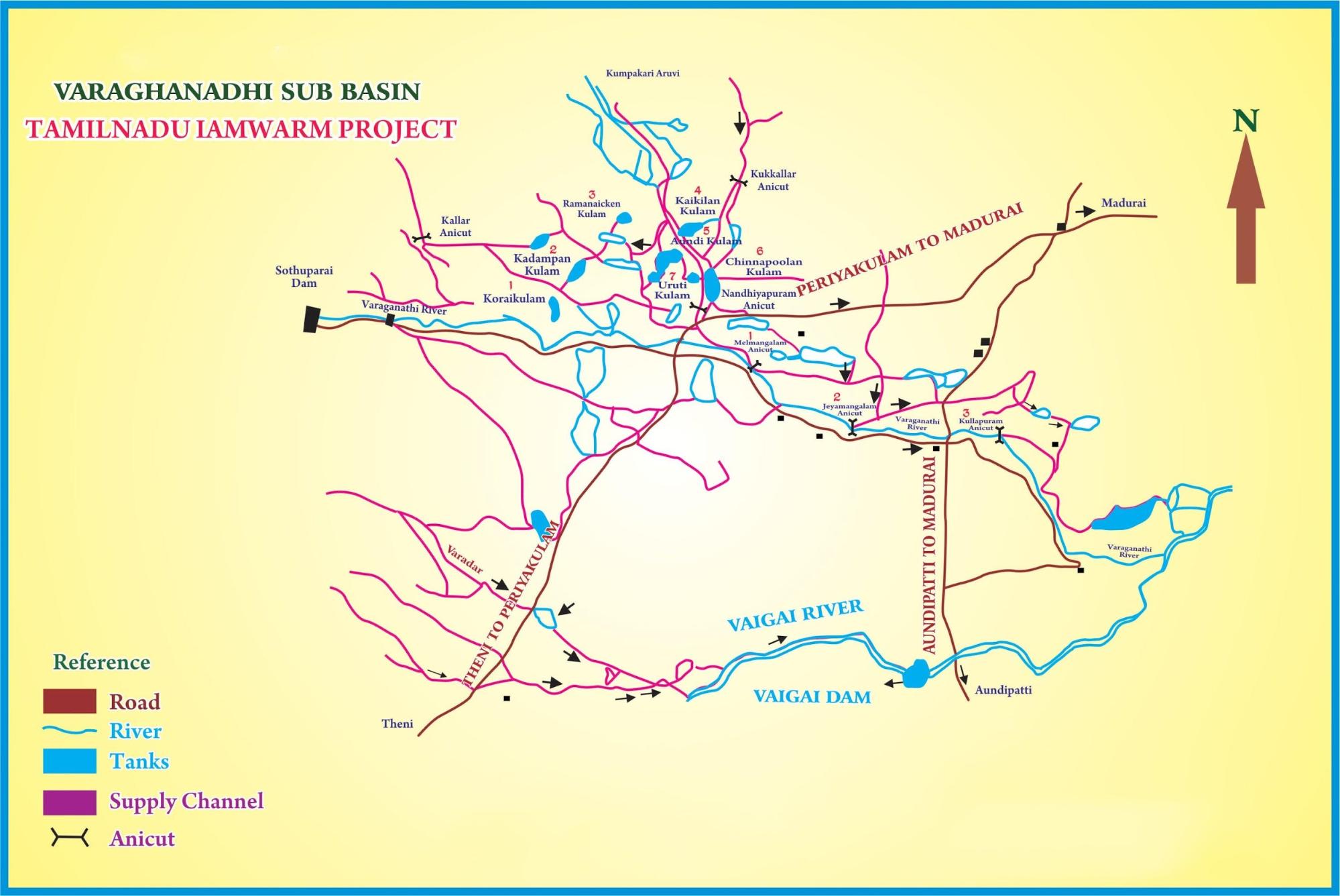
VARAGANADHI SUB BASIN MAP
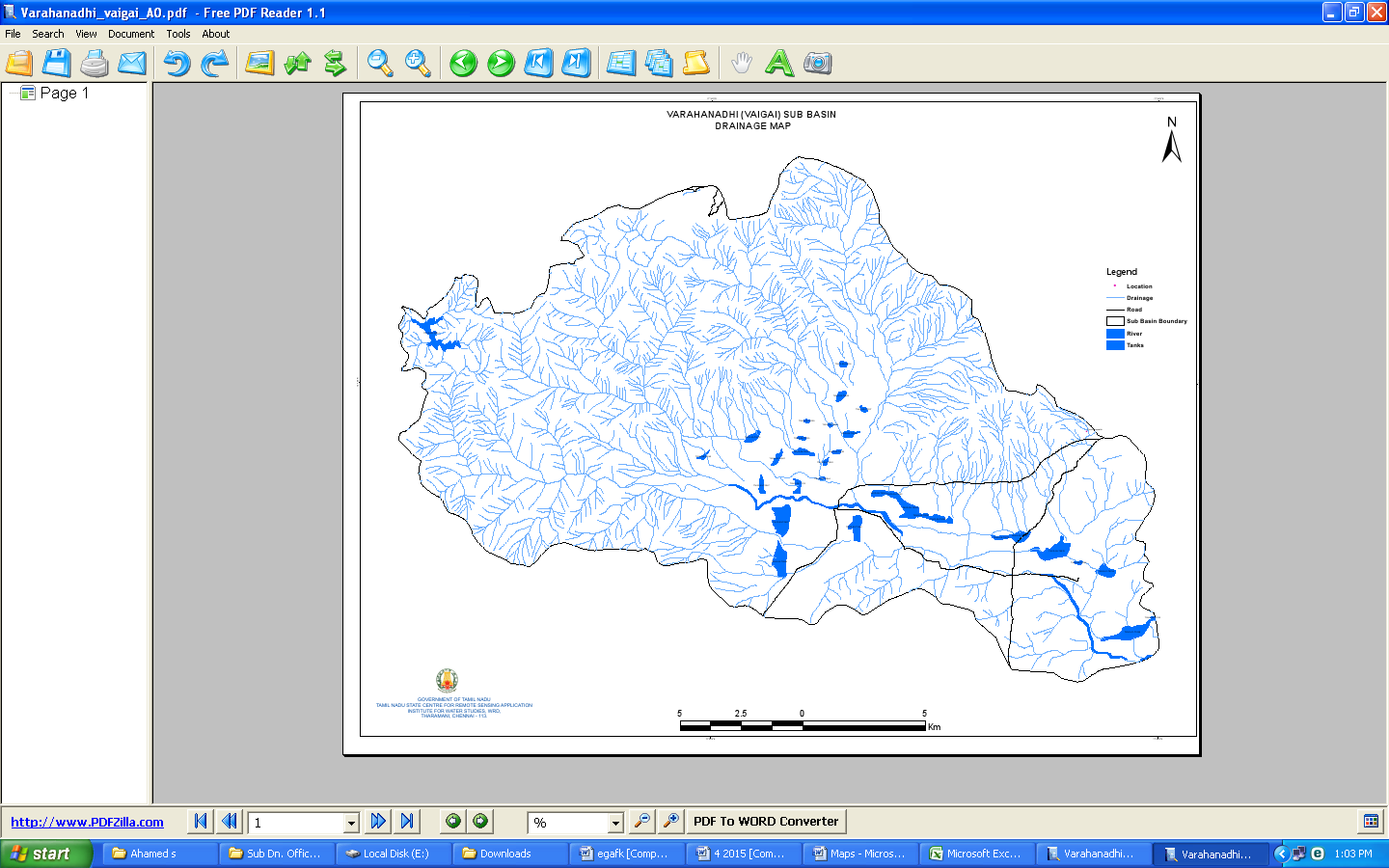
VARAGANADHI SUB BASIN DRAINAGE MAP
2. Total registered ayacut area of the sub basin
2.1 Anicut details in Varaganadhi Sub Basin (TNIAMP)
| S. No | Name of Basin | Name of Sub Basin | Name of Anaicut | District | Taluk | Block |
|---|---|---|---|---|---|---|
| 1 | Kukkalar Anaicut | |||||
| 2 | Vaigai | Varaganadhi | Nandhiyapuram Anaicut | Theni | Periyakulam | Periyakulam |
| 3 | Varaghanadhi Boulder Anaicut | |||||
| 4 | Kullappuram Anaicut | |||||
| 5 | KallarAnai Anaicut |
2.2. Split up details of tank area (Village wise)
| Sl.No. | Name of the tank | Name of the village | Registered ayacut (ha) | Parially irrigated (in ha) | Fully irrigated (in ha) | Gap(in ha) |
|---|---|---|---|---|---|---|
| 1 | Naranakulam | Melmangalam | 33.96 | 15.28 | 10.19 | 8.49 |
| 2 | Ottankulam | Jeyamangalam | 14.00 | 6.30 | 4.20 | 3.50 |
| 3 | Sirukulam(Gullapuram) | Gullapuram | 39.83 | 17.92 | 11.95 | 9.96 |
| 4 | Sirukulam | Silvarpatti | 29.16 | 13.12 | 8.75 | 7.29 |
| 5 | Koraikulam | Vadakarai | 37.83 | 17.02 | 11.35 | 9.46 |
| 6 | Kadampankulam | Vadakarai | 39.40 | 17.73 | 11.82 | 9.85 |
| 7 | Chettikulam | Vadakarai | 37.00 | 16.65 | 11.10 | 9.25 |
| 8 | Manakattukulam | Vadakarai | 19.38 | 8.72 | 5.81 | 4.85 |
| 9 | Chinnapoolankulam | Keelavadakarai | 22.89 | 10.30 | 6.87 | 5.72 |
| 10 | Ramanaikankulam | Vadakarai | 7.77 | 3.50 | 2.33 | 1.94 |
| 11 | Aandikulam | Keelavadakarai | 31.91 | 14.36 | 9.57 | 7.98 |
| 12 | Uruttikulam | Keelavadakarai | 5.00 | 2.25 | 1.50 | 1.25 |
| 13 | Pottaikulam | Thamaraikulam | 13.09 | 5.89 | 3.93 | 3.27 |
| 14 | Pudukulam(Jeyamangalam) | Jeyamangalam | 34.14 | 15.36 | 10.24 | 8.54 |
| 15 | Kakilankulam | Keelavadakarai | 16.70 | 7.52 | 5.01 | 4.18 |
| 16 | PattathikulamTank | Keelavadakarai | 51.09 | 22.99 | 15.33 | 12.77 |
| 17 | Velankulam Tank | Vadakarai | 85.57 | 38.51 | 25.67 | 21.39 |
| 18 | Balappanaikankulam | Vadakarai | 24.93 | 11.22 | 7.48 | 6.23 |
| Total | 543.650 | 244.643 | 163.095 | 135.913 |
| 2.3. Cluster wise separation details - Varahanadhi Sub Basin Table in Portrait format | |||||||||||
|---|---|---|---|---|---|---|---|---|---|---|---|
| Sl.No | Tank No | Unique_id | Tank_Name | Village | Ayacut(Ha) | FI | PI | Gap | Latitude | Longitude | Basin |
| CLUSTER I | |||||||||||
| 1 | 247 | TNVG-05-T0047 | Koraikulam tank | Vadagarai | 37.83 | 11.35 | 17.02 | 9.46 | 10⁰ 7' 44.19'' | 77⁰ 31' 7.82'' | Vaigai |
| 2 | Koraikulam Supply Channel | Vadagarai | 28.97 | 8.69 | 13.04 | 7.24 | |||||
| 3 | 248 | TNVG-05-T0041 | Kadampankulam tank | Vadagarai | 39.40 | 11.82 | 17.73 | 9.85 | 10⁰ 8' 20.32'' | 77⁰ 31' 28.69'' | Vaigai |
| 4 | Kadambankulam Supply Channel | Vadagarai | 32.14 | 9.64 | 14.46 | 8.04 | |||||
| CLUSTER II | |||||||||||
| 5 | Sothparai New Canal | Vadagarai | 421.05 | 126.32 | 189.47 | 105.26 | |||||
| 6 | Athikarikulam Supply Channel | Vadagarai | 18.71 | 5.61 | 8.42 | 4.68 | |||||
| 7 | Podankulam Supply Channel | Vadagarai | 26.28 | 7.88 | 11.83 | 6.57 | |||||
| 8 | 249 | TNVG-05-T0048 | Chettikulam Tank | Vadagarai | 37.00 | 11.1 | 16.65 | 9.25 | 10⁰ 7' 43.07'' | 77⁰ 31' 56.28'' | Vaigai |
| 9 | Chettikulam Supply Channel | Vadagarai | 32.92 | 9.88 | 14.81 | 8.23 | |||||
| 10 | 258 | TNVG-05-T0037 | Velankulam tank | Vadagarai | 85.57 | 25.671 | 38.507 | 21.393 | 10⁰ 8' 28.29'' | 77⁰ 32' 3.03'' | Vaigai |
| 11 | Varaghanadhi Boulder Anicut | Vadagarai | 189.21 | 56.76 | 85.14 | 47.3 | |||||
| 12 | 270 | TNVG-05-T0040 | Manakkattukulam | Vadagarai | 19.38 | 5.814 | 8.721 | 4.845 | 10⁰ 8' 22.71'' | 77⁰ 29' 49.45'' | Vaigai |
| CLUSTER III | |||||||||||
| 13 | 239 | TNVG-05-T0072 | Naranankulam Tank | Melmangalam | 33.96 | 10.188 | 15.282 | 8.49 | 10⁰ 6' 36.15'' | 77⁰ 36' 29.43'' | Vaigai |
| 14 | 240 | TNVG-05-T0071 | Sirukulam Tank (silvarpatti) | Silvarpatti | 29.16 | 8.748 | 13.122 | 7.29 | 10⁰ 6' 36.98'' | 77⁰ 36' 54.94'' | Vaigai |
| 15 | 242 | TNVG-05-T0085 | Ottankulam Tank | Jeyamangalam | 14.00 | 4.20 | 6.30 | 3.50 | 10⁰ 6' 2.36'' | 77⁰ 38' 13.47'' | Vaigai |
| 16 | 243 | TNVG-05-T0091 | Pudukulam Tank (Jeyamangalam) | Jeyamangalam | 34.14 | 10.242 | 15.363 | 8.535 | 10⁰ 5' 50.9'' | 77⁰ 38' 49.84'' | Vaigai |
| 17 | KullappuramAnicut | Gullapuram | 89.23 | 26.77 | 40.15 | 22.31 | |||||
| 18 | 245 | TNVG-05-T0131 | Sirukulam (Gullapuram) | Gullapuram | 39.83 | 11.949 | 17.924 | 9.958 | 10⁰ 4' 48.71'' | 77⁰ 39' 53.07'' | Vaigai |
| 19 | JeyamangalamAnicut | Jeyamangalam | 203.32 | 60.980 | 91.48 | 50.820 | |||||
| CLUSTER IV | |||||||||||
| 20 | 931 | TNVG-05-T0030 | Chinnapoolankulam Tank | Vadagarai | 22.89 | 6.867 | 10.301 | 5.7225 | 10⁰ 9' 5.16'' | 77⁰ 32' 39.84'' | Vaigai |
| 21 | 255 | TNVG-05-T0029 | Ramanaickenkulam Tank | Vadagarai | 7.77 | 2.331 | 3.4965 | 1.9425 | 10⁰ 9' 10'' | 77⁰ 32' 8.2'' | Vaigai |
| 22 | 256 | TNVG-05-T0036 | Aandikulam Tank | Keelavadagarai | 31.91 | 9.573 | 14.36 | 7.9775 | 10⁰ 8' 28.94'' | 77⁰ 32' 48.62'' | Vaigai |
| 23 | 257 | TNVG-05-T0042 | Uruttikulam Tank | Keelavadagarai | 5.00 | 1.50 | 2.25 | 1.25 | 10⁰ 8' 15.4'' | 77⁰ 32' 33.55'' | Vaigai |
| 24 | 254 | TNVG-05-T0035 | Balappanaickenkulam tank | Vadagarai | 24.93 | 7.479 | 11.219 | 6.2325 | 10⁰ 8' 47.38'' | 77⁰ 32' 1.55'' | Vaigai |
| 25 | Kallar Rajavoikkal Supply Channel | Vadagarai | 10.30 | 3.09 | 4.64 | 2.58 | |||||
| 26 | Alaguparai Anicut Supply Channel | Keelavadagarai | 164.38 | 49.31 | 73.97 | 41.1 | |||||
| CLUSTER V | |||||||||||
| 27 | Kukkalar Anicut | Keelavadagarai | 23.56 | 7.07 | 10.6 | 5.89 | |||||
| 28 | Kukkalar Anicut Supply Channel on the Right bank | Keelavadagarai | - | ||||||||
| 29 | Kukkalar Anicut Supply Channel on the Left bank | Keelavadagarai | - | ||||||||
| 30 | Nandhiyapuram Anicut | Keelavadagarai | 47.62 | 14.29 | 21.43 | 11.91 | |||||
| 31 | PambarAnicut Supply Channel | Keelavadagarai | - | ||||||||
| 32 | Kumbakkarai Anicut Supply Channel | Keelavadagarai | 27.27 | 8.18 | 12.27 | 6.82 | |||||
| 33 | 252 | TNVG-05-T0023 | Pattathikulam tank | Keelavadagarai | 51.09 | 15.327 | 22.991 | 12.773 | 10⁰ 9' 43.8'' | 77⁰ 32' 54.14'' | Vaigai |
| 34 | 265 | TNVG-05-T0032 | Kaikilankulam tank | Keelavadagarai | 16.70 | 5.01 | 7.515 | 4.175 | 10⁰ 8' 52.8'' | 77⁰ 33' 5.48'' | Vaigai |
| 35 | 260 | TNVG-05-T0052 | Pottaikulam tank | Thamaraikulam | 13.09 | 3.927 | 5.8905 | 3.2725 | 10⁰ 7' 33.18'' | 77⁰ 34' 2.65'' | Vaigai |
| Total | 1858.57 | 557.57 | 836.35 | 464.66 | |||||||
2.4 Climate and rainfall
The average rainfall of the district is 829.8 mm, covers in South west monsoon 274.20 mm and north east monsoon covers 320.70mm. During winter rainfall is 74.50 and during summer season is 160.40mm. The climate is mainly tropical in nature with the temperature ranges from 28 to 39°C and relative humidity ranging from 64 to 96 per cent. The monsoon failure is a common problem associated with farming practices.
2.5 Soil type
The major soil types found in the zone/ district are grouped as Sandy Clay loam. The pH of soil ranges from 5.60 to 8.9 and the EC ranges between 0.1 and 3.4 dsm-1. The organic carbon status is low. Soil available nutrient status is classified as low, medium and high range in Nitrogen, Phosphorus respectively. Saline and alkaline soil occurs in less than one percentage area in the district at Bodinayakanur Block.
2.6. Labour availability
Most of the agricultural labourers are engaged in Mahatma Gandhi Rural Guarantee Scheme and there is acute shortage of labourers during the peak periods of agricultural operations. Timely intercultural operations are not carried out properly and hence there is considerable yield loss of crops is obtained
2.7. Season wise crops grown in the sub-basin:
| Season | Crops grown |
|---|---|
| Kharif | Paddy, Sugarcane, Banana, Betelvine and Vegetables |
| Rabi | Paddy, Banana,Betelvine and Vegetables |
2.8. Existing scenario of irrigation practices
During this year 2016-17, the rainfall received is too low and there is a deficit of 62 % of average rainfall through NEM. All the system and non system tanks are not filled with sufficient water for cultivation. Groundwater table goes to deeper layer that will not adequate to meet out the crop water requirement.
Most of the areas in the sub basin only flooding and ridges and furrows method of irrigation is being adopted. Some areas, drip irrigation are being practiced. Water productivity and WUE is also low in this sub basin. Micro Irrigation practices are increasing year by year and becoming popular among the farmers. Drip with Fertigation practice is being popularized among the farmers and is used only for sugarcane crop now by few farmers. Slowly, the practice will be extended to the other crops.
2.9. Infrastructure available in the sub basin:
- Local markets and Uzhavar Chandi’s are facilitating farmers for potential market.
- Banks are available for easy transactions.
- Availability of inputs by AEC’s, Private dealers and PACBS
3. VARAGANATHI SUB BASIN -CROPPING PATTERN:
| Name of the sub Basin | : Varaganathi | Fully Irrigated | : | 836.36 | Ha |
| Nodal District | : Theni | Partially Irrigated | : | 557.57 | Ha |
| Registered Ayacut Area | : 1858.57Ha. | Gap | : | 464.64 | Ha |
| Total Ayacut Area | : | 1858.57 | Ha |
|---|
| S. No | Crop | Without Project | With Project | Increasing | ||||||
| FI | PI | Gap | TOTAL | FI | PI | Gap | TOTAL | |||
| I | Perennial crop | |||||||||
| 1 | Coconut | 125 | 0 | 125 | 135 | 135 | 10 | |||
| 2 | Mango | 199.57 | 199.57 | 249.6 | 249.6 | 50 | ||||
| 3 | Jackfurit | 6 | 6 | 0 | ||||||
| 4 | Betal wine | 9 | 0 | 0 | 9 | 0 | ||||
| Total | 9 | 330.57 | 339.57 | 384.21 | 384.21 | 60 | ||||
| II | Annual Crop | 0 | 0 | |||||||
| 1 | Sugarcane | 210 | 210 | 230 | 230 | 20 | ||||
| 2 | Banana | 204 | 204 | 224 | 224 | 20 | ||||
| Total | 414 | 414 | 454 | 454 | 40 | |||||
| III | 1st crop | 0 | 0 | |||||||
| 1 | Paddy | 363.36 | 363.36 | 0 | ||||||
| 2 | Paddy -SRI | 50 | 50 | 443.36 | 443.36 | 30 | ||||
| 3 | Maize | 195 | 195 | 275 | 275 | 80 | ||||
| 4 | Ragi | 0 | 20 | 20 | 20 | |||||
| 5 | Cotton | 32 | 32 | 42 | 42 | 10 | ||||
| Total | 413.36 | 227 | 0 | 640.36 | 443.36 | 337 | 0 | 780.36 | 140 | |
| Grand Total (I+II+III) | 836.36 | 557.57 | 464.64 | 1858.57 | 897.36 | 721.21 | 0 | 1858.57 | 240 | |
| 2 nd crop | 0 | 0 | ||||||||
| 1 | Paddy | 0 | 0 | |||||||
| 2 | Paddy-SRI | 0 | 0 | |||||||
| 3 | Maize | 130 | 130 | 130 | 130 | |||||
| 4 | Pulses | 0 | 443.36 | 443.36 | 443.36 | |||||
| Total | 0 | 130 | 0 | 130 | 0 | 573.36 | 0 | 573.36 | 443.36 | |
| Great Grand Total | 836.36 | 687.57 | 464.64 | 1988.57 | 897.36 | 1294.57 | 0 | 2431.93 | 683.36 | |
| Intensity % | 107.0 | 130.8 | ||||||||
|---|---|---|---|---|---|---|---|---|---|---|
3.1. Objectives
Keeping the above points in view the following interventions are proposed for Varaganadhi sub basin
- To increase the income of the farmers per drop of irrigation water per unit of land.
- Popularizing the innovative and eco friendly technologies of TNAU in crops for better returns
- Facilitating production of market driven crops through diversification
- Sustaining soil health by promotion of INM/IPM
- To educate ayacut farmers on effective water utilization and to increase the area under irrigated crop.
- To expose the farming community to the climate smart Agriculture
3.2 Implementation strategy
- Diversification of low profit high water crops to high profit, low water crops, especially to commercial crops.
- Gap area coverage with irrigated crop especially commercial crops
- Transfer of latest production technologies to increase the productivity
- Exposure visits
- Frequent review and documentation
Existing cropping pattern and horticulture crops scenario in the sub basin
- 1. Paddy-Maize-Pulse
- 2. Paddy-Maize-cotton
- 3. Paddy, banana- vegetables
- 4. Sugarcane-banana
- 5. Banana-Vegetables.
Existing horticulture crop scenario in the sub basin is Mango, Banana, Sapota, Tamarind, Acid lime, Cocoa, Betelvine, Tomato, Brinjal, Bhendi, Moringa, Cucurbits and Onion.
4. Field Interventions
4.1. Productivity enhancement of Rice – Green Manure
Adoption SRI followed by Green manure incorporation will increase the soil nutrient status as well as soil organic carbon content. Use of Cono weeder not only controls the weeds but also increases the soil nutrient content through incorporation of weeds in the soil. Adopting this practice will increase water use efficiency. Scientific management technique of allocating irrigation water based on soil and climatic condition to achieve maximum crop production per unit of water applied over a unit area in unit time is very much essential under present condition. System of Rice Intensification (SRI) is one among the scientific management tool. Under conventional system of rice cultivation the rice yield will be low due to poor water and weed management, poor aeration affects the root activity and tiller production and poor water management increases the water requirement. Efficient water management reduces the irrigation water requirement.
| S.No. | Technology | Total area (ha) | Unit cost (Rs.) | Total cost(in lakhs) |
|---|---|---|---|---|
| 1 | Productivity enhancement of Rice - GM | 10 | 8000 | 0.80 |
Details of Unit cost for Green Manure - Rice
Green Manure
| S. No. | Particulars | Amount (Rs.) |
|---|---|---|
| 1. | Seed cost 40 kg/ha @ Rs. 50/kg | 2000.00 |
| Grand Total | 2000.00 |
Details of Unit cost for Rice
| S. No | Particulars | Amount(Rs.) |
|---|---|---|
| 1 | Cost of Soil testing | 20.00 |
| 2 | Seed cost - 10 kg / ha @ Rs.30/ kg | 300.00 |
| 3 | Cost of nursery raising | - |
| 4 | Cost of fertilizers (150:50:50 kg NPK / ha) | |
| Urea - 300 kg / ha @ Rs.6 / kg | 1,800.00 | |
| Muriate of Potash – 80 kg @ Rs.16/ kg | 1,280.00 | |
| ZnSO4 25 kg @ Rs.40/ kg | 1,000.00 | |
| 5 | Bio fertilizer & Bio inoculants | 1,600.00 |
| Grand Total | 6,000.00 |
4.2. Production of Vegetables under precision farming mode by adopting of IPM concept
Under this water scarce situation, by adopting precision farming techniques productivity of banana will be increased apart from increase in WUE.
Precision farming is an approach where inputs, including water and fertilizers, are applied in precise amounts to maximize yields by reducing water use, residues in soil and water, and chemical sprays, and substantially increased average yields compared to traditional cultivation techniques. Precision farming provides a new solution to balance productivity with environmental concerns. Based on advanced information technology, it includes describing and modeling variation in soils and plant species and integrating agricultural practices to meet site specific requirements.
| S.No. | Technology | Total area (ha) | Unit cost(Rs.) | Total cost(in lakhs) |
|---|---|---|---|---|
| 1 | Production of Vegetables under precision farming mode by adopting of IPM concept | 6 | 120000 | 7.20 |
Details of Unit cost Precision Farming in Vegetables
| S. No | Particulars | Amount (Rs.) |
|---|---|---|
| 1. | Drip cost as per the Govt. norms @ 75 % subsidy | 75,000.00 |
| 2. | Cost of Seed/Seedlings | 25,000.00 |
| 3. | Water Soluble fertilizers | |
| 19:19:19-100 kg @ Rs.75/kg | 7,500.00 | |
| Urea - 200 kg @ Rs.6/kg | - | |
| MAP-50 kg @ Rs.90/kg | 4,500.00 | |
| SSP-100 kg @ Rs.7.5/kg | 750.00 | |
| 4. | Bio fertilizer | 1,750.00 |
| 5. | Mulching sheets & Laying | 5,500.00 |
| Grand Total | 1,20,000.00 |
4.3. Promotion of Sustainable Sugarcane Initiative (SSI) in sub basin under precision farming approach
Productivity of sugarcane will be increased from current average level of 105 t/ha to 150 t/ha by the adoption of SSI. WUE and FUE also are increased by this method.
| S.No. | Technology | Total area (ha) | Unit cost (Rs.) | Total cost(in lakhs) |
|---|---|---|---|---|
| 1 | Promotion of Sustainable Sugarcane Initiative (SSI) in sub basin under precision farming approach | 4 | 100000 | 4.00 |
Details of Unit cost for Precision Farming in Sugarcane
| S. No | Particulars | Amount (Rs.) |
|---|---|---|
| 1. | Drip cost as per the Govt. norms @ 75% subsidy | 64,200.00 |
| 2. | Cost of Seedlings/ha (15000 Nos/ha) @ Rs.1.50 | 22,500.00 |
| 3. | Water Soluble fertilizers | |
| 12:61:00 – 100 kg @ Rs.100/kg | 10,000.00 | |
| 00:00:50 – 225 kg @ Rs.75/kg | ||
| 4. | Bio Fertilizers & Bio pesticide | 1,550.00 |
| 5. | Sugarcane booster 5 kg/ha @ Rs.350/kg | 1,750.00 |
| Grand Total | 1,00,000.00 |
4.4. Introduction of new technologies in fruit crops by demonstrating TNAU High density planting with drip fertigation in Mango
Productivity level will be increased due to the adoption of high density planting of high value crops. By adopting closer spacing, plant population will be increased. High density planting is the planting of more number of plants than optimum through manipulation of tree size. It is one of the improved production technologies to achieve the objective of enhanced productivity of fruit crops. HDP aims at maintaining a balance between vegetative and reproductive load without impairing the plant health.
HDP induces precocity, increases yield and improves quality of fruit. Reduces labour cost resulting in low cost of production and enables the mechanization of fruit crop production. Facilitates more efficient use of fertilizers, water, light, fungicides, herbicides and pesticides
| S.No. | Technology | Total area (ha) | Unit cost (Rs.) | Total cost(in lakhs) |
|---|---|---|---|---|
| 1 | TNAU High density planting with drip fertigation in Mango | 6 | 75000 | 4.50 |
Details of Unit cost for Precision Farming in Mango under High Density Planting (HDP - 5m × 5m)
| S. No | Particulars | Amount (Rs.) |
|---|---|---|
| 1. | Drip cost as per the Govt. norms @75% Subsidy | 26,000.00 |
| 2. | Cost of Seed/Seedlings (400 Nos/Ha)@Rs.70.00 | 28,000.00 |
| 3. | Water Soluble fertilizers (19:19:19, MAP, Urea) | 19,500.00 |
| 4. | Bio inoculants & Bio fertilizers | 1,500.00 |
| Grand Total | 75,000.00 |
4.5. Promotion of Pesticide Free vegetables in sub-basins through climate resilience activity in model Bio Villages known as pesticide free Village
Continuous use of pesticides leads to residual effect in the produce as well as the soil health deterioration. Use of organics will reduce the residual effect of pesticides.
| S.No. | Technology | Total Groups | Unit cost (Rs.) | Total cost(in lakhs) |
|---|---|---|---|---|
| 1 | Promotion of Pesticide Free Vegetables | 40 | 2500 | 1.00 |
Farm implements:
| S.No. | Technology | Quantity | Unit cost (Rs.) | Total cost(in lakhs) |
|---|---|---|---|---|
| 1 | Cono weeder | 10 | 1000 | 0.10 |
5. Capacity Building & Information, Education & Communication
5.1. Capacity building
5.1.1. Training to stakeholders
Under this activity, imparting training to all the beneficiaries either as off-campus or as on-campus is planned.
| Sl. No. | Particulars | Duration (days) | No/batch | Total batch | Budget / batch | Total budget (lakhs) |
|---|---|---|---|---|---|---|
| 1. | Nursery technology for SRI paddy | 1 | 50 | 2 | 10,000 | 0.10 |
| 2. | SSI and Micro-Irrigation Technology in sugarcane | 1 | 50 | 2 | 10,000 | 0.10 |
| 3. | Pesticide free vegetable cultivation practices | 1 | 50 | 3 | 10,000 | 0.20 |
| 4. | Precision Farming in Mango under High Density Planting | 1 | 50 | 2 | 10,000 | 0.10 |
| Total | 0.50 |
5.2. IEC including Awareness creation, documentation and IEC equipment
5.2.1. Organize awareness campaign
- Informal meetings with Farmers / Water Users Association through PRA methods – Focus group discussion and transect walk.
- Organizing informal meetings in sub basin villages
- Message on AIR / local cable TV
- Ensure transparency
- Explain about the scheme – organization objectives, activities, project contribution and farmers share
- Emphasis the role of stake holders in the project
- Project the expected benefit
5.2.2. Documentation
- Maintenance of records and registers
- Field note for each activity
- Daily memorandum sheet
- Receipt and issue of inputs
- Technical observations on soil, water and crop
- Printing pamphlets about the scheme
- Wall paintings
5.2.3. IEC Equipments -
purchase of Computer and Camera
5.2.4. Out sourcing charges on vehicles
- Expenditure on TA /DA for the purpose of TN-IAM Project
- Fuel bill of university vehicle utilized for the project
- Hire charges of university vehicle utilized for this purpose
6. Management Cost
6.1. Outsourcing of technical staff
Outsourcing of technical staff is included in TNAU sub basin plan to carry out the field activities.
7. Year Wise Crop Based Activities
| S. No. | Particulars | Area (Ha) | Total (ha) | |||||
| I | II | III | IV | V | VI | |||
| Green Manure-Paddy (SRI) | 10 | 0 | 0 | 0 | 0 | 0 | 10 | |
| Sustainable Sugarcane Initiative (SSI) | 2 | 2 | 0 | 0 | 0 | 0 | 4 | |
| Pesticide free Vegetable cultivation through precision farming | 3 | 3 | 0 | 0 | 0 | 0 | 6 | |
| TNAU High density planting with MI in fruit crops (Mango/Pomegranate) | 3 | 3 | 0 | 0 | 0 | 0 | 6 | |
| Total | 18 | 8 | 0 | 0 | 0 | 0 | 26 | |
|---|---|---|---|---|---|---|---|---|
Total Budget (Year wise) for Varaghanadhi Sub basin (in lakhs)
P-Physical in ha, F-Financial in Rupees
| S.No | Particulars | Unit cost Rs / ha | I Year | II Year | III Year | IV Year | V Year | VI Year | Total | |||||||
| I | A.Field Activities | P | F | P | F | P | F | P | F | P | F | P | F | P | F | |
| 1 | GM-SRI | 8000 | 10 | 0.80 | 0 | 0.00 | 0 | 0.00 | 0 | 0.00 | 0 | 0.00 | 0 | 0.00 | 10 | 0.80 |
| 2 | Sustainable Sugarcane Initiative (SSI) | 100000 | 2 | 2.00 | 2 | 2.00 | 0 | 0.00 | 0 | 0.00 | 0 | 0.00 | 0 | 0.00 | 4 | 4.00 |
| 3 | Vegetable under precision farming and IPM concept | 120000 | 3 | 3.60 | 3 | 3.60 | 0 | 0.00 | 0 | 0.00 | 0 | 0.00 | 0 | 0.00 | 6 | 7.20 |
| 4 | TNAU High density planting with MI in Mango/Pomegranate | 75000 | 3 | 2.25 | 3 | 2.25 | 0 | 0.00 | 0 | 0.00 | 0 | 0.00 | 0 | 0.00 | 6 | 4.50 |
| 5 | Promotion of Pesticide Free villages | 2500 | 20 | 0.50 | 20 | 0.50 | 0 | 0.00 | 0 | 0.00 | 0 | 0.00 | 0 | 0.00 | 40 | 1.00 |
| Total (A) | 38 | 9.15 | 28 | 8.35 | 0 | 0.00 | 0 | 0.00 | 0 | 0.00 | 0 | 0.00 | 66 | 17.50 | ||
| B. Implements for farm mechanization | ||||||||||||||||
| 1 | Cono weeder | 1000 | 10 | 0.10 | 0 | 0.00 | 0 | 0.00 | 0 | 0.00 | 0 | 0.00 | 0 | 0.00 | 10 | 0.10 |
| TOTAL(A+B) | 48 | 9.25 | 28 | 8.35 | 0 | 0 | 0 | 0 | 0 | 0 | 0 | 0 | 76 | 17.60 | ||
| II | IEC & CB | |||||||||||||||
| 1 | Capacity Building | |||||||||||||||
| a.Training to stakeholders | 0.30 | 0.20 | 0.00 | 0.00 | 0.00 | 0.00 | 0.50 | |||||||||
| b. Exposure visit | 0.50 | 0.50 | 0.00 | 0.00 | 0.00 | 0.00 | 1.00 | |||||||||
| 2 | IEC | |||||||||||||||
| a) Awareness creation activities | 0.50 | 0.50 | 0.00 | 0.00 | 0.00 | 0.00 | 1.00 | |||||||||
| b)Documentation | 0.40 | 0.40 | 0.00 | 0.00 | 0.10 | 0.10 | 1.00 | |||||||||
| c)IEC Equipments | 0.75 | 0.00 | 0.00 | 0.00 | 0.00 | 0.00 | 0.75 | |||||||||
| d)Outsourcing of Vehicle and TA | 0.65 | 0.55 | 0.10 | 0.10 | 0.10 | 0.10 | 1.60 | |||||||||
| Total | 3.10 | 2.15 | 0.10 | 0.10 | 0.20 | 0.20 | 5.85 | |||||||||
| III | Management cost | |||||||||||||||
| 1 | Out sourcing of technical staff | 1.92 | 1.92 | 0.00 | 0.00 | 0.00 | 0.00 | 3.84 | ||||||||
| Overall total (I+II+III) | 14.27 | 12.42 | 0.10 | 0.10 | 0.20 | 0.20 | 27.29 | |||||||||
|---|---|---|---|---|---|---|---|---|---|---|---|---|---|---|---|---|
Varaganadhi Sub basin Abstract (in lakhs)
| S.No | Intervention details | Unit cost Rs/ha | P | F |
|---|---|---|---|---|
| I | A.Field Activities | |||
| 1 | GM-SRI | 8000 | 10 | 0.80 |
| 2 | Promotion of sustainable Sugarcane Initiative (SSI) in sub basin under precision farming approach. Scaling up SSI through joint venture with the nearby Sugar mills. | 100000 | 4 | 4.00 |
| 3 | Production of vegetable under precision farming mode by adopting of IPM concept. | 120000 | 6 | 7.20 |
| 4 | TNAU High density planting with MI in Mango/Pomegranate | 75000 | 6 | 4.50 |
| 5 | Promotion of Pesticide Free vegetables in sub-basins through climate resilience activity in model Bio Villages known as pesticide free Village. | 2500 | 40 | 1.00 |
| B. Implement for farm mechanization | ||||
| 1 | Conoweeder | 1000 | 10 | 0.10 |
| Total(A+B) | 76 | 17.60 | ||
| II | IEC & CB | |||
| 1 | Capacity Building | |||
| a.Training to stakeholders | 0.50 | |||
| b. Exposure visit | 1.00 | |||
| 2 | IEC | |||
| a)Awareness creation activities | 1.00 | |||
| b)Documentation | 1.00 | |||
| c)IEC Equipments | 0.75 | |||
| d)Outsourcing of Vehicle and TA | 1.60 | |||
| Total | 5.85 | |||
| III | Management cost | |||
| 1 | Out sourcing of technical staff | 3.84 | ||
| Overall total (I+II+III) | 27.29 |